Allresist PMMA Electra 92 (AR-PC 50) Conductive Protective Coating
| Brand | Allresist |
|---|---|
| Origin | UK |
| Model | PMMA Electra 92 (AR-PC 50) |
| Formulation | Aqueous/isopropanol solution of polyaniline derivative |
| Application | Charge-dissipative topcoat for non-novolac e-beam resists |
| Removal | Post-exposure aqueous rinse |
| Compliance | Compatible with standard e-beam lithography workflows (JEOL, Raith, Zeiss systems) |
Overview
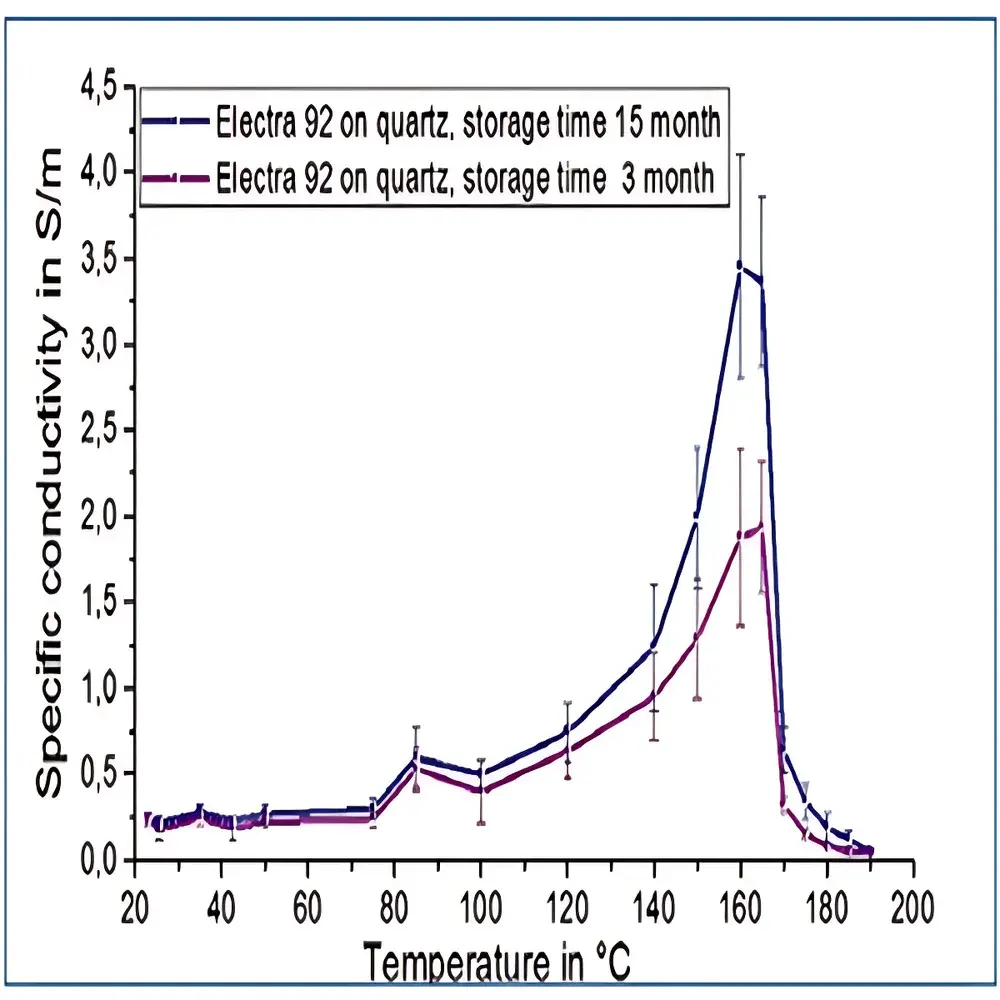
Allresist PMMA Electra 92 (AR-PC 50) is a water- and isopropanol-based conductive protective coating engineered specifically for high-resolution electron-beam lithography (EBL) on electrically insulating substrates. Unlike conventional antistatic agents or metal evaporation layers, AR-PC 50 functions as a sacrificial, radiation-inert topcoat that enables stable charge dissipation during e-beam exposure without interfering with the underlying resist chemistry. Its formulation—based on a proprietary polyaniline derivative—provides controlled surface conductivity (10−3–10−1 S/cm range, typical as-spun) while maintaining optical transparency and minimal outgassing under vacuum. This eliminates charging artifacts such as beam drift, pattern distortion, and stochastic dose variation—critical concerns when patterning high-aspect-ratio features in PMMA, CSAR 62, HSQ, ZEP, and other non-novolac chemically amplified or non-chemically amplified resists.
Key Features
- Radiation-insensitive composition: No sensitivity to UV, DUV, or electron irradiation—ensures zero unintended crosslinking or decomposition during exposure.
- Ultra-thin film capability: Forms uniform, pinhole-free layers between 5–30 nm thickness via spin-coating (3000–6000 rpm), compatible with standard cleanroom coaters (e.g., Laurell WS-650MZ).
- Aqueous/IPA process compatibility: Solvent system avoids chlorinated or high-boiling-point solvents—reducing environmental, health, and safety (EHS) burden and simplifying exhaust handling.
- Post-exposure removal: Fully soluble in deionized water within 60 seconds; no organic strippers, plasma ashing, or ultrasonic treatment required—preserving delicate nanostructures and substrate integrity.
- Long-term shelf stability: Supplied in sealed amber vials; stable for ≥12 months at 4–25°C with no sedimentation or phase separation.
- Low metal ion content: <1 ppb Na/K/Ca/Mg per ICP-MS analysis—meets stringent semiconductor fab requirements for trace contamination control.
Sample Compatibility & Compliance
AR-PC 50 is validated for use with silicon, SiO2, quartz, sapphire, glass, and metal-coated wafers (e.g., Cr, Ti, Au). It exhibits excellent adhesion to hydrophobic and hydrophilic surfaces following standard HMDS priming or O2 plasma activation. The coating demonstrates full compatibility with industry-standard e-beam tools—including JEOL JSM/JSW series, Raith eLINE/EVOLUTION, and Zeiss Sigma SEM-based lithography platforms—under high-vacuum (≤1×10⁻⁵ mbar) and variable-pressure modes. As a non-regulated material under REACH Annex XIV and RoHS Directive 2011/65/EU, AR-PC 50 requires no special import licensing for EU or US destinations. It supports GLP-compliant documentation packages (CoA, TDS, SDS) and is routinely employed in academic cleanrooms and pilot-line facilities operating under ISO 14644-1 Class 5/6 environments.
Software & Data Management
While AR-PC 50 itself is a consumable material and does not incorporate embedded firmware or digital interfaces, its integration into automated lithography workflows is fully supported through standard process recipe management in common EBL control software (e.g., Nanometer Pattern Generation System [NPGS], WinBEAM, or Raith’s ELPHY Quantum). Users define spin parameters, bake steps, and development protocols directly within tool-specific job files. Batch traceability is maintained via lot-numbered vials, each accompanied by a Certificate of Analysis (CoA) reporting viscosity (2.8–3.2 cP @ 25°C), solids content (0.85–0.95 wt%), and conductivity baseline (verified via four-point probe on calibrated Si/SiO2 test wafers). Audit-ready records comply with FDA 21 CFR Part 11 requirements when used within validated GMP-aligned R&D processes.
Applications
- High-fidelity patterning of sub-10 nm line/space features in PMMA and HSQ on fused silica blanks for EUV mask prototyping.
- Charge mitigation in multilayer resist stacks (e.g., AR-P 6200/AR-N 7500 bilayers) for deep-etch transfer into SiC or GaN substrates.
- Maskless direct-write fabrication of plasmonic metasurfaces and photonic crystal cavities requiring low-dose, high-contrast exposure.
- Electron-transparent support film stabilization during cryo-EBL of 2D materials (graphene, h-BN) on TEM grids.
- Process development for next-generation resist systems where traditional Espacer-type coatings induce interfacial delamination or residue formation.
FAQ
Is AR-PC 50 compatible with lift-off processes?
Yes—its complete water solubility ensures clean removal before metallization, eliminating undercut or residue-related lift-off failures.
Can it be applied over already-baked resists?
Yes; AR-PC 50 is applied post-soft-bake and pre-exposure, and remains stable up to 120°C for ≤1 min, avoiding thermal degradation of underlying PMMA or CSAR layers.
Does it require inert atmosphere storage?
No—ambient storage is sufficient due to inherent oxidative stability of the doped polyaniline derivative; nitrogen purging is unnecessary.
What is the minimum recommended spin speed for 10 nm thickness?
For 10 nm films on 4-inch wafers, 4500 rpm for 45 s yields reproducible thickness (±5% CV, n=10) using a calibrated ellipsometer (J.A. Woollam M-2000DI).
How does AR-PC 50 compare to carbon evaporation for charge control?
Unlike carbon coating—which requires vacuum infrastructure, introduces contamination risk, and is irreversible—AR-PC 50 offers rapid, room-temperature, non-destructive application and removal with nanometer-level thickness control.