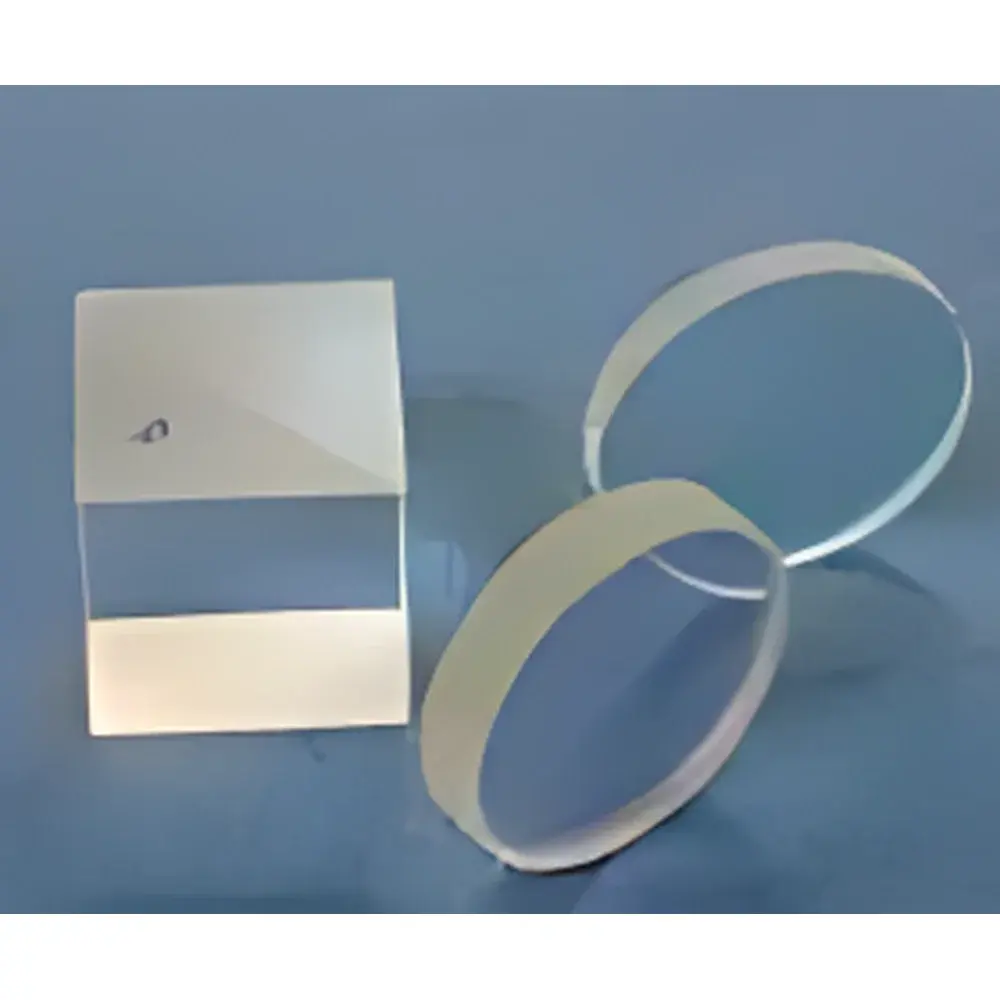
ZOLIX OBHS Series Harmonic Separator
| Brand | ZOLIX |
|---|---|
| Model | OBHS Series |
| Origin | Beijing, China |
| Manufacturer Type | Original Equipment Manufacturer (OEM) |
| Product Category | Domestic |
| Diameter Options | 25.4 mm, 30 mm, 50 mm, 50.8 mm |
| Thickness Options | 5 mm, 6.35 mm, 8 mm |
| High-Reflectance Wavelengths | 355 nm, 532 nm, 1064 nm |
| High-Transmission Wavelengths | Complementary harmonic pairs (e.g., HR @ 1064 nm / HT @ 532 nm) |
| Reflectance (HR) | ≥99.5% |
| Transmission (HT) | ≥85% (for 355/532/1064 nm combinations), ≥95% (for 532/1064 pairs) |
| Substrate Material | Fused silica or BK7 (standard) |
| Surface Quality | 20–10 scratch-dig |
| Wavefront Distortion | λ/4 @ 633 nm (typ.) |
| Damage Threshold | >5 J/cm² @ 10 ns, 10 Hz, 1064 nm (tested) |
Overview
The ZOLIX OBHS Series Harmonic Separator is a precision dielectric thin-film interference filter engineered for high-fidelity spectral separation of harmonic wavelengths in laser-based optical systems. Operating on the principle of multilayer quarter-wave stack interference, the OBHS series delivers deterministic reflectance and transmission characteristics at fundamental and harmonic frequencies—primarily targeting Nd:YAG and Nd:YVO4 laser architectures (1064 nm fundamental, 532 nm second harmonic, 355 nm third harmonic). Unlike broadband dichroics or absorptive filters, these harmonic separators leverage angle-insensitive, polarization-maintaining coatings deposited via ion-assisted e-beam evaporation, ensuring stable performance under collimated or near-collimated beam conditions. Each unit is optimized for use in intracavity or extracavity harmonic extraction, beam combining/splitting, and multi-wavelength alignment setups common in ultrafast amplifier chains, DPSS laser modules, and nonlinear frequency conversion laboratories.
Key Features
- High-precision dielectric coating architecture with R ≥ 99.5% at designated harmonic wavelength (e.g., 355 nm, 532 nm, or 1064 nm) and T ≥ 95% at its complementary harmonic pair
- Multiple aperture options: standard diameters of 25.4 mm, 30 mm, 50 mm, and 50.8 mm; thicknesses of 5 mm, 6.35 mm, and 8 mm to accommodate mechanical mount constraints and thermal stability requirements
- Low wavefront distortion (< λ/4 @ 633 nm) and high surface quality (20–10 scratch-dig) ensure minimal beam degradation in interferometric and cavity-coupled applications
- High laser-induced damage threshold (LIDT) exceeding 5 J/cm² (10 ns pulse width, 10 Hz repetition rate, 1064 nm), validated per ISO 21254-1
- Available in both ZOLIX domestic OBHS variants and imported YHS-grade equivalents (SIGMA-certified specifications), enabling cross-platform compatibility and supply chain redundancy
- Custom coating design support for non-standard harmonic ratios (e.g., 266 nm/532 nm, 946 nm/473 nm) and AOI-tuned configurations (0° ± 2° incidence)
Sample Compatibility & Compliance
The OBHS series is compatible with continuous-wave (CW), nanosecond, and picosecond pulsed laser sources operating across the UV–NIR spectrum (355–1064 nm). It integrates seamlessly into standard kinematic mounts (e.g., Thorlabs KM100, Newport UMB1), lens tubes, and OEM laser heads. All units comply with ISO 9001:2015 manufacturing protocols and undergo 100% spectral verification using calibrated NIST-traceable spectrophotometers (PerkinElmer Lambda 1050+, Acton SpectraPro 2300i). Coating durability meets MIL-C-48497A environmental stress standards (thermal cycling: −40 °C to +70 °C; humidity: 95% RH, 48 h). For regulated environments, documentation packages support GLP/GMP traceability, including batch-specific coating deposition logs, spectral reports, and LIDT test certificates.
Software & Data Management
While the OBHS is a passive optical component, ZOLIX provides downloadable spectral data files (.csv, .txt) for each serial-numbered unit, compatible with industry-standard optical design platforms including Zemax OpticStudio, CODE V, and FRED. These datasets include full-angle-resolved transmission (T) and reflection (R) curves from 200 nm to 1200 nm at 0° and 45° incidence. Customers may request integration-ready metadata (JSON schema) for automated QA/QC workflows, including spectral deviation thresholds and pass/fail criteria aligned with internal SOPs or ISO/IEC 17025 calibration frameworks. No proprietary software is required—data interoperability ensures seamless ingestion into LIMS or MES systems supporting ASTM E2916-compliant instrument qualification.
Applications
- Second- and third-harmonic generation (SHG/THG) beam extraction in Nd:YAG and Nd:YLF oscillator-amplifier systems
- Wavelength multiplexing/demultiplexing in confocal microscopy and Raman spectroscopy excitation paths
- Cavity-dumping and intra-cavity frequency doubling in mode-locked Ti:sapphire and fiber laser systems
- Beam combiners for dual-wavelength laser machining (e.g., simultaneous 1064 nm ablation + 532 nm marking)
- Reference path conditioning in heterodyne interferometry and gravitational wave detection prototypes
- OEM integration into medical laser platforms compliant with IEC 60601-2-22 (laser product safety)
FAQ
What is the angular sensitivity of the OBHS harmonic separator?
The standard OBHS series is optimized for 0° ± 2° angle of incidence (AOI). Performance shifts (e.g., center wavelength drift) remain within ±0.5 nm across this range. Custom AOI-optimized versions (e.g., 45° AOI) are available upon request.
Can OBHS separators be used with femtosecond pulses?
Yes—provided pulse energy density remains below the specified LIDT. Group delay dispersion (GDD) is not characterized for standard units; for sub-100-fs applications, ZOLIX recommends GDD-optimized variants (OBHS-GDD series) with compensated layer stacks.
Is coating adhesion tested per MIL-C-48497A?
Yes—tape adhesion (ASTM D3359) and thermal shock testing (MIL-STD-810G Method 502.6) are performed on every production lot.
Do you provide spectral certification for individual units?
Yes—each shipped OBHS separator includes a serialized spectral report with measured R/T curves, certified by ZOLIX’s ISO/IEC 17025-accredited metrology lab.
Are custom substrate materials supported?
Yes—fused silica (UV-grade), CaF2, and sapphire substrates are available for extended UV or high-power thermal management; lead times and MOQs apply.