
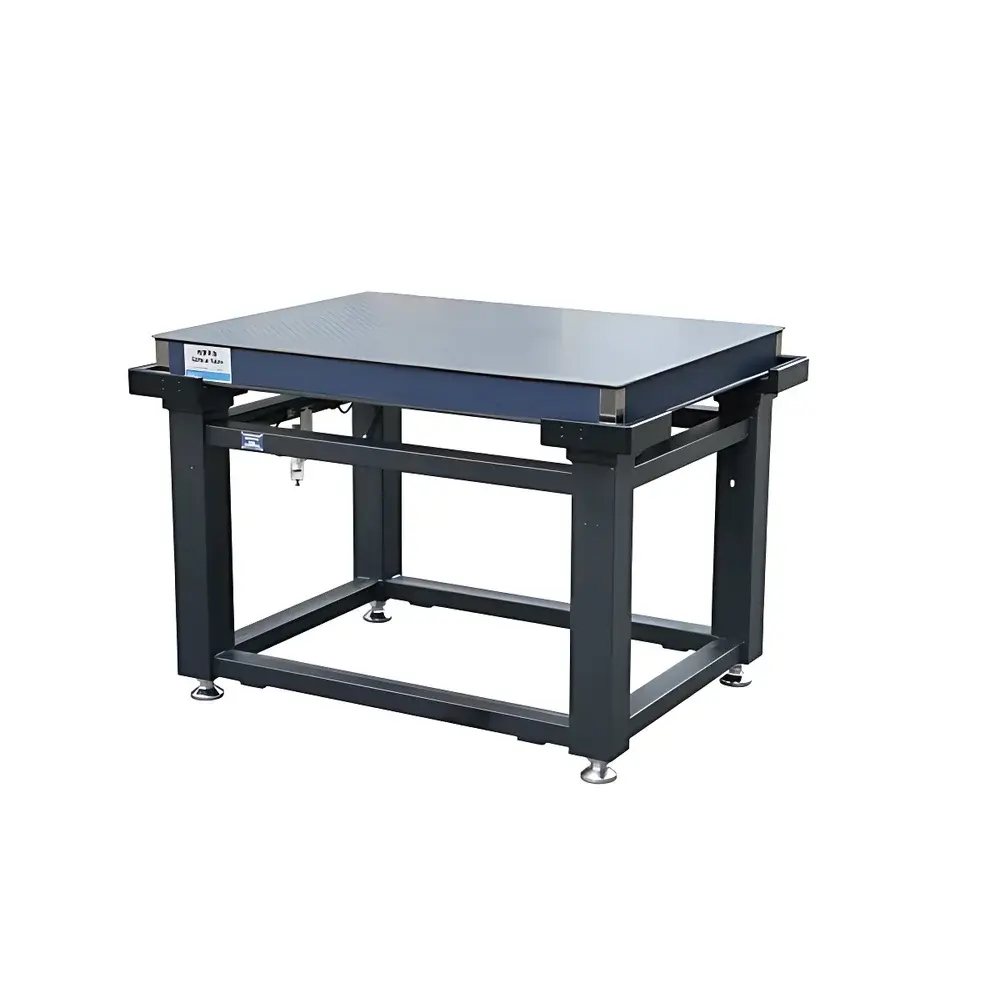
ZOLIX NAP Series Air-Floating Optical Vibration Isolation Platform
| Brand | ZOLIX |
|---|---|
| Model | NAP |
| Origin | Beijing, China |
| Manufacturer | ZOLIX (Producer) |
| Type | Air-floated optical platform with triple-wire pendulum isolation and laminar-flow damping |
| Platform Thickness | 100 mm |
| Surface Flatness (Welded) | 0.02–0.05 mm / 600 mm × 600 mm |
| Surface Flatness (Adhesive w/ Isolation Cups) | ±0.1 mm / 600 mm × 600 mm |
| Mounting Pattern | M6 threaded holes on 25 mm × 25 mm grid |
| Natural Frequency | Vertical < 1.5–2.5 Hz |
| Vibration Isolation Efficiency | Vertical — 75–92% @ 5 Hz, 90–95% @ 10 Hz |
| Load Capacity | 500 kg (total), 125 kg per leg |
| Operating Air Pressure | 0.3–0.4 MPa (max 0.6 MPa) |
| Height Adjustment Range | –10 to +15 mm |
| Leveling Repeatability | ±0.5 mm |
| Top Plate | 4–6 mm SUS430 stainless steel |
| Base Plate | 4–6 mm carbon steel, black powder-coated |
| Total Height (Platform + Frame) | 800 mm |
| Casters | Integrated for mobility |
| Structural Design | Three-layer honeycomb core, welded or adhesive-bonded configurations available |
Overview
The ZOLIX NAP Series Air-Floated Optical Vibration Isolation Platform is an engineered solution for ultra-stable optical experimentation and precision instrumentation placement in research laboratories, metrology facilities, and semiconductor R&D environments. It employs a dual-isolation architecture combining a triple-wire pendulum suspension system with laminar-flow viscous damping to decouple sensitive payloads from floor-borne vibrations across both vertical and horizontal degrees of freedom. This mechanical design achieves sub-2 Hz natural frequencies—specifically < 1.5–2.5 Hz vertically and < 1.0–1.5 Hz horizontally—enabling effective attenuation of low-frequency disturbances commonly generated by building HVAC systems, footfall, and nearby machinery. The platform’s structural integrity derives from its monolithic three-layer honeycomb core, fabricated from high-conductivity SUS430 stainless steel (top plate) and powder-coated carbon steel (base), delivering high stiffness-to-mass ratio and thermal stability essential for interferometric, holographic, and single-photon detection applications.
Key Features
- Triple-wire pendulum isolation mechanism providing passive, frictionless suspension with minimal hysteresis and long-term drift stability.
- Laminar-flow damping elements integrated into the pneumatic chamber system ensure rapid settling time (< 2 seconds typical) after perturbation without overshoot or resonance ringing.
- 100 mm thick honeycomb-core work surface with two mounting configuration options: welded construction (flatness ≤ 0.05 mm over 600 mm × 600 mm) or adhesive-bonded version with isolation cups for enhanced decoupling of localized mechanical excitation.
- M6 threaded hole array on a precise 25 mm × 25 mm grid, with 37.5 mm edge offset, compatible with standard optical mounts, translation stages, and kinematic positioning systems per ISO 10110 and DIN 2080 standards.
- Four-point support frame with individually adjustable leveling valves (response time < 0.8 s) and dual-stage height compensation: coarse adjustment at each leg base and fine-tuning via three independent top-mounted actuators.
- Integrated corner guards and real-time air-gap height indicators simplify setup and enable repeatable re-leveling during instrument reconfiguration or facility maintenance cycles.
- Industrial-grade casters allow safe, controlled relocation without disassembly; load-rated at 125 kg per leg (500 kg total) under recommended operating pressure (0.3–0.4 MPa).
Sample Compatibility & Compliance
The NAP platform supports payloads ranging from compact laser alignment setups to multi-axis nanopositioning systems and full-scale optical benches. Its inert surface finish and non-magnetic top plate (SUS430) ensure compatibility with electron microscopy auxiliary optics, magneto-optic traps, and cryogenic sample stages requiring minimal magnetic interference. All structural welds conform to ISO 5817-B quality criteria, and surface treatments meet ISO 14644-1 Class 5 cleanroom particulate emission limits when operated in controlled environments. While not certified to ISO 10360 or ASTM E1772, the platform’s performance envelope aligns with vibration-sensitive requirements defined in ISO 20816-1 (machinery vibration evaluation) and ANSI/EIA-637-B (laboratory equipment seismic and vibrational specifications). It is routinely deployed in GLP-compliant photonics labs where traceable leveling repeatability (±0.5 mm) and documented air-pressure calibration logs are maintained as part of instrument qualification protocols.
Software & Data Management
The NAP platform operates as a fully passive mechanical system with no embedded electronics or firmware; therefore, no proprietary software or drivers are required. However, its operational parameters—including air pressure, leveling status, and height offset—are designed to integrate seamlessly with facility-wide monitoring systems via analog 4–20 mA pressure transducers (optional add-on) and digital inclinometer modules compliant with Modbus RTU or EtherCAT protocols. Users may log stabilization time, pressure decay profiles, and positional drift over extended periods using LabVIEW, MATLAB, or Python-based DAQ frameworks. For regulated environments subject to FDA 21 CFR Part 11, audit trails for manual leveling records and pressure calibration certificates can be maintained within validated electronic lab notebooks (ELNs) such as Benchling or LabArchives.
Applications
- High-resolution laser interferometry and gravitational wave detector prototype testing.
- Atomic force microscopy (AFM) and scanning near-field optical microscopy (SNOM) staging where sub-nanometer vertical stability is mandatory.
- Quantum optics experiments involving entangled photon sources, cavity QED setups, and cold atom trapping apparatus.
- Optical coherence tomography (OCT) system integration requiring motion artifact suppression below 10 nm RMS.
- Calibration of coordinate measuring machines (CMMs) and laser trackers in metrology labs adhering to ISO/IEC 17025 accreditation criteria.
- Photolithography mask alignment stations and wafer inspection tools in semiconductor pilot lines.
FAQ
What is the maximum allowable payload for the NAP platform?
The total static load capacity is rated at 500 kg, distributed across four legs (125 kg per leg), assuming uniform mass distribution and operation within the specified air pressure range (0.3–0.4 MPa).
Can the platform be used in vacuum or cleanroom environments?
The base structure is compatible with ISO Class 5 cleanrooms; however, pneumatic components require external compressed air supply and are not vacuum-rated. Optional stainless-steel air lines and HEPA-filtered air manifolds are available upon request.
How frequently must the leveling valves be recalibrated?
No recalibration is required—the mechanical valve design ensures repeatable positioning over >10,000 actuation cycles. Periodic verification using a calibrated digital level (e.g., Thorlabs PCL-1000) every six months is recommended for GLP/GMP compliance.
Is custom hole patterning or cutouts supported?
Yes—ZOLIX offers OEM machining services including non-standard M6/M8 grids, through-holes for fiber feedthroughs, and recessed mounting pockets, subject to structural integrity review and lead-time confirmation.
Does the platform meet seismic anchoring requirements?
The frame includes pre-drilled M12 anchor points compatible with IBC 2021 seismic restraint guidelines; anchoring hardware and load-path analysis documentation are provided separately for site-specific engineering sign-off.





