
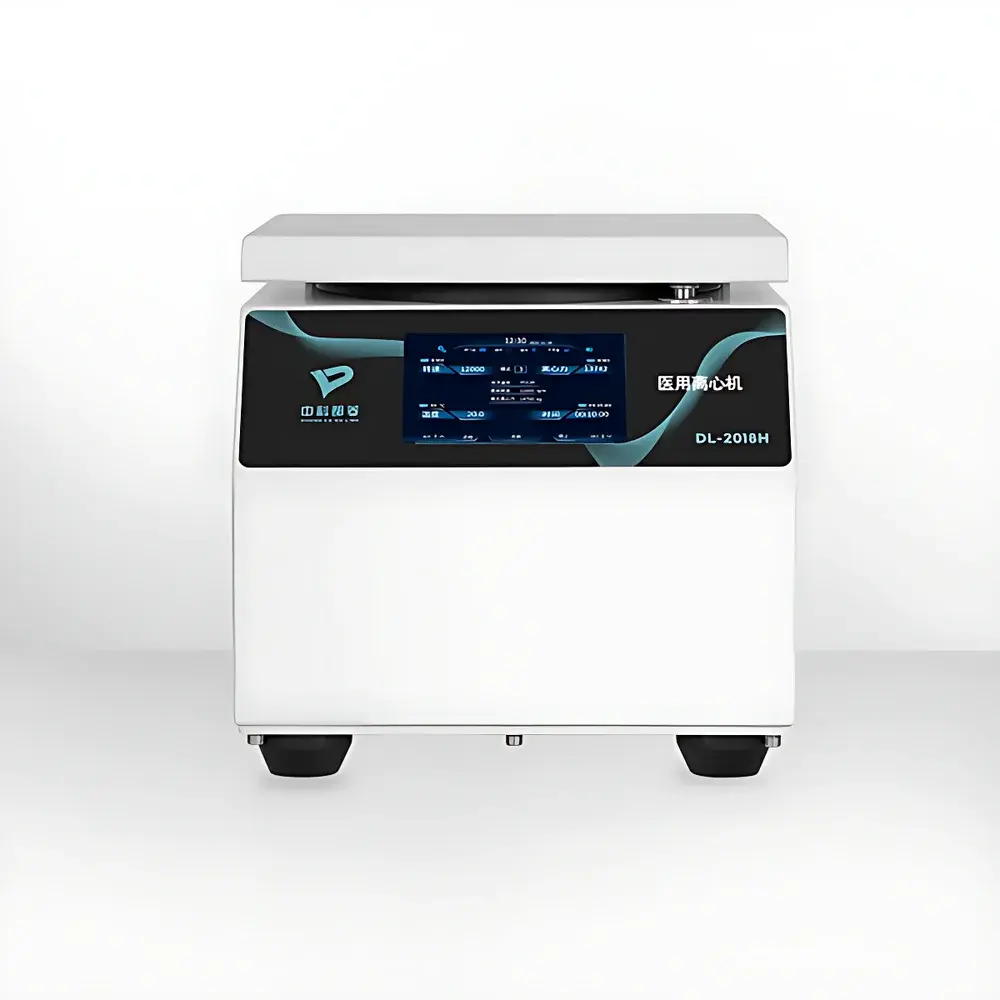
Duling DL-2018H High-Speed Benchtop Centrifuge
| Brand | Duling |
|---|---|
| Origin | Anhui, China |
| Model | DL-2018H |
| Instrument Type | Benchtop Centrifuge |
| Speed Range | 10,000–30,000 rpm (Max. 18,800 rpm) |
| Max. RCF | 26,870 × g |
| Max. Capacity | 10 mL × 12 |
| Rotor Recognition | Magnetic auto-identification |
| Acceleration/Deceleration | 15 steps each |
| Timer Range | 1 s – 99 h 59 min 59 s |
| Speed Accuracy | ±10 rpm |
| Temperature Rise | <10 °C after 20 min operation |
| Noise Level | ≤58 dB(A) |
| Power Supply | AC 220 V, 50 Hz, 10 A |
| Power Consumption | 400 W |
| Dimensions (L×W×H) | 426 × 322 × 340 mm |
| Net Weight | 28 kg |
| Rotor Compatibility | H0.136, H0.232, H0.512, H0.524, H0212, H0224, H0512, H1012 |
| Sterilization | Autoclavable at 121 °C for ≥2 h |
| Safety | Dual interlock door, imbalance detection & auto-stop, soft-brake (SOFT mode), overspeed protection |
| Software Features | Programmable protocols (20 presets), differential centrifugation (DCT) mode (5 dedicated slots), real-time parameter display (speed, RCF, time, acceleration/deceleration profile), on-the-fly parameter adjustment |
Overview
The Duling DL-2018H is a high-performance benchtop centrifuge engineered for precision separation in life science and analytical laboratories. It operates on the principle of sedimentation under controlled centrifugal force, enabling rapid and reproducible isolation of cellular components—including bacteria, subcellular organelles, nucleic acids, and protein complexes—based on differences in density, size, and shape. Designed for routine and method-development workflows, the DL-2018H integrates a brushless AC frequency-controlled motor with microprocessor-based control architecture to ensure stable rotational dynamics across its full speed range (up to 18,800 rpm / 26,870 × g). Its compact footprint (426 × 322 × 340 mm) and low acoustic signature (≤58 dB[A]) make it suitable for shared lab environments, laminar flow hoods, and biosafety cabinets without compromising operational integrity.
Key Features
- Brushless AC frequency-controlled motor with dedicated drive module for high torque consistency, minimal thermal drift, and extended service life
- True-color LCD touchscreen interface with real-time simultaneous display of speed (rpm), relative centrifugal force (×g), elapsed/remaining time, acceleration/deceleration profile, and rotor identification
- Magnetic rotor auto-recognition system eliminates manual rotor configuration errors and enables automatic overspeed protection based on certified rotor specifications
- Dual mechanical interlock door system with positive engagement verification—motor disables unless lid is fully sealed and latched
- 20 programmable protocols with user-defined naming; supports recall, edit, and copy functions for repeatable method execution
- Differential Centrifugation Technology (DCT) framework: five dedicated protocol slots preconfigured for sequential low-to-high speed runs, facilitating standard subcellular fractionation workflows (e.g., nuclear → mitochondrial → microsomal pellet isolation)
- Soft-brake (SOFT) deceleration mode minimizes sample resuspension during stop phase—critical for pelleting fragile vesicles, exosomes, or cryopreserved cells
- Multi-stage damping system with reinforced dual-layer steel housing and stainless-steel centrifuge chamber (AISI 304) resistant to organic solvents and mild corrosives
- Dynamic imbalance detection with audible/visual alarm and immediate rotor halt—compliant with IEC 61010-2-020 safety requirements for laboratory equipment
- On-the-fly parameter modification: adjust speed, time, or acceleration during active run without interrupting centrifugation
Sample Compatibility & Compliance
The DL-2018H accommodates a broad spectrum of sample formats through interchangeable rotors certified for autoclaving at 121 °C for ≥120 minutes—ensuring compliance with ISO 13485 and GLP-aligned sterilization protocols. Compatible tubes include PCR strips (0.2 mL), microcentrifuge tubes (0.5–2.2 mL), conical tubes (5–10 mL), and capillary tubes (75 mm × 36). All rotors feature hermetic sealing (IPX7-rated) and are validated for biosafety level 2 (BSL-2) applications. The instrument meets electromagnetic compatibility (EMC) standards per IEC 61326-1 and electrical safety requirements per IEC 61010-1. Optional RS-485 serial interface supports integration into centralized lab management systems compliant with FDA 21 CFR Part 11 audit trail requirements when paired with validated third-party software.
Software & Data Management
The embedded firmware supports timestamped protocol logging with automatic storage of executed parameters (speed, RCF, duration, rotor ID, acceleration/deceleration setting, ambient temperature). No external PC is required for basic operation; however, optional RS-485 connectivity enables remote monitoring, batch protocol deployment, and export of CSV-formatted run logs for LIMS integration. All user-modifiable settings—including password-protected administrator access for calibration lockout—are retained across power cycles. Firmware updates are performed via USB flash drive with cryptographic signature verification to maintain data integrity and regulatory traceability.
Applications
The DL-2018H serves as a core separation platform across regulated and research-intensive domains: microbial pelleting in food safety testing (ISO 6887-1); plasma/serum separation for clinical diagnostics; nucleic acid purification in molecular biology workflows; organelle isolation in cell biology studies; nanoparticle recovery in nanotoxicology; and residue analysis in agricultural chemistry. Its programmable DCT capability supports standardized protocols referenced in USP , ASTM E2934, and CLSI GP44-A4 for differential sedimentation of heterogeneous biological suspensions.
FAQ
What rotor configurations are included standard with the DL-2018H?
The base configuration includes the H0212 angle rotor (1.5/2.2 mL × 12). Additional rotors—including H0.524 (0.5 mL × 24), H0224 (1.5/2.2 mL × 24), and H1012 (10 mL × 12)—are available as optional accessories.
Is the centrifuge compatible with cold room operation?
Ambient operating temperature range is specified at 10–32 °C. While not rated for refrigerated enclosures, its low thermal output (<10 °C sample rise over 20 min) ensures stability in air-conditioned labs.
Can the instrument be validated for GMP environments?
Yes—its deterministic control logic, non-volatile parameter logging, rotor-specific safety limits, and optional RS-485 interface support IQ/OQ/PQ documentation per ASTM E2500 and Annex 11 guidelines.
Does the DL-2018H support continuous operation mode?
No. It is designed for discrete timed runs only; continuous spin is not supported due to thermal and mechanical duty-cycle constraints.
How is rotor lifetime tracked and managed?
Rotor usage is not electronically logged; users must maintain manual maintenance records per manufacturer-recommended service intervals (typically every 500 hours or 1,000 runs, whichever occurs first).



