
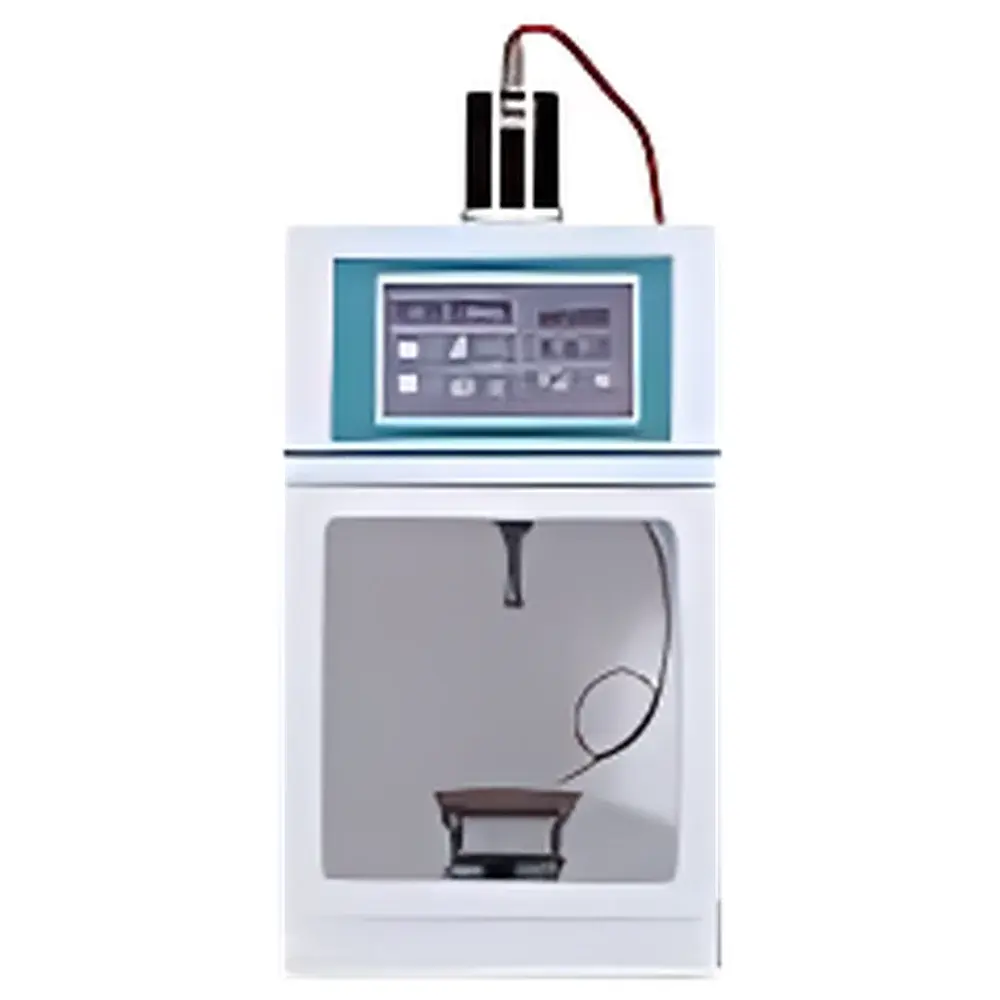
Duling DL-100Y Integrated Ultrasonic Processor
| Brand | Duling |
|---|---|
| Origin | Anhui, China |
| Manufacturer Type | Authorized Distributor |
| Country of Origin | China |
| Model | DL-100Y |
| Ultrasonic Power | 100 W |
| Frequency Range | 19–26 kHz |
| Heating Power | 100 W (optional integrated heating) |
| Temperature Control Range | 1–10 °C (external chiller required for sub-ambient operation) |
| Sample Volume Capacity | 0.1–10 mL |
| Standard Probe Diameter | Φ1.5 mm |
| Optional Probe Diameters | Φ2 mm, Φ3 mm |
Overview
The Duling DL-100Y Integrated Ultrasonic Processor is an engineered benchtop system designed for controlled, reproducible ultrasonic energy delivery in small-volume liquid-phase applications. It operates on the principle of piezoelectric transduction, converting electrical input into high-frequency mechanical oscillations transmitted through a titanium alloy probe into the sample medium. This generates intense localized cavitation—microbubble formation, growth, and implosive collapse—which facilitates cell disruption, particle deagglomeration, emulsification, and accelerated solvent-based extraction. Unlike bath-type ultrasonicators, the DL-100Y employs direct probe coupling, enabling precise spatial energy localization and significantly higher power density per unit volume. Its integrated architecture combines ultrasonic generation, real-time amplitude control, temperature monitoring, and programmable duty cycling within a single compact chassis—eliminating external controllers, cables, or auxiliary chillers in standard configurations.
Key Features
- Auto-resonance tracking: Continuously scans and locks onto the optimal operational frequency within the 19–26 kHz range to maintain maximum energy transfer efficiency despite load variations or probe wear.
- Intelligent amplitude compensation: Dynamically adjusts output voltage and phase to sustain consistent tip displacement amplitude across varying sample viscosities and acoustic impedances—critical for method reproducibility in QC and R&D workflows.
- Three-dimensional probe geometry: The proprietary stepped-tip design enhances radial energy dispersion and reduces longitudinal stress concentration at the probe base, extending service life and minimizing harmonic distortion compared to conventional cylindrical probes.
- Multi-mode ultrasonic delivery: Supports continuous, pulsed (duty-cycle adjustable from 10% to 90%), and time-programmed modes—including total sonication duration, on-time, and off-time parameters—with non-volatile memory retention.
- Integrated thermal monitoring: Built-in Pt100-grade temperature sensor positioned near the probe tip provides real-time feedback (±0.5 °C accuracy), enabling correlation of cavitation intensity with thermal accumulation—a key parameter in heat-sensitive biomolecule extraction.
- Fail-safe protection suite: Automatic shutdown triggers upon overtemperature (≥12 °C), probe overload (reflected power >30%), or internal fault detection, with visual alarm indicators and persistent error logging.
Sample Compatibility & Compliance
The DL-100Y is validated for use with aqueous, organic, and mixed-solvent systems across biological, pharmaceutical, and materials science laboratories. Its 0.1–10 mL capacity supports microscale extractions—from single-cell lysates to nanomaterial dispersions—without cross-contamination risk. Probe options (Φ1.5 mm standard; Φ2 mm and Φ3 mm optional) allow optimization for viscosity and vessel geometry. While not certified to IEC 61000-4 electromagnetic compatibility standards out-of-box, the unit meets GB/T 14710 environmental testing requirements for laboratory equipment. For regulated environments, its digital interface supports manual audit trail documentation; however, full 21 CFR Part 11 compliance requires integration with validated third-party LIMS or ELN platforms.
Software & Data Management
The DL-100Y features an embedded 3.5-inch TFT LCD with tactile membrane keypad for local parameter configuration. All operational settings—including frequency setpoint, power level (0–100% in 1% increments), pulse ratio, timer values, and temperature thresholds—are stored in EEPROM with write-protection. No proprietary PC software is bundled; however, RS-232 serial output (TTL-level) enables connection to external data loggers or custom SCADA systems for timestamped acquisition of power, temperature, and runtime status. Exported logs conform to ASCII CSV format, facilitating post-acquisition analysis in MATLAB, Python (Pandas), or Excel.
Applications
- Pre-analytical sample preparation: DNA/RNA shearing, chromatin fragmentation (ChIP-seq), bacterial endotoxin release.
- Green extraction of phytochemicals: Polyphenols, flavonoids, and terpenoids from plant matrices using ethanol/water mixtures.
- Nanomaterial synthesis: Exfoliation of graphene oxide, dispersion stabilization of metal-organic frameworks (MOFs), and size-controlled nanoparticle formation.
- Pharmaceutical development: Solubilization enhancement of BCS Class II/IV compounds, liposome size reduction, and protein aggregate dissociation.
- Quality control: Viscosity-independent homogenization of calibration standards for HPLC, GC, and ICP-MS sample introduction.
FAQ
What is the recommended maintenance interval for the ultrasonic probe?
Probe inspection—including surface pitting, tip erosion, and thread integrity—is advised after every 200 hours of cumulative operation or prior to critical experiments.
Can the DL-100Y operate without active cooling?
Yes, for short-duration pulses (<30 s) and low-viscosity samples; however, sustained continuous mode above 40% amplitude requires external recirculating chiller (e.g., Huber CC-K20) to prevent thermal denaturation.
Is probe sterilization supported?
Titanium alloy probes tolerate autoclaving at 121 °C for 20 minutes; chemical sterilization with 70% ethanol or 2% glutaraldehyde is also validated.
Does the unit support GLP-compliant electronic records?
Not natively—the device lacks user authentication, electronic signatures, or immutable audit trails; integration with compliant ELN systems is required for regulated workflows.
How does frequency variability (19–26 kHz) affect cavitation yield?
Lower frequencies (19–21 kHz) generate larger, more energetic bubbles suited for tough matrices (e.g., woody tissue); higher frequencies (24–26 kHz) produce finer, denser bubble clouds ideal for delicate biomolecules and nanoemulsions.



