
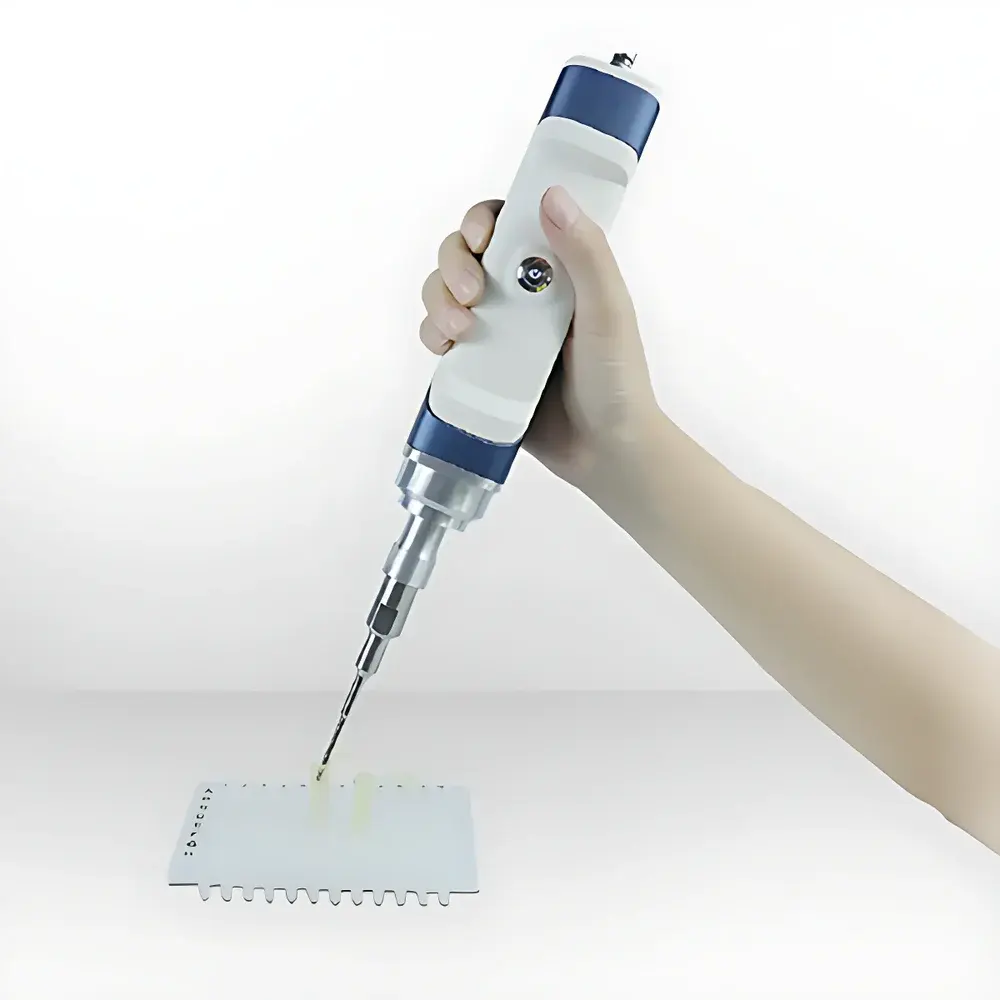
Duling DL-100S Handheld Ultrasonic Processor
| Brand | Duling |
|---|---|
| Origin | Anhui, China |
| Manufacturer Type | Authorized Distributor |
| Country of Origin | China |
| Model | DL-100S |
| Ultrasonic Power | 100 W |
| Ultrasonic Frequency | 30 kHz |
| Temperature Range | 1–10 °C (with optional cooling module) |
| Sample Volume Capacity | 0.1–10 mL |
| Standard Probe Tip Diameter | Φ2 mm |
| Optional Probe Tips | Φ1.5 mm, Φ3 mm |
| Input Power Options | AC 100–240 V, 50/60 Hz |
| Safety Features | Real-time temperature monitoring, over-temperature alarm, automatic amplitude compensation, frequency auto-tracking, thermal protection circuitry |
| Probe Material | Titanium alloy (Grade 5, Ti-6Al-4V) |
Overview
The Duling DL-100S Handheld Ultrasonic Processor is an engineered solution for rapid, controlled sonication in field-deployable and benchtop laboratory environments. It operates on the principle of piezoelectric transduction, converting high-frequency electrical energy (30 kHz) into mechanical oscillations transmitted through a titanium alloy probe tip. These oscillations generate intense localized cavitation—microbubble formation, growth, and implosive collapse—in liquid media, resulting in shear forces sufficient to disrupt cellular membranes, disintegrate tissue aggregates, and accelerate mass transfer during extraction or reaction processes. Unlike fixed-tank ultrasonicators, the DL-100S delivers focused energy directly into small-volume samples (0.1–10 mL), minimizing sample dilution, thermal diffusion, and cross-contamination risk. Its design prioritizes operational stability under variable load conditions, supported by real-time frequency auto-tracking and amplitude compensation—critical for reproducible lysis efficiency across heterogeneous biological matrices such as plant tissues, microbial cultures, and clinical specimens.
Key Features
- Integrated handheld architecture with ergonomic grip and balanced weight distribution—enabling precise manual positioning during delicate procedures including microcentrifuge tube, PCR strip, and 96-well plate sonication.
- Titanium alloy (Ti-6Al-4V) probe construction ensures high acoustic impedance, excellent corrosion resistance in aqueous and mildly acidic/alkaline solvents, and sustained mechanical integrity after repeated sterilization cycles (autoclavable at ≤121 °C for 20 min).
- Dual power input capability: universal AC input (100–240 V, 50/60 Hz) for lab use and regulated 12 V DC input with included automotive cable—validated for continuous operation in mobile labs, environmental monitoring vehicles, and remote field stations.
- Intelligent thermal management system featuring embedded NTC thermistor feedback, digital temperature display (range: 1–10 °C when used with external cooling module), and audible/visual over-temperature alarm (trigger threshold: ≥45 °C at probe base).
- Microprocessor-controlled ultrasonic output with adjustable duty cycle (0–100%), pulse mode (0.1–5 s ON/OFF), and real-time load-adaptive frequency tuning—ensuring consistent energy delivery regardless of sample viscosity or volume changes during processing.
Sample Compatibility & Compliance
The DL-100S is validated for direct sonication of sealed microtubes (0.2–2.0 mL), PCR strips, and shallow-well plates without adapter fixtures. It supports common extraction solvents including ethanol, methanol, acetone, aqueous buffers (PBS, Tris-HCl), and mild detergent solutions (e.g., 0.1% SDS). While not certified for ISO 13485 or FDA 21 CFR Part 11 compliance out-of-the-box, its operational parameters—including time-stamped manual log entries, fixed amplitude settings, and absence of network connectivity—align with GLP-aligned documentation requirements for non-regulated research workflows. All electrical components meet IEC 61010-1 safety standards for laboratory equipment. Probe sterilization follows ISO 17664 guidelines for reusable ultrasound devices.
Software & Data Management
The DL-100S operates via front-panel tactile controls only—no embedded firmware, no USB interface, and no cloud connectivity. This architecture eliminates software validation burdens and ensures deterministic behavior per ICH Q5A and USP recommendations for analytical instrument qualification (AIQ). Users maintain full procedural traceability through handwritten or LIMS-integrated run logs documenting: date/time, probe type, amplitude setting (%), duration, pulse parameters, sample identity, and observed thermal response. Optional external data loggers (e.g., HOBO UX100-003) may be deployed for independent temperature and runtime verification during method transfer or audit preparation.
Applications
- Botanical extraction: Accelerated release of alkaloids, flavonoids, and polysaccharides from dried herb matrices (e.g., Ginseng radix, Scutellaria baicalensis) with reduced solvent consumption vs. reflux methods.
- Microbial lysis: Efficient disruption of Gram-negative (E. coli, Pseudomonas aeruginosa) and Gram-positive (Bacillus subtilis) strains for plasmid isolation and proteomic sample prep.
- Diagnostic specimen processing: Rapid homogenization of nasopharyngeal swabs, sputum, and whole blood lysates prior to nucleic acid extraction in point-of-care molecular testing workflows.
- Material science: Dispersion of nanomaterials (graphene oxide, metal oxides) in polymer precursors and solvent-based coatings.
- Field-deployable QC: On-site verification of extract consistency in agricultural supply chains using portable HPLC or UV-Vis systems downstream.
FAQ
Is the DL-100S suitable for continuous operation beyond 5 minutes?
Yes—when operated within specified ambient temperature limits (15–30 °C) and with intermittent cooling intervals (≥30 s pause after each 120 s active cycle), the unit maintains thermal equilibrium. Continuous duty is not recommended without active probe cooling.
Can the Φ2 mm probe be used for volumes exceeding 10 mL?
No—the 0.1–10 mL range reflects optimal cavitation density and energy transfer efficiency. For larger volumes (up to 300 mL), Duling recommends the DL-300B benchtop system with flow-cell configuration.
Does the device support regulatory-compliant electronic records?
No—it lacks audit-trail functionality, user authentication, or electronic signature capability. It is intended for research-use-only (RUO) applications where paper-based or LIMS-managed documentation suffices.
What maintenance is required for long-term reliability?
Probe tip inspection before each use for pitting or cracking; periodic cleaning with isopropanol and lint-free wipe; annual calibration verification of amplitude linearity using a calibrated hydrophone (per ASTM E1001).



