
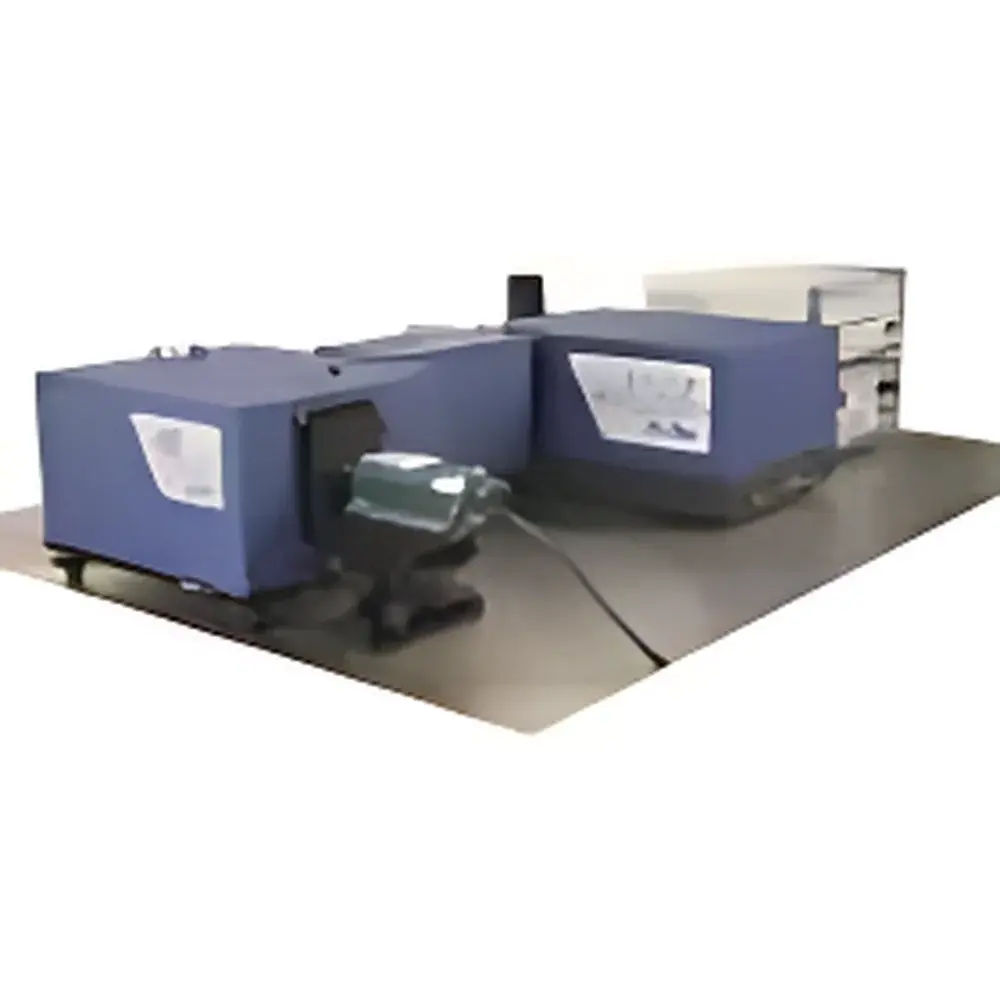
ZOLIX ZLX-RS Series Modular Raman Spectroscopy System
| Brand | ZOLIX |
|---|---|
| Model | ZLX-RS-532 |
| Excitation Wavelength | 532 nm DPSS Laser |
| Output Power | ≥50 mW |
| Spectrometer Focal Length | 300 mm |
| f/# | f/3.9 |
| Grating | 1200 g/mm, Blaze @ 500 nm |
| Slit Width Range | 0.01–3 mm (0.01 mm resolution) |
| Spectral Range | 200–900 nm |
| Spectral Resolution | <0.1 nm (@ 435.83 nm) |
| Wavelength Accuracy | ≤ ±0.2 nm |
| Wavelength Repeatability | ≤ 0.1 nm |
| Stray Light | ≤ 10⁻⁴ |
| Linear Dispersion | 2.7 nm/mm |
| SNR | >12,000:1 (water Raman peak, 532 nm excitation, 1 s integration) |
| Detector | High-sensitivity PMT with photon counting electronics |
| Interface | USB 2.0 |
Overview
The ZOLIX ZLX-RS Series Modular Raman Spectroscopy System is a research-grade, benchtop Raman spectrometer engineered for high-fidelity molecular vibrational analysis based on inelastic light scattering. Operating on the principle of spontaneous Raman scattering, the system enables non-destructive, label-free identification and structural characterization of chemical species by measuring energy shifts between incident laser photons and scattered photons—providing fingerprint-like spectral signatures unique to molecular bond vibrations and symmetries. Unlike infrared absorption spectroscopy, Raman measurements require minimal or no sample preparation, are insensitive to water interference, and offer superior compatibility with aqueous, gelatinous, or turbid media. The ZLX-RS-532 variant employs a frequency-doubled diode-pumped solid-state (DPSS) laser at 532 nm as its excitation source, delivering stable output power ≥50 mW with narrow linewidth and low temporal jitter—critical for achieving high signal-to-noise ratio and minimizing fluorescence background in diverse sample matrices.
Key Features
- Modular architecture enabling configuration flexibility across excitation wavelengths, spectrometer gratings, detectors, and sampling accessories—supporting both Raman and complementary fluorescence spectroscopy workflows.
- High-throughput Czerny–Turner monochromator with 300 mm focal length, f/3.9 optics, and precision-machined 1200 g/mm blazed grating (500 nm), optimized for resolution and throughput balance in the visible–NIR range.
- Continuously adjustable entrance slit (0.01–3 mm, 0.01 mm resolution) for real-time trade-off control between spectral resolution and signal intensity.
- Ultra-low-stray-light optical path (<10⁻⁴) achieved via imported notch filters and rigorous baffling design—essential for suppressing Rayleigh scatter and resolving weak Raman bands adjacent to the elastic peak.
- Photon-counting detection using a high-quantum-efficiency photomultiplier tube (PMT), coupled with dedicated single-photon counting electronics for optimal dynamic range and linearity over six orders of magnitude.
- USB 2.0 interface ensures plug-and-play compatibility with standard Windows-based laptops or workstations—eliminating proprietary hardware dependencies and supporting field-deployable operation.
Sample Compatibility & Compliance
The ZLX-RS-532 accommodates a broad spectrum of physical sample forms—including powders, crystals, thin films, liquids, gels, and suspended colloids—via interchangeable sample stages: a 3-axis vertical translation stage for solid samples, a horizontal cuvette holder for liquid cells, and a dedicated powder/sample pellet holder. Its 532 nm excitation wavelength offers favorable resonance enhancement for many organic dyes, carbon allotropes (e.g., graphene, carbon nanotubes), and transition metal oxides, while maintaining acceptable fluorescence suppression for many pharmaceutical and polymer systems. The system’s mechanical stability, thermal drift compensation (passive), and calibrated wavelength scale support traceable measurements compliant with ASTM E1840 (Standard Guide for Raman Shift Standards) and ISO 8601–1 (spectral data formatting conventions). While not pre-certified for regulated environments, its architecture supports audit-ready data logging when integrated with GLP/GMP-compliant laboratory information management systems (LIMS).
Software & Data Management
The system ships with ZOLIX SpectraAcq—a native Windows application supporting real-time spectral acquisition, multi-curve overlay, baseline correction (asymmetric least squares), peak fitting (Gaussian/Lorentzian convolution), and spectral library matching against user-defined or public-domain databases (e.g., RRUFF, ICDD). All raw and processed spectra are saved in vendor-neutral ASCII or HDF5 formats, preserving metadata including excitation wavelength, integration time, grating position, slit width, and detector gain settings. The software implements full audit trail functionality: every parameter change, acquisition event, and processing step is timestamped and logged with operator ID (if configured via Windows domain authentication). Export options include SVG, PNG, CSV, and JCAMP-DX—ensuring interoperability with third-party chemometric tools (e.g., MATLAB, Python SciPy, Unscrambler X) and regulatory documentation workflows aligned with FDA 21 CFR Part 11 principles when deployed on validated computing infrastructure.
Applications
- In situ monitoring of catalytic reactions and polymerization kinetics in sealed reactor cells or flow-through cuvettes.
- Polymorph identification and crystallinity assessment in active pharmaceutical ingredients (APIs) without solvent extraction or grinding artifacts.
- Carbon material characterization—including defect density (D/G band ratios), layer count (2D band shape), and doping state in graphene and related 2D materials.
- Forensic pigment analysis in art conservation and document authenticity verification.
- Environmental microplastic identification in filtered water samples using spectral fingerprint matching against reference libraries.
- Teaching laboratories: modular design facilitates hands-on instruction in optical alignment, grating dispersion theory, and quantum selection rules governing Raman activity.
FAQ
What excitation wavelengths are supported beyond 532 nm?
The ZLX-RS platform is optically agnostic; users may integrate alternative lasers (e.g., 785 nm diode, 514 nm Ar⁺, or 633 nm HeNe) by replacing the laser module and corresponding notch filter—retaining full compatibility with the monochromator and detection chain.
Can the system perform time-resolved Raman measurements?
No—this is a steady-state Raman system. Time-resolved capabilities require pulsed excitation sources and gated detection hardware, which are not part of the ZLX-RS-532 configuration.
Is calibration traceable to NIST standards?
Yes—wavelength calibration is performed using Hg/Ar emission lamps with certified line positions per NIST SRM 2034; intensity calibration requires optional NIST-traceable radiometric standards.
Does the software support automated batch processing of multiple spectra?
Yes—SpectraAcq includes scripting support (VBScript-compatible) for unattended acquisition sequences, background subtraction, normalization, and export of processed datasets to spreadsheet or database formats.
What maintenance is required for long-term wavelength stability?
No routine optical recalibration is needed under normal lab conditions; the monochromator uses kinematic mounts and thermally stable Invar components. Annual verification using emission lamp standards is recommended for ISO/IEC 17025-accredited labs.





