
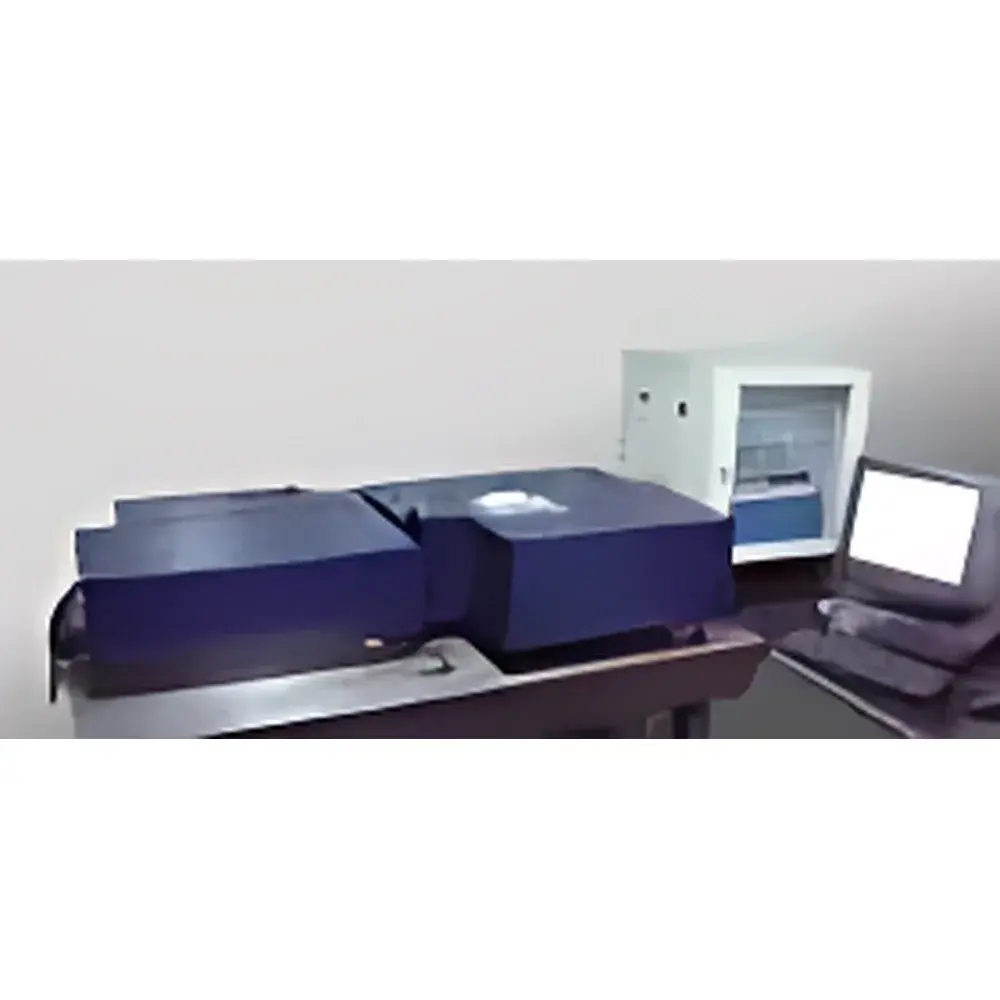
ZOLIX UV-Vis Spectrophotometer Calibration Standard System
| Brand | ZOLIX |
|---|---|
| Origin | Beijing, China |
| Manufacturer Type | Original Equipment Manufacturer (OEM) |
| Product Type | Domestic Metrological Standard System |
| Model | UV-Vis Spectrophotometer Calibration Standard System |
| Pricing | Upon Request |
Overview
The ZOLIX UV-Vis Spectrophotometer Calibration Standard System is a primary metrological reference instrument developed in collaboration with the National Institute of Metrology (NIM), People’s Republic of China. Engineered for national-level photometric calibration and traceability, it serves as a high-accuracy transfer standard for verifying and calibrating routine UV-Vis spectrophotometers used in metrology laboratories, pharmaceutical QC facilities, and materials research institutes. The system operates on a single-beam optical architecture with collimated illumination, where samples—primarily certified neutral density filters and spectral transmittance standards—are mounted vertically in the beam path to measure spectral transmittance (T%) with minimal scattering-induced uncertainty. Its core design prioritizes wavelength fidelity, photometric linearity, stray light suppression, and long-term measurement stability—all essential for compliance with ISO/IEC 17025 accreditation requirements and alignment with international photometric standards such as ISO 9000 series, ASTM E275, and CIE S 014.
Key Features
- Double monochromator configuration with 750 mm focal length and dual holographic gratings (110 mm × 110 mm active area), enabling exceptional spectral resolution and ultra-low stray light performance (< 5 × 10⁻⁹ at 220 nm)
- Automated wavelength scanning across 200–850 nm range, with wavelength accuracy ±0.05 nm and repeatability ±0.005 nm (verified against Hg and D2 emission lines)
- Integrated multi-source lamp compartment: deuterium lamp (UV), tungsten-halogen lamp (VIS), mercury calibration lamp (wavelength reference), and alignment He–Ne laser (beam collimation verification)
- Motorized sample stage with precision linear translation, enabling automated insertion/removal of calibration standards into the collimated beam path
- Dual-aperture linearity verification module for direct assessment of photometric response linearity per ISO 10140-3
- Glan-Thompson polarizers integrated into the optical path for polarization-dependent transmittance characterization (e.g., for polarizing filter certification)
- Motorized variable iris diaphragm and programmable shutter for dynamic beam diameter control and dark-signal subtraction during high-precision measurements
- Aspheric mirror optics throughout the beam path to minimize aberrations and improve image quality at all wavelengths
Sample Compatibility & Compliance
The system is optimized for flat, optically homogeneous transmission standards—including NIM-certified neutral density filters, glass filters with certified transmittance values, and quartz reference plates. Sample dimensions up to Ø50 mm or 25 mm × 25 mm are accommodated via adjustable kinematic mounts. All mechanical and optical components comply with GB/T 26571–2011 (Chinese National Standard for Spectrophotometer Calibration Systems) and support traceability to SI units through NIM’s primary radiometric scale. The hardware architecture and software audit trail functionality are designed to meet GLP and GMP documentation requirements, including full data integrity controls compatible with FDA 21 CFR Part 11–compliant environments when deployed with validated software configurations.
Software & Data Management
A modular software suite provides full instrument orchestration: spectrometer control (grating position, slit width, lamp selection), filter wheel sequencing, data acquisition, and post-processing analysis. All measurement parameters—including lamp status, slit settings, integration time, and environmental temperature—are automatically timestamped and embedded in raw data files (ASCII or HDF5 format). The software supports both wavelength-scan mode (for full spectral characterization) and fixed-wavelength mode (for rapid point measurements at user-defined λ-values). Export functions include CSV, PDF reports, and direct printing; calibration reports include uncertainty budgets calculated per GUM (JCGM 100:2008). Audit logs record all user actions, parameter changes, and calibration events—enabling full retrospective review for ISO/IEC 17025 internal audits.
Applications
- Primary calibration of working-standard UV-Vis spectrophotometers in national metrology institutes and accredited calibration labs
- Verification and recalibration of certified reference materials (CRMs) for transmittance and absorbance
- Stray light characterization and linearity validation of commercial spectrophotometers per ISO 6252 and ASTM E387
- Development and validation of new photometric standards, especially for high-dynamic-range applications (e.g., OD 0.01–6.0)
- Supporting inter-laboratory comparison studies under APMP and BIPM frameworks
- Research into optical thin-film coatings, solar cell spectral response, and UV-curable material kinetics
FAQ
What is the intended use of this system?
It is a metrological reference standard—not a routine analytical instrument—designed exclusively for calibration, verification, and uncertainty evaluation of UV-Vis spectrophotometers and transmission standards.
Can it be used for absorbance measurements of liquid samples?
No. It is configured only for solid, flat transmission standards; no cuvette holder or flow cell interface is included.
Is the software compliant with 21 CFR Part 11?
The base software includes electronic signatures, audit trails, and data integrity features; formal Part 11 compliance requires site-specific validation protocols and IT infrastructure alignment.
Does the system support external trigger synchronization?
Yes—TTL-compatible trigger I/O is provided for integration with external detectors or timing systems in synchronized measurement setups.
What maintenance is required for long-term accuracy?
Annual recalibration against NIM’s primary standard is recommended; lamp output stability monitoring and grating alignment verification should be performed quarterly using built-in diagnostic routines.




