
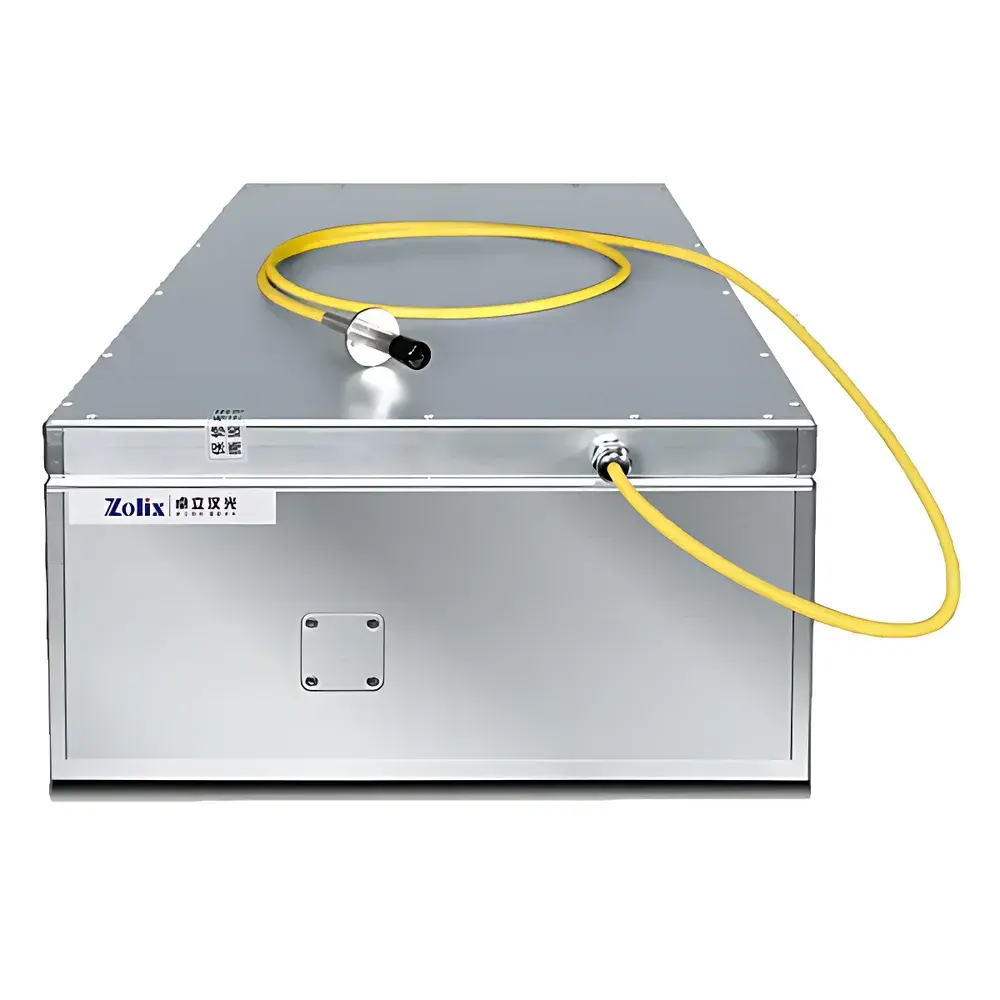
ZOLIX Gloria-SC-P-UVE Ultrafast Supercontinuum Laser Source
| Brand | ZOLIX |
|---|---|
| Origin | Beijing, China |
| Manufacturer Type | Direct Manufacturer |
| Product Category | Domestic |
| Model | Gloria-SC-P-UVE |
| Light Source Type | Supercontinuum Laser (Fiber-Based, UV-Extended) |
| Pulse Width | 450 ps |
| Repetition Rate Range | 1.5–3 MHz |
| Spectral Coverage | 380–2400 nm |
| Max. Average Output Power | 7 W |
| Polarization | Unpolarized |
| Beam Profile | Near-Gaussian, Fundamental Mode (M² ≈ 1.1 @ >430 nm) |
| Beam Diameter | ~1.5 mm @ 530 nm, ~2.5 mm @ 1100 nm |
| Power Stability (RMS) | ≤0.5% over 8 hours at full output |
Overview
The ZOLIX Gloria-SC-P-UVE is an engineered ultrafast supercontinuum (SC) laser source designed for demanding applications in broadband spectroscopy, time-resolved microscopy, and advanced optical metrology. It operates on the physical principle of supercontinuum generation (SCG) via nonlinear spectral broadening in photonic crystal fiber (PCF), driven by high-peak-power picosecond pulses. Unlike thermal or arc-based broadband sources, the Gloria-SC-P-UVE delivers spatially coherent, diffraction-limited output with exceptional brightness and shot-to-shot phase stability—enabling interference-sensitive techniques such as OCT and frequency-domain spectroscopy. Its unique UV-extended spectral coverage—from 380 nm through visible to near-infrared (up to 2400 nm)—is achieved through optimized PCF dispersion engineering and precise pump laser parameter control, making it especially suited for applications requiring deep-UV excitation combined with NIR detection.
Key Features
- UV-extended spectral output (380–2400 nm), enabling simultaneous multi-band excitation and detection across critical absorption edges of semiconductors, 2D materials, and biological chromophores
- High average power scalability up to 7 W, with fine-tunable repetition rate (1.5–3 MHz) and adjustable output power via integrated electronic attenuation
- Exceptional amplitude stability: ≤0.5% RMS power fluctuation over 8-hour continuous operation at rated output—validated under controlled environmental conditions (±0.5°C, vibration-isolated platform)
- Diffraction-limited beam quality (M² 430 nm), supporting efficient coupling into single-mode fibers, confocal systems, and scanning optics
- Robust architecture incorporating thermally stabilized pump laser diodes, actively cooled PCF module, and hermetically sealed optical path—designed for laboratory and OEM integration environments
Sample Compatibility & Compliance
The Gloria-SC-P-UVE is compatible with standard free-space optical mounts (SM1-threaded), FC/PC and FC/APC fiber interfaces (optional), and modular spectrometer input slits. Its broadband output supports calibration traceable to NIST-traceable radiometric standards when used with calibrated integrating spheres and silicon/InGaAs photodiode reference detectors. The system complies with IEC 60825-1:2014 Class 4 laser safety requirements; full interlock-ready design includes TTL-compatible shutter control, key-switch enable, and emission indicator LED. For regulated environments, optional firmware modules support audit trails and user-access logging aligned with GLP and ISO/IEC 17025 documentation frameworks.
Software & Data Management
Control is provided via ZOLIX’s SC-Control Suite—a cross-platform (Windows/Linux) application offering real-time monitoring of output power, repetition rate, internal temperature sensors, and pump diode current. The suite supports SC spectrum acquisition synchronization with external devices (e.g., CCD spectrometers, lock-in amplifiers) via programmable TTL triggers and USB 2.0/3.0 interfaces. All operational logs—including timestamps, setpoints, and environmental telemetry—are exportable in CSV and HDF5 formats for long-term data integrity and regulatory review. Optional SDK (C/C++, Python, LabVIEW) enables integration into custom automation pipelines compliant with FDA 21 CFR Part 11 electronic record requirements.
Applications
- Fiber optic characterization: dispersion mapping, nonlinear coefficient measurement, and splice loss analysis across telecom and mid-IR bands
- Nanomaterial photophysics: time-resolved PL spectroscopy of quantum dots, perovskite nanocrystals, and transition metal dichalcogenides (TMDs)
- Biomedical imaging: swept-source OCT with axial resolution <5 µm (in air), multispectral fluorescence lifetime imaging (FLIM), and label-free tissue histopathology
- Photovoltaic R&D: EQE mapping, carrier lifetime extraction via TRPL, and defect-state probing using sub-bandgap excitation
- Ultrafast dynamics: pump-probe spectroscopy of graphene, carbon nanotubes, and topological insulators with <500 fs temporal resolution (when synchronized with external femtosecond lasers)
- Industrial inspection: micro-defect detection in thin-film solar cells, OLED substrates, and semiconductor wafers using hyperspectral reflectance imaging
FAQ
What is the typical warm-up time required to achieve spectral and power stability?
The system reaches thermal equilibrium and specified power stability within 30 minutes after cold start, assuming ambient temperature variation ≤±1°C.
Is the output beam polarization-maintained or unpolarized?
The default configuration provides unpolarized output; polarization-maintaining (PM) fiber-coupled variants are available upon request with extinction ratio >20 dB.
Can the Gloria-SC-P-UVE be synchronized with external femtosecond lasers for pump-probe experiments?
Yes—via its low-jitter (<10 ps RMS) sync-out port and configurable delay generator interface, enabling precise timing alignment with Ti:sapphire or Yb-fiber oscillators.
Does the system include built-in spectral monitoring?
No integrated spectrometer is included, but the unit features a dedicated 5% tap port with FC/APC connector for real-time spectral sampling using external benchtop or OEM-grade spectrometers.
What maintenance is required during routine operation?
No consumables or periodic recalibration are required; annual verification of power stability and spectral flatness using factory-calibrated references is recommended for ISO/IEC 17025 compliance.





