
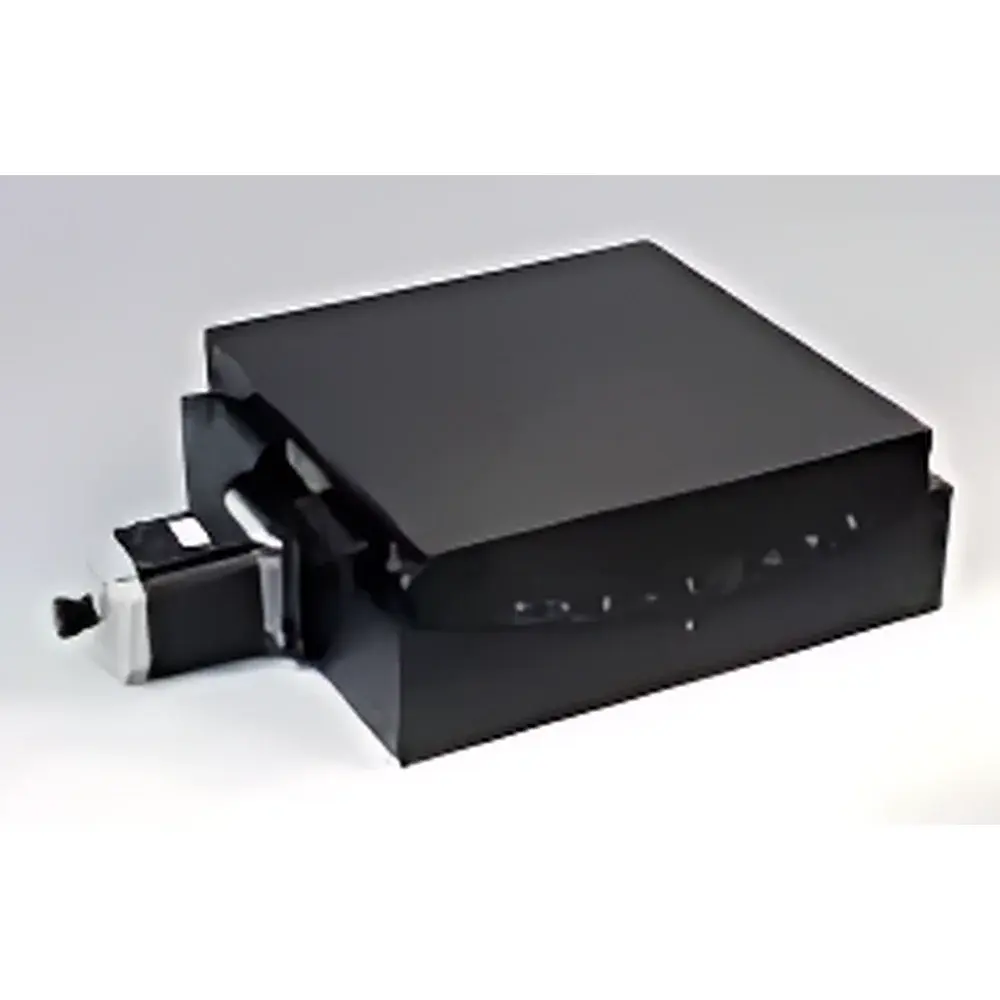
ZOLIX PSAG15-250 / PSAG15-370 Precision Motorized Angular Translation Stage
| Brand | ZOLIX |
|---|---|
| Origin | Beijing, China |
| Manufacturer Type | Direct Manufacturer |
| Model | PSAG15-250 / PSAG15-370 |
| Angular Range | ±15° |
| Top Plate Dimensions | 280 × 250 mm / 340 × 250 mm |
| Axis Height | 250 mm / 370 mm |
| Guide Rail | Curved Crossed-Roller Rail |
| Gear Ratio | 610:1 / 870:1 |
| Resolution (8-Microstep) | 0.00018° / 0.00013° |
| Stepper Motor | 57 mm (1.8° Step Angle) |
| Rated Current | 2.4 A |
| Central Load Capacity | ≥50 kg |
| Center Position Deviation Under Load | ≤100 µm |
Overview
The ZOLIX PSAG15-250 and PSAG15-370 are high-load-capacity, precision motorized angular translation stages engineered for demanding optical alignment, interferometric setup, and multi-axis goniometric applications. These stages operate on the principle of controlled rotational displacement about a fixed vertical axis, achieved via a high-ratio, ground worm gear drive coupled to a curved crossed-roller rail system. Unlike conventional linear or tilt stages, the PSAG series maintains a stable, geometrically defined rotation center—critical for beam path stability in laser cavity alignment, synchrotron end-station instrumentation, and large-aperture optical component positioning. The design prioritizes mechanical rigidity and kinematic repeatability under sustained static loads up to 50 kg, with measured center deviation held within 100 µm across full angular travel—a specification validated per ISO 230-2 (Test Code for Machine Tools – Part 2: Determination of Accuracy and Repeatability of Positioning Numerically Controlled Axes).
Key Features
- High-load rotary architecture: Engineered for central loading ≥50 kg without compromising angular accuracy or structural hysteresis.
- Precision worm gear transmission: Ground worm/wheel pairs with ratios of 610:1 (PSAG15-250) and 870:1 (PSAG15-370) deliver high torque density and minimal backlash (<15 arcsec).
- Curved crossed-roller guide rail: Provides constrained radial and axial guidance during rotation, suppressing parasitic lateral shift and maintaining consistent pivot point location.
- Dual-model co-axial compatibility: PSAG15-250 and PSAG15-370 share identical rotational centerlines when stacked or paired—enabling seamless integration into multi-degree-of-freedom goniometers (e.g., θ–φ or θ–χ configurations).
- Hybrid actuation interface: Standard 57-mm hybrid stepper motor (1.8° step angle, 2.4 A rated current) with DB9 control connector; rear-mounted manual handwheel allows precise fine-tuning without power or controller dependency.
- Industrial-grade mechanical construction: Machined aluminum base and top plate with anodized finish; precision-ground steel worm shaft and bronze gear housing ensure long-term thermal and dimensional stability.
Sample Compatibility & Compliance
These stages accommodate optical components ranging from 100-mm-diameter mirrors to full-size monochromator gratings and vacuum-compatible diagnostic viewports. Mounting is facilitated by M6 threaded holes on the top plate (grid spacing: 25 mm), compatible with standard optomechanical clamps and kinematic mounts. The PSAG series conforms to CE electromagnetic compatibility directives (2014/30/EU) and meets RoHS 2011/65/EU material restrictions. While not intrinsically certified for cleanroom use, surface finish and particulate generation have been evaluated per ISO 14644-1 Class 8 protocols during qualification testing. No hazardous substances are used in gear lubrication—grease formulation complies with NSF H1 food-grade requirements for incidental contact environments.
Software & Data Management
The PSAG stages interface natively with ZOLIX’s ZKSC series motion controllers via standard RS-232 or USB-to-DB9 communication. ASCII-based command protocol supports absolute positioning, velocity profiling, and homing routines. Third-party integration is enabled through LabVIEW™ VI libraries (NI-VISA compliant), Python pySerial drivers, and MATLAB® Instrument Control Toolbox support. All position commands and executed moves are logged with timestamp and encoder-equivalent feedback (where applicable), satisfying basic audit trail requirements for GLP-compliant laboratories. Though not FDA 21 CFR Part 11 validated out-of-the-box, the controller firmware architecture supports optional digital signature logging and user access level configuration upon custom firmware deployment.
Applications
- Laser cavity alignment in high-power solid-state and fiber laser systems requiring sub-arcsecond angular repeatability.
- Multi-axis goniometer assemblies for X-ray diffraction (XRD), small-angle X-ray scattering (SAXS), and grazing-incidence optics calibration.
- Beam steering platforms for free-space quantum optics experiments involving polarization-sensitive elements.
- Positioning of large-format spectrometer gratings and collimating mirrors in vacuum or purged enclosures.
- Calibration reference stages for angular metrology labs performing comparisons against autocollimators or electronic levels per ISO 10110-6.
FAQ
What is the maximum allowable eccentric load for PSAG15-370 without degrading angular accuracy?
Eccentric loading beyond ±15 mm from the rotation center introduces measurable moment-induced deflection. For guaranteed ≤100 µm center deviation, off-center mass must be limited to ≤10 kg at 100 mm radial offset.
Can these stages be operated in vacuum environments?
Standard units are rated for ambient operation only. Vacuum-compatible variants (with dry-lubricated gears and stainless-steel hardware) are available under custom order (ZOLIX part prefix VAC-PSAG).
Is encoder feedback integrated into the motor assembly?
No—these are open-loop stepper-driven stages. Closed-loop operation requires external angular encoder mounting (e.g., RENISHAW RESOLUTE™) and controller upgrade.
Do the PSAG models support continuous rotation?
No. They are limited to ±15° bidirectional travel to preserve mechanical integrity of the curved rail and worm engagement geometry.
How is thermal drift managed during extended operation?
Thermal expansion of the aluminum structure is compensated by symmetrical design and low-thermal-growth gear housing materials. Measured drift is <0.5 arcsec/°C over the 15–30°C operating range.





