
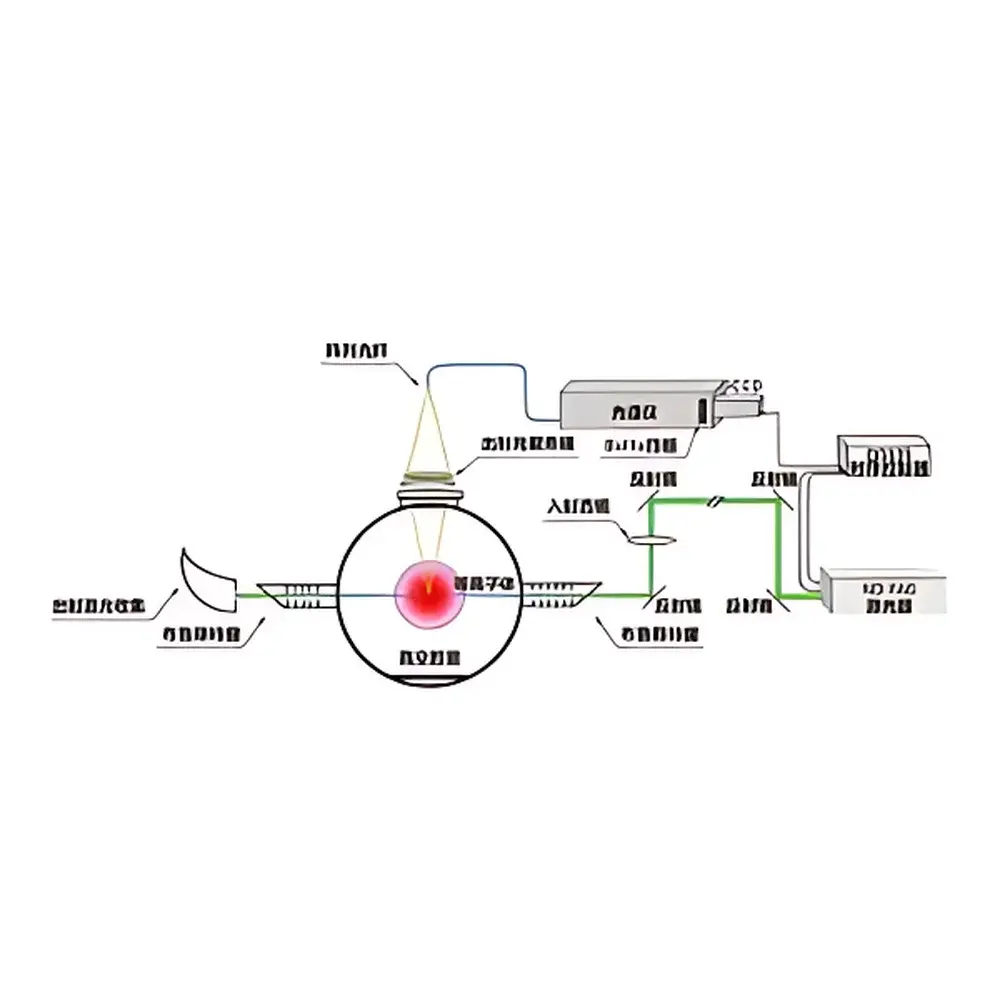
ZOLIX Thomson Scattering Spectroscopic Diagnostic System
| Brand | ZOLIX |
|---|---|
| Origin | Beijing, China |
| Manufacturer Type | Original Equipment Manufacturer (OEM) |
| Product Category | Domestic |
| Model | Thomson Scattering Spectroscopic Diagnostic System |
| Pricing | Upon Request |
Overview
The ZOLIX Thomson Scattering Spectroscopic Diagnostic System is a precision-engineered instrument for non-invasive, spatially resolved measurement of fundamental plasma parameters—primarily electron temperature (Te) and electron density (ne)—in both high-temperature fusion-relevant plasmas and low-temperature non-equilibrium plasmas. Based on the principle of inelastic laser–electron interaction, Thomson scattering occurs when a monochromatic laser beam (typically 532 nm Nd:YAG) propagates through a plasma and undergoes coherent scattering by free electrons. The scattered spectrum exhibits Doppler broadening proportional to √Te, while its integrated intensity scales linearly with ne. Unlike Langmuir probes or optical emission spectroscopy (OES), Thomson scattering provides absolute, calibration-free measurements without perturbing the plasma, making it a gold-standard technique for quantitative plasma diagnostics under controlled laboratory conditions.
Key Features
- High-spatial-resolution local probing enabled by tight laser focusing (e.g., ~1 mm beam waist at focal plane using f = 1000 mm lens and 0.5 mrad divergence)
- Dual-angle optical collection geometry optimized for 90° scattering configuration to maximize signal-to-noise ratio and minimize stray light coupling
- Modular spectrometer integration: compatible with ZOLIX Omni-750i (750 mm focal length) or 207-series (670 mm focal length) imaging spectrometers equipped with 1200 l/mm or 1800 l/mm holographic gratings
- Flexible detector interface supporting intensified CCD (ICCD) systems (e.g., iStar 334T, 13.3 × 13.3 mm active area) or sCMOS/CCD cameras coupled via ZOLIX IIM-A series lens-coupled image intensifier modules (25 mm phosphor screen, 1:1 magnification)
- Dedicated Rayleigh scattering suppression architecture incorporating Brewster-angle windows, cage-based baffling, and black-anodized mechanical stops to isolate Thomson-scattered photons from elastic atomic/molecular background
- Multi-fiber linear array design (up to 13 mm fiber pitch) enabling simultaneous multi-point radial profiling with sub-millimeter spatial sampling
Sample Compatibility & Compliance
The system is designed for use in low- to medium-pressure (10−3–103 Pa) DC, RF, microwave, or pulsed plasma sources—including cascaded arc discharges, dielectric barrier discharges (DBD), atmospheric pressure plasma jets (APPJ), and laser-produced plasmas. It supports measurement of Te in the range of 0.1–10 eV (corresponding to spectral full width at 1/e height Δλ1/e ≈ 0.47–4.70 nm at 532 nm incident wavelength) and ne down to 1 × 10¹⁹ m−3. All optical and electronic components comply with CE safety directives and RoHS material restrictions. Data acquisition workflows support traceable calibration using NIST-traceable standard lamps (e.g., tungsten-halogen A-source), and metadata tagging aligns with FAIR data principles for reproducible plasma science.
Software & Data Management
Acquisition and analysis are supported by ZOLIX’s proprietary SpectraMaster™ platform, which provides real-time spectral preview, multi-channel fiber synchronization, delay-generator triggering (via DG645-compatible TTL interfaces), and automated background subtraction. Spectral fitting routines implement Voigt deconvolution to separate instrumental broadening (dictated by fiber core diameter, grating dispersion, and slit width) from intrinsic Thomson line profiles. Export formats include HDF5, ASCII, and MATLAB .mat, ensuring compatibility with third-party plasma modeling tools (e.g., CRModel, Eirene, or OpenFOAM plasma modules). Audit trails, user access logs, and electronic signatures satisfy GLP-compliant documentation requirements per ISO/IEC 17025:2017 Annex A.
Applications
- Validation of kinetic simulations in non-equilibrium plasma chemistry (e.g., vibrational excitation pathways in N2/O2 mixtures)
- Time-resolved electron thermalization studies during nanosecond-pulse plasma initiation
- Cross-calibration of OES-derived excitation temperatures against absolute Te values
- Diagnostic benchmarking for plasma-assisted combustion, surface functionalization, and thin-film deposition reactors
- Development of compact TS systems for tokamak edge-localized mode (ELM) monitoring and stellarator boundary physics
FAQ
What is the minimum detectable electron temperature?
The system achieves reliable resolution down to Te = 0.1 eV when configured with a 400 µm core fiber, 1200 l/mm grating, and ≤50 µm entrance slit—yielding an instrumental broadening of Δλinst ≈ 0.4–0.48 nm.
Can this system measure heavy-particle temperatures?
While optimized for Thomson scattering from free electrons, the same optical train may be reconfigured to collect Rayleigh-scattered light for rotational/vibrational thermometry of neutrals—subject to additional calibration and spectral separation hardware.
Is the system compatible with vacuum chamber integration?
Yes. All collection optics, fiber feedthroughs, and mounting brackets are rated for UHV compatibility (≤10−7 mbar) and feature CF-63 or KF-40 flange interfaces.
Does the system support time-resolved acquisition?
Fully supported via external trigger synchronization with DG645 digital delay generators; ICCD gate widths adjustable from 2 ns to seconds, with jitter < 50 ps RMS.
Are software updates and technical support included?
ZOLIX provides lifetime firmware upgrades, remote diagnostic assistance, and annual on-site calibration verification services under extended service agreements compliant with ISO 9001:2015 quality management standards.
Related Products





