
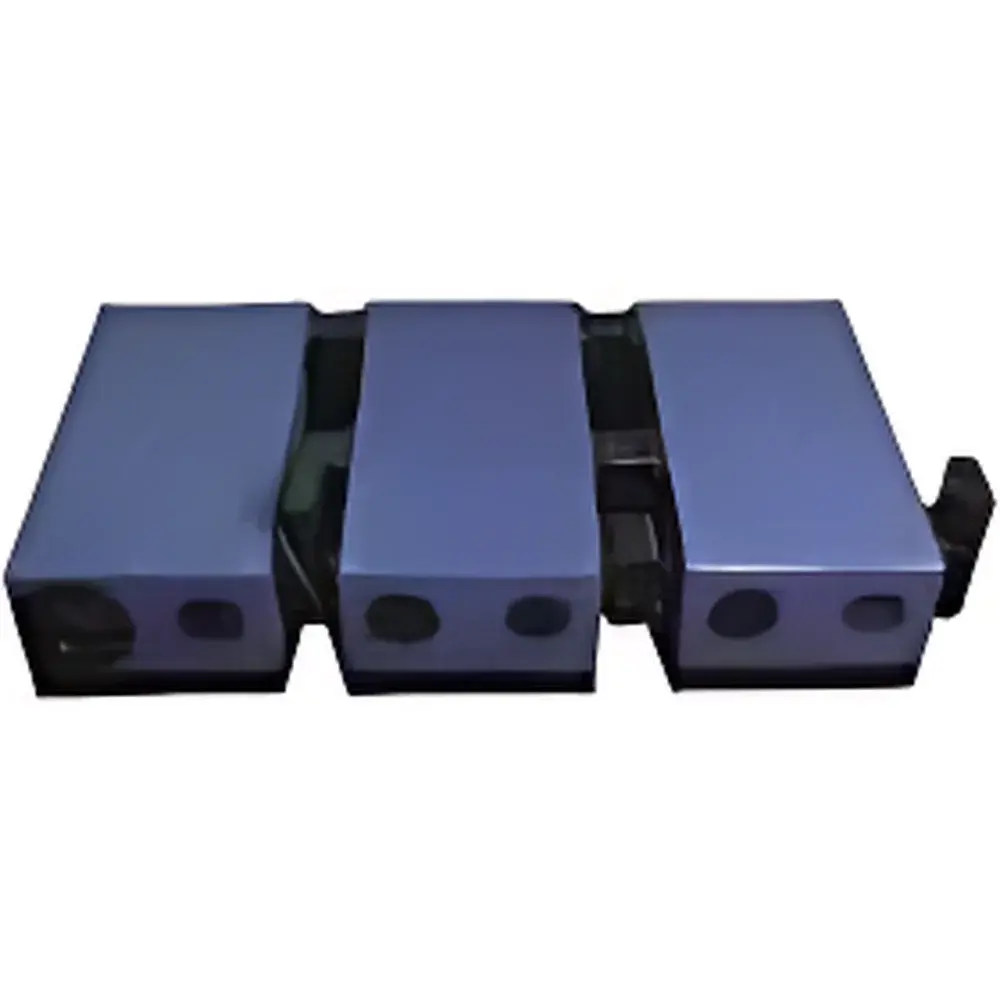
ZOLIX Omni-λ Triple Monochromator
| Brand | ZOLIX |
|---|---|
| Model | Omni-λ Series |
| Type | Triple-stage grating monochromator |
| Focal Length | 500 mm per stage |
| Configuration | Two-stage subtractive dispersion + one-stage additive dispersion |
| Spectral Range | 200–800 nm |
| Wavenumber Range (at 325 nm excitation) | 50–18,000 cm⁻¹ |
| Resolution | 3 cm⁻¹ |
| Repeatability | ±5 cm⁻¹ |
| Imaging Range (single acquisition) | 700 cm⁻¹ |
| Grating Mounts | Three gratings per stage (9 total) |
| Grating Options | 1800, 1200, 600, 3600, and 2400 grooves/mm |
| Blaze Wavelengths | 250 nm, 300 nm, 500 nm |
| Grating Size | 68 × 68 mm |
| Reflectivity (peak) | ~70% across UV–Vis |
| Input/Output | Stage 1 & 2 — side-entry dual-output |
| Detector Compatibility | CCD array detectors, PMT, and other single-channel photodetectors |
| Origin | Beijing, China |
| Manufacturer | ZOLIX (Beijing Zolix Instruments Co., Ltd.) |
Overview
The ZOLIX Omni-λ Triple Monochromator is a high-performance, three-stage grating-based spectroscopic instrument engineered for ultra-low stray light and high spectral resolution in demanding Raman and fluorescence applications. It integrates three independently optimized 500 mm focal length monochromators—each based on the proven “Spectrum King” optical platform—into a unified mechanical and alignment architecture. The first two stages operate in subtractive dispersion mode to suppress stray light by more than four orders of magnitude (typical stray light level < 1 × 10⁻⁸), while the third stage employs additive dispersion to maximize resolving power. This hybrid configuration enables both high-throughput scanning and narrow-band, high-fidelity spectral isolation—critical for resonance-enhanced Raman measurements, particularly in the deep ultraviolet regime (e.g., 244 nm or 325 nm excitation). The system is fundamentally designed around Czerny–Turner optical geometry with kinematically stabilized mounts, precision-machined aluminum alloy chassis, and thermally compensated optical path lengths to ensure long-term wavelength stability under laboratory conditions.
Key Features
- Triple-stage architecture with configurable dispersion modes: subtractive (stages 1 & 2) for stray light suppression; additive (stage 3) for resolution enhancement
- Three independent grating turrets per stage—nine total gratings—enabling seamless switching between UV, UVC, and visible spectral bands without realignment
- High-efficiency ruled gratings (imported from leading European manufacturers) with peak reflectivity up to ~70% at blaze wavelengths of 250 nm, 300 nm, and 500 nm
- Dual-input/dual-output optical interface on stage 3, supporting simultaneous coupling to array detectors (e.g., back-illuminated CCDs) and single-channel detectors (e.g., PMTs or APDs)
- Side-entry/dual-output design on stages 1 and 2 facilitates flexible beam routing and integration into complex optical benches or confocal Raman setups
- Wavelength calibration traceable to NIST-traceable emission lines (e.g., Hg, Ne, Ar lamps); optional motorized wavelength drive with encoder feedback for sub-pixel repeatability
Sample Compatibility & Compliance
The Omni-λ Triple Monochromator is compatible with standard Raman excitation sources including continuous-wave (CW) lasers at 244 nm, 325 nm, 488 nm, 532 nm, and 785 nm, as well as pulsed systems operating under gated detection protocols. Its low-stray-light performance meets ASTM E275 and ISO 17025 requirements for high-dynamic-range spectral measurement. When integrated into a full Raman spectrometer system, it supports GLP/GMP-compliant operation when paired with validated software platforms that provide full audit trails, user access control, and electronic signatures per FDA 21 CFR Part 11. The mechanical housing conforms to IP20 environmental protection standards and is certified for CE compliance under the EU Machinery Directive 2006/42/EC and Electromagnetic Compatibility Directive 2014/30/EU.
Software & Data Management
Instrument control and spectral acquisition are supported via ZOLIX’s proprietary SpectraMaster™ software suite (v5.x), which provides native support for Windows 10/11 (64-bit) and integrates with third-party environments including LabVIEW, MATLAB, and Python (via PyVISA and DLL wrappers). The software implements real-time wavelength calibration, grating auto-selection logic based on target spectral region, and synchronized detector triggering. All raw spectral data are saved in vendor-neutral HDF5 format with embedded metadata (wavelength axis, grating ID, slit width, integration time, detector gain), ensuring long-term archival integrity and interoperability with analysis tools such as OriginPro, Igor Pro, and Python-based SciPy workflows. Audit trail logs record every parameter change, user login event, and calibration action with timestamp and operator ID.
Applications
- UV Resonance Raman Spectroscopy (UVRR) of biological macromolecules (e.g., proteins, nucleic acids) using 244 nm or 325 nm excitation
- Low-frequency Raman studies (< 200 cm⁻¹) requiring high stray-light rejection and thermal drift compensation
- Time-resolved Raman spectroscopy with nanosecond-gated detection and spectral deconvolution
- Photoluminescence excitation (PLE) mapping across wide spectral ranges with minimal background interference
- Secondary ion mass spectrometry (SIMS) depth profiling where precise monochromatic ion beam filtering is required
- Calibration reference source characterization for synchrotron beamlines and metrology labs
FAQ
What is the primary advantage of the triple-stage subtractive-additive configuration?
It achieves an optimal trade-off between stray light suppression (< 1 × 10⁻⁸) and spectral resolution (3 cm⁻¹ at 325 nm), surpassing conventional double-monochromator designs in both metrics simultaneously.
Can the Omni-λ Triple Monochromator be used as a standalone single- or double-stage instrument?
Yes—optical baffles and motorized shutters allow individual stages to be isolated, enabling reconfiguration as a single monochromator (one stage), double monochromator (two stages in series), or full triple configuration.
Is external wavelength calibration required after installation?
No—the system ships pre-aligned and factory-calibrated using mercury–argon spectral lamp references; however, users may perform optional verification or recalibration using built-in lamp ports and automated routines.
Which detectors are natively supported?
Back-illuminated CCDs (e.g., Andor Newton, Princeton Instruments PIXIS), PMTs (e.g., Hamamatsu R928, H10721), and InGaAs arrays (for extended NIR configurations) are fully supported via standard analog/digital trigger interfaces and software-defined ROI mapping.
Does the system comply with international regulatory documentation standards?
Yes—full IEC 61000-4 electromagnetic immunity testing reports, CE Declaration of Conformity, and RoHS 2.0 compliance documentation are provided with each unit; IQ/OQ validation templates are available upon request for GxP environments.





