
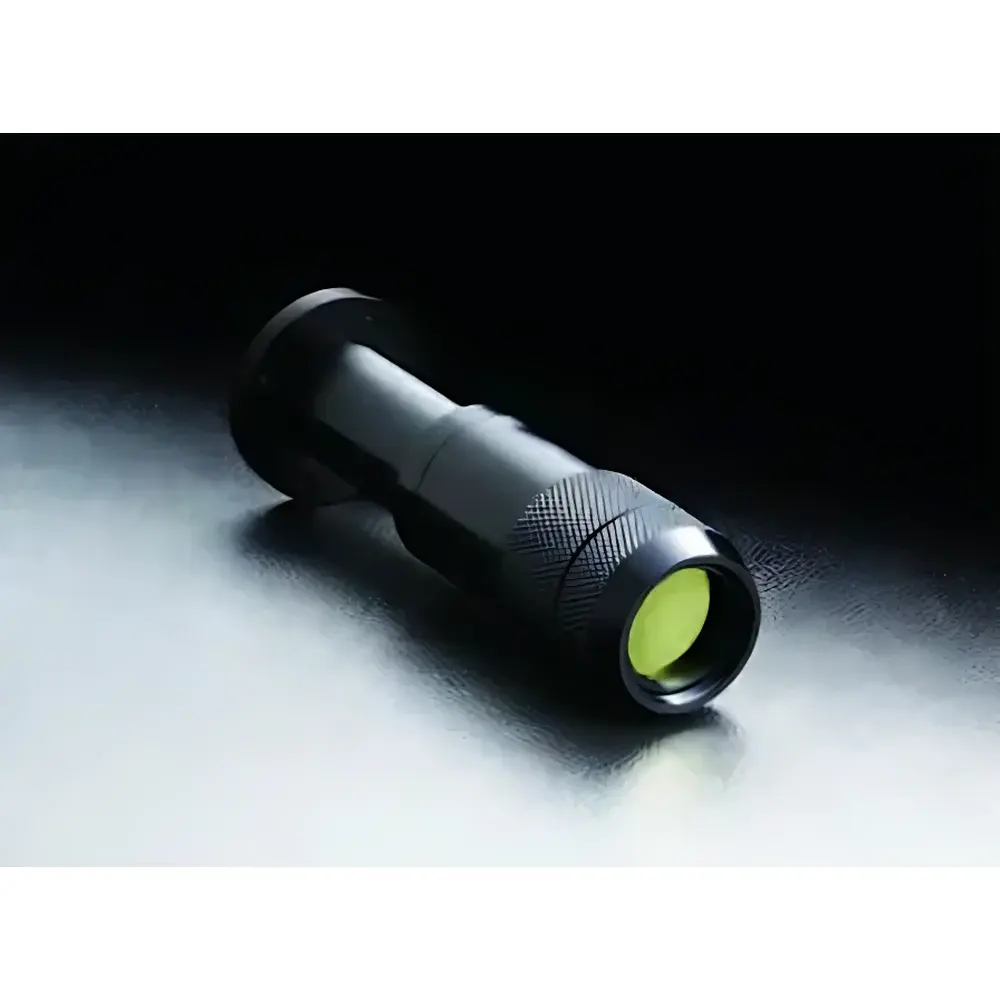
Sigma LBE Series Galilean Laser Beam Expander
| Key | Brand: Sigma |
|---|---|
| Model | LBE Series |
| Type | Galilean Beam Expander |
| Construction | Air-Spaced, Cementless Lens Design |
| Wavelength Range | Visible (e.g., 632.8 nm for He-Ne) |
| Mounting Compatibility | Direct integration with He-Ne laser output ports (e.g., Melles Griot 05-LHP) |
| Compliance | Designed for laboratory-grade optical alignment and low-aberration beam manipulation |
| Component Category | Optical Element |
| Origin | Beijing, China |
Overview
The Sigma LBE Series Galilean Laser Beam Expander is a precision-engineered optical component designed to increase the diameter of collimated laser beams while maintaining beam collimation and minimizing wavefront distortion. Based on the Galilean optical configuration—comprising a negative (diverging) front element and a positive (converging) rear element—the LBE series eliminates internal lens cementing, employing an air-spaced design that ensures high laser-induced damage threshold (LIDT) performance and thermal stability under moderate-to-high irradiance conditions. Unlike Keplerian expanders, the Galilean architecture inherently suppresses internal focus formation, eliminating the risk of air ionization or optical damage at high peak powers. This makes the LBE series particularly suitable for continuous-wave (CW) and pulsed visible lasers—including standard He-Ne sources operating at 632.8 nm—as well as other visible-wavelength systems requiring compact, alignment-stable beam scaling without introducing focal planes within the device.
Key Features
- Air-Spaced, Cementless Optics: All lens elements are mechanically mounted with precise air gaps, avoiding optical adhesives that degrade under UV exposure or high-intensity irradiation—critical for long-term reliability in demanding optical setups.
- Compact Galilean Architecture: Reduced total length compared to equivalent Keplerian designs; optimized for space-constrained optical benches and integrated laser systems where mechanical footprint matters.
- Collimation-Preserving Performance: Pre-aligned during manufacturing to deliver diffraction-limited output when fed with a well-collimated input beam; minimal added divergence (< ±0.05 mrad typical for nominal configurations).
- Visible-Spectrum Optimized Coating: Broadband anti-reflection (BBAR) coatings applied to all surfaces for >99.2% transmission across 400–700 nm, minimizing ghost reflections and power loss.
- Standardized Mechanical Interface: Compatible with industry-standard kinematic mounts (e.g., SM1-threaded housings), enabling direct coupling to He-Ne laser modules such as the Melles Griot 05-LHP series without adapter hardware.
Sample Compatibility & Compliance
The LBE series is intended for use with spatially coherent, collimated or near-collimated laser sources in research laboratories, educational optics labs, and industrial alignment applications. It is not designed for divergent or convergent input beams—users must verify input beam parameters (M² factor, Rayleigh range, and waist location) prior to integration. While not certified to ISO 10110 or MIL-PRF-13830 surface quality standards by default, each unit undergoes visual inspection and transmitted wavefront error testing per internal QC protocols aligned with ISO 10110-5 (λ/4 PV tolerance at 633 nm). The device complies with general safety requirements for Class 3R/3B laser system accessories per IEC 60825-1:2014 when used within specified input power limits. No FDA 21 CFR Part 11 or GLP/GMP validation documentation is provided, as the component is classified as a passive optical element—not a regulated medical or analytical instrument.
Software & Data Management
As a purely passive optical component, the Sigma LBE Series requires no firmware, drivers, or software interface. Performance characterization data—including measured transmission spectra, wavefront maps, and focal shift curves—are available upon request in CSV and Zemax (.zmx) format for integration into optical design simulations (e.g., Zemax OpticStudio, CODE V, or FRED). Users performing rigorous beam propagation analysis are advised to incorporate manufacturer-provided surface prescription data and coating specifications into their models to ensure accurate prediction of throughput, pointing stability, and M² degradation.
Applications
- Laser interferometry setups requiring expanded reference beams with preserved coherence length
- Optical trapping and tweezers systems where beam diameter and depth-of-field trade-offs must be precisely controlled
- Alignment of large-aperture optical systems (e.g., telescope collimation, lidar receiver paths)
- Integration into OEM laser marking or engraving subsystems where compact beam shaping is critical
- Undergraduate and graduate optics laboratories for hands-on demonstration of beam parameter product (BPP) conservation and Gaussian beam transformation
FAQ
Can the LBE expander be used with non-collimated input beams?
No. Input beams must be collimated or have divergence ≤ ±1.5 mrad to achieve diffraction-limited output. Divergent/convergent inputs will result in residual wavefront error and degraded collimation.
What happens if the expander is mounted at an angle relative to the incident beam axis?
Angular misalignment introduces beam walk-off and tilt in the output beam. Use adjustable kinematic mounts with tip/tilt capability and align using shear plate or autocollimator feedback.
Is reverse operation (i.e., using the expander as a beam reducer) supported?
No. The Galilean design is asymmetric and not reversible. Attempting reverse use results in uncorrected spherical aberration and failure to produce a collimated output.
Does Sigma provide custom magnification ratios or wavelength-specific coatings?
Yes—custom LBE configurations (e.g., 3×, 5×, or 10× magnification; UV-enhanced or NIR-optimized AR coatings) are available under OEM agreement with lead-time and MOQ considerations.
How is mechanical stability ensured during thermal cycling?
The housing uses matched aluminum alloy (6061-T6) with low CTE differential relative to BK7/SF10 glass substrates; axial shift remains < ±1.2 µm over 15–35 °C ambient range.





