
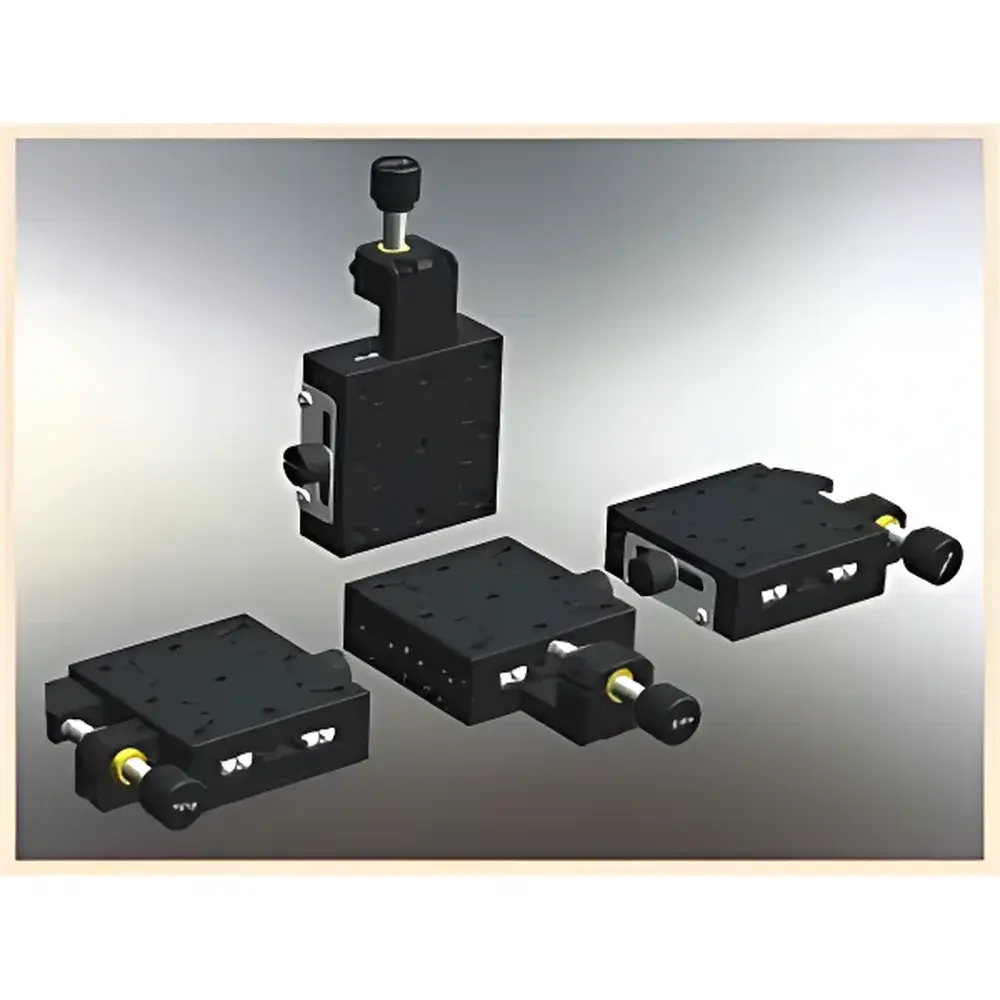
ZOLIX KSM25(A)-65 Series High-Precision Manual Translation Stage
| Brand | ZOLIX |
|---|---|
| Origin | Beijing, China |
| Manufacturer Type | OEM Manufacturer |
| Product Category | Domestic |
| Model | KSM25(A)-65 Series |
| Quotation | Upon Request |
| Sensitivity | 2 µm |
| Travel Range | 25 mm |
| Platform Dimensions | 65 mm × 65 mm |
| Guide Mechanism | Crossed Roller Bearings |
| Drive Mechanism | Micrometer-Driven (Fine-Pitch Thread) |
| Drive Position Options | Central, Right-Side, Left-Side, Vertical-Mount Configurations |
| Load Capacity | Up to 7 kg (varies by configuration) |
| Construction Material | Anodized Black Aluminum Alloy |
Overview
The ZOLIX KSM25(A)-65 Series is a manually operated, high-precision translation stage engineered for demanding optical alignment, interferometry, and micro-positioning applications in research laboratories and precision instrumentation setups. Based on the fundamental principle of mechanical displacement via calibrated fine-pitch thread translation, the stage delivers repeatable sub-micron-level positioning stability under static loading conditions. Its core architecture integrates crossed roller bearings—providing low-friction, high-rigidity linear guidance with minimal wobble and angular deviation—ensuring consistent straightness and orthogonality across the full 25 mm travel range. Designed explicitly for integration into compact optical benches and multi-axis kinematic systems, the KSM25(A)-65 Series meets stringent requirements for thermal stability, mechanical hysteresis control, and surface finish compatibility with laser-grade optics.
Key Features
- Precision sensitivity of 2 µm per graduation, achieved through a fine-pitch micrometer-driven screw mechanism with hardened stainless steel thread and brass nut assembly.
- Structural frame fabricated from aerospace-grade aluminum alloy (6061-T6), anodized black for enhanced corrosion resistance, reduced stray light reflection, and improved thermal dissipation characteristics.
- Crossed roller bearing guide system with preloaded contact geometry, delivering <0.5 µrad angular deviation over full stroke and axial runout <1 µm (typical).
- Modular drive interface options: central-drive (KSM25(A)-65C), right-side drive (KSM25(A)-65SR), left-side drive (KSM25(A)-65SL), and vertical-mount configuration (KSM25(A)-65CZ) for inverted or gravity-assisted alignment tasks.
- Compact footprint (65 mm × 65 mm platform) with optimized mass-to-stiffness ratio—enabling stable operation in space-constrained environments such as vacuum chambers, cryostats, and multi-stage nanopositioning stacks.
- Load capacity up to 7 kg for horizontal configurations; 2.5 kg for vertical orientation (KSM25(A)-65CZ), validated per ISO 230-2:2014 testing protocols for positional repeatability and creep behavior.
Sample Compatibility & Compliance
The KSM25(A)-65 Series is compatible with standard optical components including mirror mounts, lens holders, fiber couplers, and detector stages conforming to 1/4″-20 or M6 threaded mounting patterns. Its black-anodized surface meets MIL-A-8625 Type II specification for non-reflective finish, minimizing parasitic reflections in visible to near-infrared (400–1100 nm) optical paths. The stage complies with RoHS Directive 2011/65/EU for hazardous substance restrictions and is manufactured under ISO 9001:2015-certified quality management systems. While not inherently certified for cleanroom use, its non-outgassing aluminum construction and absence of lubricants make it suitable for Class 1000 (ISO 6) environments when paired with appropriate handling protocols.
Software & Data Management
As a purely manual positioning device, the KSM25(A)-65 Series does not incorporate embedded electronics, motor drivers, or digital interfaces. Consequently, it requires no firmware, driver installation, or software dependency—eliminating electromagnetic interference (EMI) risks and ensuring long-term operational reliability in sensitive measurement environments. Position data logging must be performed externally using calibrated dial indicators, capacitive sensors, or laser interferometers traceable to NIST standards. For GLP/GMP-aligned workflows, users may document adjustment sequences and final positions via laboratory notebooks or LIMS-integrated electronic records, maintaining full audit trail integrity without proprietary software lock-in.
Applications
- Alignment of collimated laser beams in Michelson and Mach-Zehnder interferometers.
- Coarse/fine positioning of objective lenses and sample stages in confocal microscopy platforms.
- Integration into multi-axis goniometers for angular calibration of spectrometers and monochromators.
- Stabilized mounting of photodetectors and quadrant photodiodes in beam stabilization loops.
- Position reference stage for calibrating piezoelectric nano-positioners and closed-loop motorized stages.
- Teaching platforms in university optics labs for demonstrating mechanical resolution limits and Abbe error principles.
FAQ
What is the maximum recommended load for vertical orientation?
The KSM25(A)-65CZ variant supports up to 2.5 kg in vertical mounting configuration, with gravitational preload applied directly along the bearing axis.
Is backlash compensation available in the micrometer drive?
No built-in backlash compensation is provided; however, consistent unidirectional approach methodology (per ISO 230-2 Annex C) ensures repeatable positioning within ±1 µm under controlled environmental conditions.
Can this stage be used inside a vacuum chamber?
Yes—the aluminum body and dry-running crossed roller bearings are compatible with high-vacuum environments (<10⁻⁵ mbar); optional vacuum-compatible grease can be specified upon order.
Are custom platform hole patterns available?
Standard platforms feature a 25 mm grid of M4 threaded holes; bespoke patterns (e.g., SM1, SM2, or kinematic triangle layouts) are available under OEM agreement.
Does ZOLIX provide calibration certificates for individual units?
Traceable calibration reports (including travel linearity, sensitivity verification, and orthogonality test results) are available as an optional service, compliant with ISO/IEC 17025:2017 requirements.





