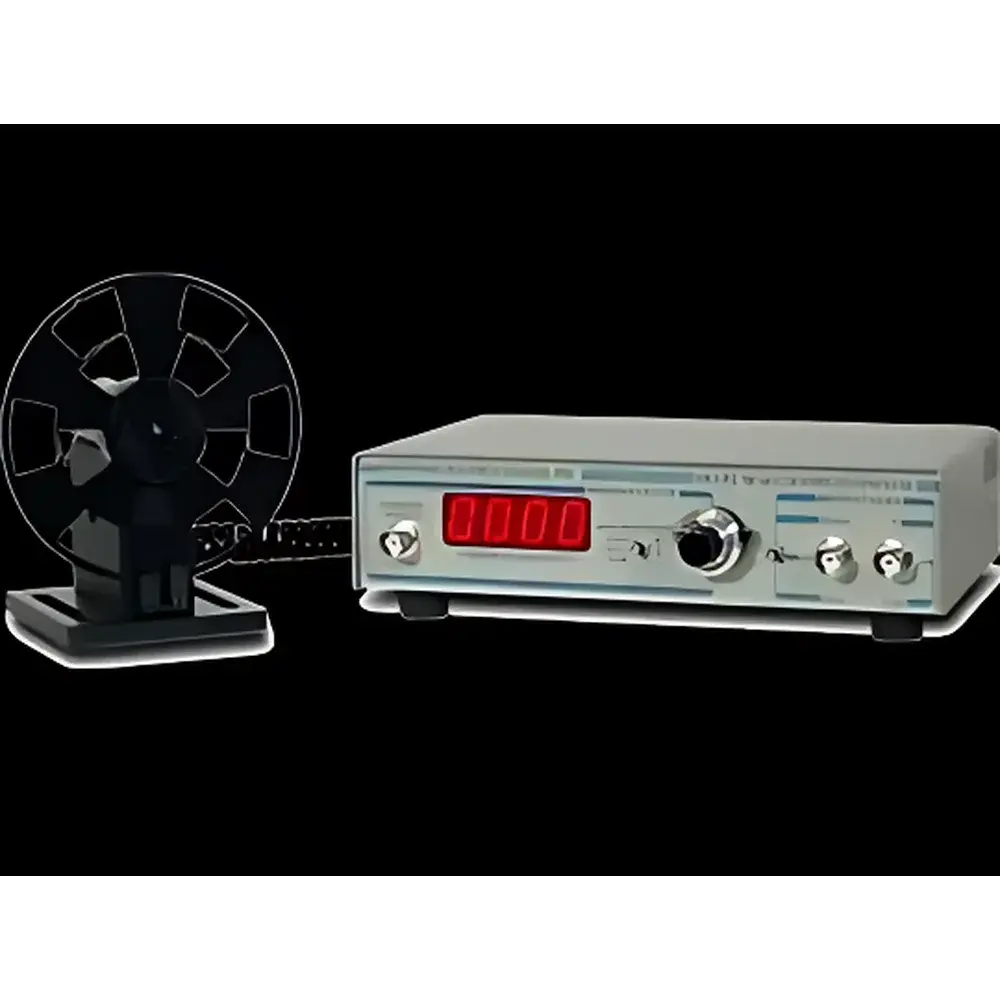
ZOLIX Model-310CD High-Speed Optical Chopper
| Brand | ZOLIX |
|---|---|
| Model | Model-310CD |
| Type | High-Speed Optical Chopper |
| Frequency Range | 100 Hz to 120 kHz |
| Frequency Stability | ±0.1% |
| Chopper Blade Diameter | 102 mm |
| Blade Surface Treatment | Photochemical blackening and demagnetization |
| Construction | Open-type chopper assembly |
| Compliance | CE-marked, RoHS-compliant |
| Interface | BNC sync output, optional TTL trigger input |
Overview
The ZOLIX Model-310CD High-Speed Optical Chopper is a precision electromechanical modulation instrument engineered for stable, repeatable interruption of continuous light beams in time-resolved optical experiments. It operates on the principle of synchronous mechanical rotation of a slotted chopper wheel driven by a brushless DC motor with closed-loop speed control. The device converts CW (continuous-wave) illumination—such as from lasers, LEDs, or broadband sources—into a square-wave modulated beam with precisely defined duty cycle and frequency. This modulation enables phase-sensitive detection when paired with lock-in amplifiers, significantly enhancing signal-to-noise ratio (SNR) in low-light or high-background environments. Designed for integration into spectroscopic, ellipsometric, photoacoustic, and pump-probe systems, the Model-310CD delivers exceptional temporal fidelity across its full operational bandwidth, supporting both fundamental research and industrial metrology applications requiring high-frequency optical gating.
Key Features
- Wide frequency range: 100 Hz to 120 kHz — optimized for high-speed photodetection and ultrafast transient measurements
- Frequency stability of ±0.1% over 8-hour continuous operation, maintained via real-time tachometer feedback and digital PID regulation
- 102 mm diameter chopper blade fabricated from aerospace-grade aluminum alloy, featuring photochemically blackened slots to minimize stray reflections and thermal drift
- Demagnetized blade substrate to eliminate magnetic interference with nearby electron optics, SQUIDs, or Hall-effect sensors
- Open-type chopper assembly allows unobstructed optical access and straightforward alignment with collimated or focused beams up to Ø25 mm
- Integrated BNC sync output provides TTL-compatible square-wave reference signal synchronized to blade passage timing
- Optional external TTL trigger input (sold separately) enables precise start/stop synchronization with pulsed laser systems or data acquisition hardware
- Low-vibration motor mount and balanced rotor assembly ensure mechanical stability under vacuum or vibration-sensitive setups
Sample Compatibility & Compliance
The Model-310CD supports standard optical configurations including free-space beam paths, fiber-coupled inputs (via collimator adapters), and integration into OEM vacuum chambers (with optional feedthrough-compatible mounting flanges). Its open architecture accommodates custom blade geometries and slot patterns upon request. The instrument complies with IEC 61000-6-3 (EMI emission limits) and IEC 61000-6-2 (immunity to electrostatic discharge and RF fields). All electrical interfaces meet EN 61000-4-5 surge immunity requirements. For regulated environments, the device supports GLP/GMP documentation packages and can be qualified per IQ/OQ protocols. While not intrinsically safe, it is rated for use in Class 1, Division 2 hazardous locations when installed with appropriate barrier systems.
Software & Data Management
The Model-310CD operates as a stand-alone analog instrument and does not require proprietary software for basic functionality. However, optional RS-232 or USB-to-serial interface modules (e.g., ZOLIX COM-Link Adapter) enable remote frequency programming and status monitoring via SCPI command set. Supported commands include *IDN?, FREQ:SET, FREQ:READ, and STAT:QUES:COND?. All communication logs are timestamped and exportable in CSV format for audit trails. Firmware updates are delivered via signed binary files with SHA-256 checksum verification. When integrated into automated test systems, the chopper satisfies FDA 21 CFR Part 11 requirements for electronic records and signatures when deployed with validated host software and access-controlled user accounts.
Applications
- Lock-in amplified photothermal and photorefractive measurements
- Synchronous detection in Fourier-transform infrared (FTIR) and Raman spectrometers
- Reference channel modulation in dual-beam absorption and reflectance setups
- Time-gated fluorescence lifetime imaging (FLIM) calibration sources
- Pump-probe delay line synchronization in ultrafast spectroscopy
- Modulation transfer function (MTF) characterization of IR detectors and focal plane arrays
- Calibration of high-bandwidth photodiodes and oscilloscopes using known-duty-cycle square waves
FAQ
What is the minimum pulse width achievable at 120 kHz?
At 120 kHz and 50% duty cycle, the theoretical minimum pulse width is 4.17 µs; practical limit is ~5 µs due to motor inertia and edge transition time.
Can the Model-310CD be used in vacuum environments?
Yes, with optional CF-35 or KF-25 vacuum feedthrough mounts; standard version is rated for ambient pressure only.
Is phase jitter specified for this model?
Phase jitter is <±0.3° RMS at frequencies above 1 kHz, measured relative to the BNC sync output using a 1 GHz digital phosphor oscilloscope.
Does the chopper support arbitrary waveform modulation?
No — it generates fixed-frequency square-wave modulation only; arbitrary waveforms require external function generators driving electro-optic modulators.
How is blade imbalance corrected during manufacturing?
Each blade undergoes dynamic balancing to ≤0.1 g·mm residual unbalance, verified using ISO 1940 Grade G2.5 certification procedures.