
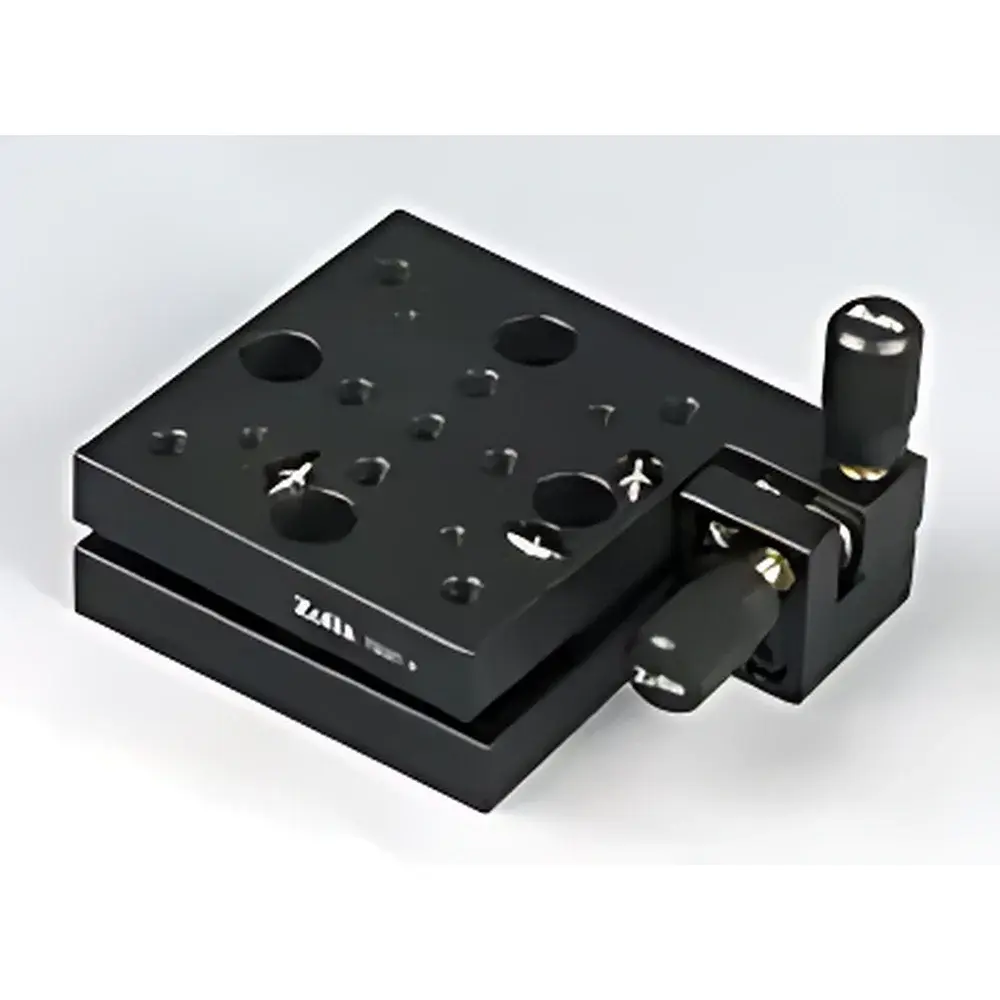
TSMT-4 Dual-Axis Tip-Tilt Rotation Stage by ZOLIX
| Brand | ZOLIX |
|---|---|
| Origin | Beijing, China |
| Manufacturer Type | Direct Manufacturer |
| Country of Origin | China |
| Model | TSMT-4 |
| Price | Upon Request |
| Tilt Range | ±4° |
| Rotation Range | ±2.5° |
| Axes | 2 (Tip & Tilt) |
| Mass | 0.3 kg |
| Drive Mechanism | Micrometer-Driven Adjustment Screw |
| Return Mechanism | Precision Tension Spring |
| Mounting Pattern | Standard ISO/Metric Threaded Hole Array (M4/M6 Compatible) |
Overview
The TSMT-4 Dual-Axis Tip-Tilt Rotation Stage is a precision optomechanical positioning platform engineered for high-stability angular alignment in optical bench and laser system integration applications. Designed around a kinematic steel-ball pivot architecture, the stage enables independent, decoupled adjustment of tip (pitch) and tilt (yaw) degrees of freedom about a common center of rotation—critical for collimation, beam steering, cavity alignment, and interferometric setup optimization. Unlike single-axis goniometers or cantilever-based mounts, the TSMT-4’s coaxial dual-axis geometry ensures minimal off-axis displacement (<5 µm over full ±4° range), preserving beam path integrity during iterative alignment. Its compact monolithic aluminum body (6061-T6) provides thermal stability and mechanical rigidity while maintaining low inertia for vibration-resilient operation in ambient lab environments.
Key Features
- Kinematic steel-ball fulcrum: Ensures repeatable, hysteresis-free rotation with sub-arcsecond resolution per micrometer turn (typical sensitivity: 0.005°/µm).
- Independent tip and tilt adjustment: Two orthogonally mounted micrometer screws (10-32 UNC, 0.5 mm pitch) drive orthogonal angular motion without cross-coupling.
- Passive spring return mechanism: Integrated phosphor-bronze tension springs provide consistent restoring force (≈1.2 N) to eliminate backlash and maintain zero-reference stability under thermal drift or minor shock.
- Standardized mounting interface: Top plate features a 25 × 25 mm grid of M4 threaded holes (depth 6 mm), compatible with ISO 10307-compliant optical posts, lens holders, and translation stages.
- Low-mass design: Total mass of 0.3 kg minimizes dynamic loading on supporting optical tables and reduces susceptibility to acoustic excitation in sensitive interferometry setups.
- No-lubrication operation: All sliding interfaces utilize hardened stainless-steel-on-aluminum contact surfaces with dry-film solid lubricant (MoS₂), eliminating outgassing risk in vacuum-adjacent or cleanroom applications.
Sample Compatibility & Compliance
The TSMT-4 is compatible with optical components up to Ø50 mm diameter or 100 g mass when centered on the pivot point. It supports standard optical elements including mirrors (dielectric or metallic coatings), waveplates, polarizers, and fiber couplers. The stage meets ISO 10110-7 surface form tolerance requirements for mounting interfaces and complies with RoHS 2011/65/EU directives for hazardous substance restriction. While not certified for Class 100 cleanrooms, its anodized finish (Type II, 15 µm thickness) and absence of adhesives or elastomers make it suitable for controlled laboratory environments operating under GLP-aligned protocols. No calibration certificate is supplied as standard; however, traceable angular verification can be performed using autocollimators (e.g., Thorlabs ACL2501) or digital theodolites compliant with ISO 17123-3.
Software & Data Management
The TSMT-4 is a manually operated mechanical stage with no embedded electronics, motorization, or digital interface. As such, it requires no firmware, drivers, or software installation. Angular position data must be recorded manually or integrated into automated systems via external encoders (e.g., Renishaw RESOLUTE™ with RSLM scale) mounted externally on the rotation arms. When used within FDA-regulated analytical workflows (e.g., optical coherence tomography system validation), users may document adjustment history in electronic lab notebooks (ELN) with audit-trail-enabled timestamping per 21 CFR Part 11 requirements. ZOLIX provides dimensional drawings (STEP/IGES) and GD&T specifications for third-party integration into CAD-based optical modeling (Zemax OpticStudio, CODE V).
Applications
- Laser cavity mirror alignment in DPSS and ultrafast oscillator systems
- Fiber-to-waveguide coupling optimization in photonic integrated circuit (PIC) packaging
- Reference beam angle tuning in Mach-Zehnder and Michelson interferometers
- Angle-sensitive filter characterization (e.g., etalons, Lyot filters)
- Optical axis stabilization in free-space quantum optics experiments
- Educational demonstration of Euler angle decomposition and gimbal lock avoidance
FAQ
Is the TSMT-4 compatible with vacuum environments?
The stage is not vacuum-rated due to the presence of non-evaporable spring materials and anodized surface layers; however, it has been successfully deployed in low-vacuum (<10⁻² mbar) enclosures with prior outgassing bakeout.
Can I mount a kinematic mirror mount directly onto the TSMT-4 top plate?
Yes—the standardized M4 hole pattern aligns with industry-standard kinematic mounts (e.g., Thorlabs KM100, Newport U100A) without adapter plates.
What is the maximum load capacity at full ±4° tilt?
Static load limit is 100 g when centered; eccentric loads >25 g require recalibration of gravitational torque compensation using optional counterweight kits.
Does ZOLIX offer motorized versions of this stage?
No—TSMT-4 is exclusively manual. For motorized tip-tilt solutions, refer to ZOLIX’s EMT series (e.g., EMT-25T) with closed-loop stepper control and RS-485/USB-C interface.
How is angular repeatability verified during manufacturing?
Each unit undergoes interferometric angular verification using a WYKO NT1100 optical profiler and calibrated autocollimator traceable to NIM (National Institute of Metrology, China). Repeatability is specified as ±3 arcseconds over 100 cycles at mid-range positions.





