
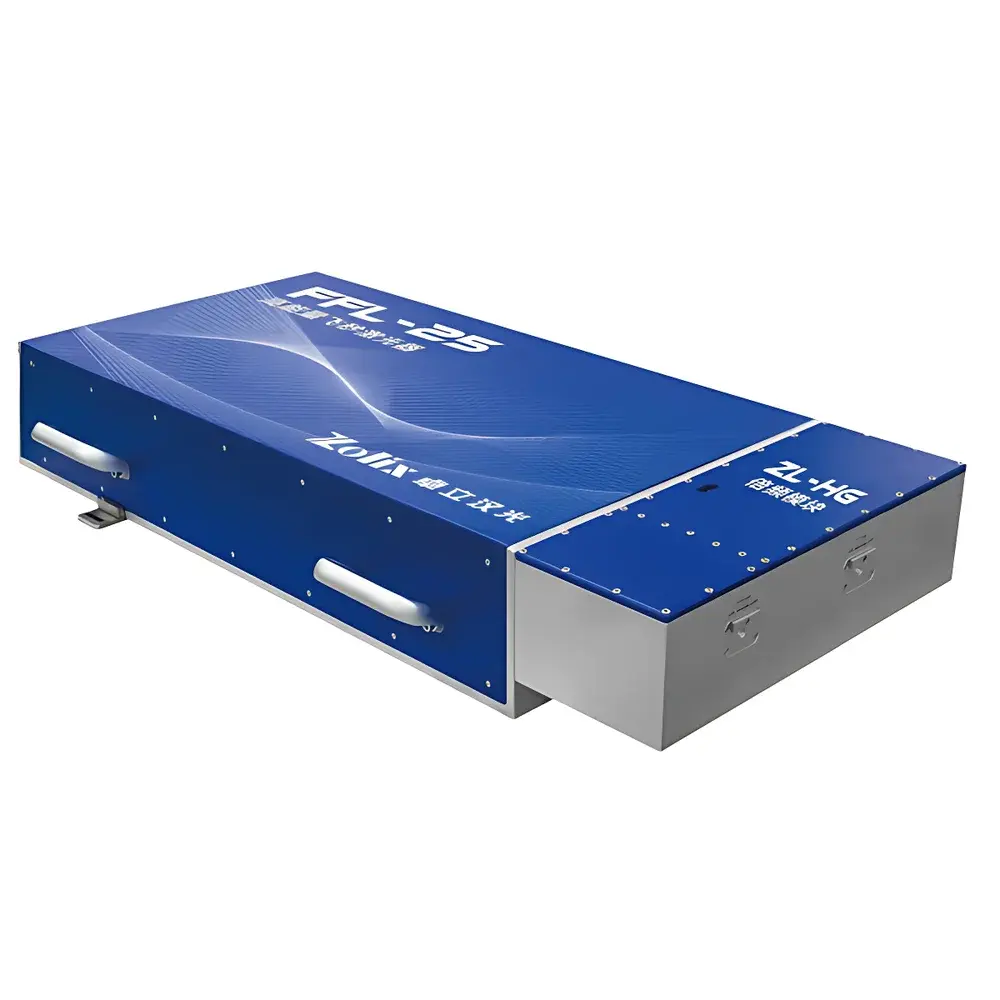
ZOLIX FFL-25 High-Energy Femtosecond Laser System
| Brand | ZOLIX |
|---|---|
| Origin | Beijing, China |
| Manufacturer Type | Original Equipment Manufacturer (OEM) |
| Product Category | Domestic |
| Model | FFL-25 |
| Core Architecture | Solid-State Amplified Chirped Pulse Amplification (CPA) Laser System |
| Output Configuration | Free-Space Beam Delivery |
| Laser Class | Class 4 |
| Central Wavelengths | 1030 ± 5 nm (fundamental), 515 ± 3 nm (second harmonic) |
| Average Power | >20 W (1030 nm), >2.5 W (515 nm) |
| Pulse Energy | >200 µJ @ 100 kHz (1030 nm), >25 µJ @ 100 kHz (515 nm) |
| Pulse Duration | Adjustable from 600 fs to 10 ps |
| Repetition Rate | Single-shot to 1 MHz (software-tunable) |
| Beam Quality | M² < 1.3 |
| Beam Pointing Stability | <25 µrad (rms, 8 hrs) |
| Power Stability | <0.5% rms (24 hrs) |
| Beam Divergence | <1 mrad |
| Polarization Extinction Ratio | 100:1 |
| Dimensions (Amplifier Unit) | 750 × 500 × 156 mm |
| Dimensions (SHG Module) | 210 × 500 × 93 mm |
Overview
The ZOLIX FFL-25 is a high-energy, industrial-grade femtosecond laser system engineered for precision material processing and advanced photonics research. Built upon a hybrid architecture combining an ultra-low-noise fiber oscillator with a diode-pumped solid-state (DPSS) amplifier stage, the FFL-25 implements chirped pulse amplification (CPA) to deliver microjoule-level pulse energies while maintaining sub-picosecond temporal fidelity. Its dual-wavelength output—fundamental at 1030 ± 5 nm and second harmonic at 515 ± 3 nm—is generated via intracavity or external nonlinear conversion, enabling flexibility across transparent material interaction regimes. Designed for continuous-duty operation in production environments, the system meets stringent requirements for thermal management, mechanical rigidity, and long-term pointing stability (<25 µrad rms over 8 hours), making it suitable for integration into automated optical platforms, vacuum chambers, or OEM laser processing tools.
Key Features
- High pulse energy output: >200 µJ at 1030 nm and >25 µJ at 515 nm under standard 100 kHz operation—scalable across repetition rates from single-shot to 1 MHz.
- Adjustable pulse duration: Precisely tunable from 600 fs to 10 ps via dispersion compensation control, allowing optimization of ablation threshold, heat-affected zone (HAZ), and nonlinear conversion efficiency.
- Advanced pulse shaping capability: Supports programmable burst mode (Burst Mode) and pulse-on-demand (POD) triggering with sub-microsecond latency, compatible with motion synchronization in high-throughput micromachining.
- Dual-wavelength architecture: Integrated or modular second-harmonic generation (SHG) with >60% conversion efficiency and polarization-maintaining beam delivery.
- Industrial-grade mechanical design: Compact footprint (750 × 500 × 156 mm amplifier unit), rigid aluminum alloy chassis, and passive/active thermal regulation ensure minimal drift under ambient temperature fluctuations.
- Class 4 laser safety compliance: Full alignment with IEC 60825-1:2014; includes interlock-ready connectors, key-switch enable, and beam shutter interface for integration into ISO 13849-1 compliant machinery control systems.
Sample Compatibility & Compliance
The FFL-25 is optimized for interaction with dielectric, semiconductor, and metallic substrates—including fused silica, sapphire, lithium niobate, silicon wafers, and thin-film coatings—where minimal thermal diffusion and high spatial confinement are critical. Its ultrashort pulses enable non-thermal ablation mechanisms such as multiphoton ionization and Coulomb explosion, reducing recast layer formation in glass cutting and waveguide inscription. The system conforms to ISO 11146-1/2 for beam parameter measurement, supports traceable calibration per ISO/IEC 17025 when used with NIST-traceable photodiodes and autocorrelators, and operates within GLP-compliant workflows when paired with audit-trail-enabled control software. Optional third-harmonic generation (THG) and broadband supercontinuum modules extend spectral utility for pump-probe spectroscopy and OCT source development.
Software & Data Management
Control is executed via ZOLIX Laser Control Suite (LCS), a Windows-based application supporting TCP/IP and USB 2.0 communication protocols. LCS provides real-time monitoring of pulse energy (via internal pyroelectric sensor), repetition rate, pulse width (indirectly inferred from dispersion grating position and verified via autocorrelation), and thermal load status. All operational parameters—including burst sequence definition, delay timing, and harmonic selection—are stored in encrypted XML configuration files with version stamping. Audit trail functionality logs user actions, parameter changes, and system faults with timestamps compliant with FDA 21 CFR Part 11 requirements when deployed in regulated QC/QA laboratories. Remote API (C++/Python SDK) enables integration with LabVIEW, MATLAB, or custom PLC-driven motion controllers.
Applications
- Industrial glass and display panel cutting with sub-50 µm kerf width and negligible chipping.
- Waveguide writing in photosensitive glasses and crystals for integrated photonics.
- Two-photon polymerization (TPP) in high-resolution 3D microfabrication.
- Pump-probe transient absorption spectroscopy requiring synchronized dual-wavelength excitation.
- Time-resolved photoelectron spectroscopy (TR-PES) and ultrafast electron diffraction (UED) source seeding.
- Nonlinear frequency conversion studies (e.g., OPA, DFG) requiring stable, high-peak-power input.
FAQ
What safety certifications does the FFL-25 meet?
The system complies with IEC 60825-1:2014 (Edition 3) for Class 4 laser products and includes CE marking for EMC Directive 2014/30/EU and Low Voltage Directive 2014/35/EU.
Is remote diagnostics supported?
Yes—via embedded Ethernet port with SSH access to system logs, temperature telemetry, and power supply health metrics; requires prior authorization and secure network segmentation.
Can the FFL-25 be integrated into a cleanroom environment?
The amplifier unit is designed for Class 1000 (ISO 6) compatibility; optional hermetic housing and filtered air purge ports are available upon request.
What maintenance intervals are recommended?
Optical alignment verification every 6 months; SHG crystal inspection and cleaning every 12 months; full recalibration of pulse energy monitor annually or after 5,000 operating hours.
Does the system support third-party pulse measurement tools?
Yes—standard free-space output with Ø12 mm clear aperture and SM1-threaded mounts enables direct coupling to commercial autocorrelators, FROG devices, and spectrometers with minimal beam manipulation.





