
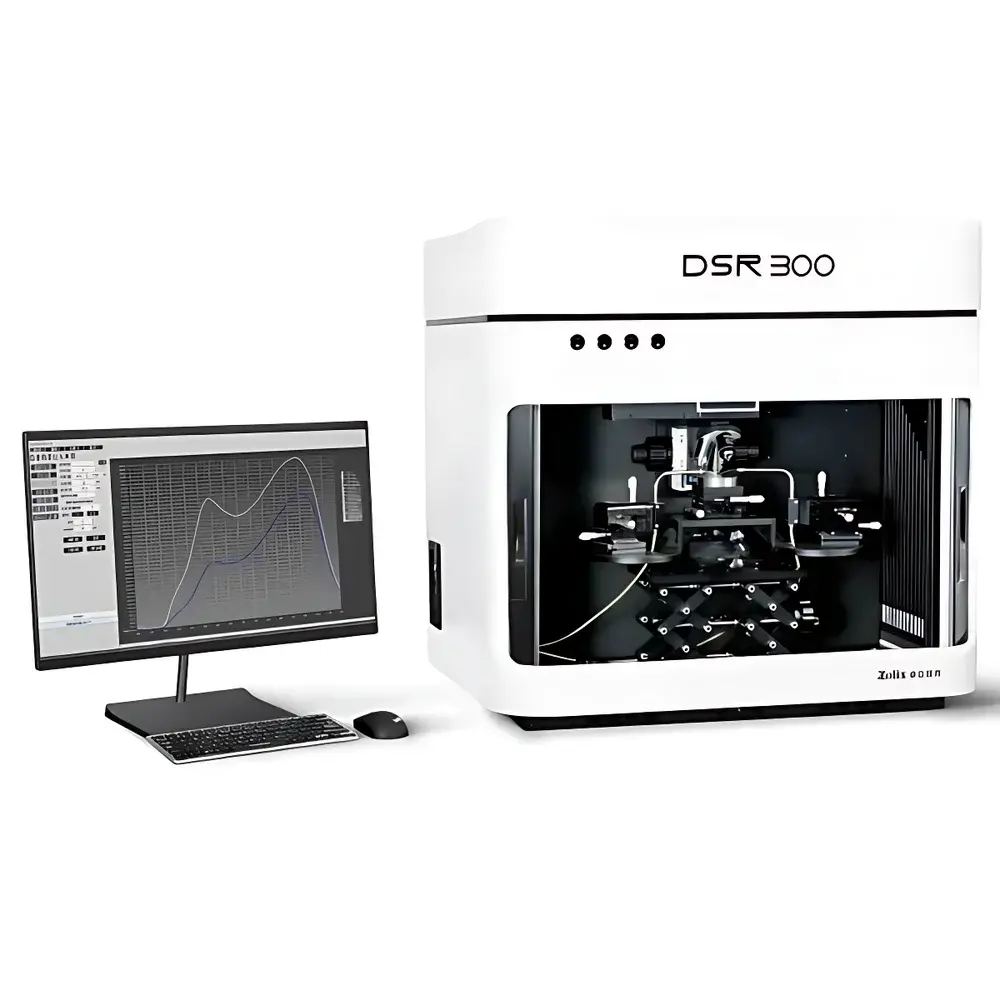
ZOLIX DSR300 Series Micro/Nano Device Spectral Responsivity Measurement System
| Brand | ZOLIX |
|---|---|
| Model | DSR300 Series |
| Origin | Beijing, China |
| Manufacturer Type | Direct Manufacturer |
| Automation Level | Semi-Automatic |
| Effective Test Area | > Ø40 µm |
| Current Measurement Resolution | 10 pA |
| Light Spot Size | 40 µm (diffraction-limited) |
| Compatible Light Sources | Supercontinuum White-Light Laser, Picosecond Pulsed Lasers, Semiconductor Lasers, Halogen Lamps, Xenon Arc Lamps |
| Key Measurement Functions | Spectral Responsivity (A/W), Monochromatic & Power-Variable I–V, Irradiance-Dependent I–t (200 ms resolution), Bias-Dependent I–t, LBIC Mapping, Linearity Analysis, Response Speed (Transient Photovoltage/Photocurrent) |
Overview
The ZOLIX DSR300 Series Micro/Nano Device Spectral Responsivity Measurement System is a purpose-built optoelectronic characterization platform engineered for quantitative spectral and dynamic response analysis of low-dimensional semiconductor devices—including 2D materials (e.g., MoS₂, graphene), perovskite photodetectors, nanowire photodiodes, and micro-scale organic photovoltaic cells. At its core, the system implements calibrated monochromatic illumination coupled with synchronized low-noise current–voltage acquisition to determine absolute spectral responsivity (Rλ, in A/W) traceable to NIST-traceable reference detectors. Unlike generic IV analyzers, the DSR300 integrates a thermally stabilized monochromator with <1 nm bandwidth resolution, a high-stability broadband or tunable laser excitation path, and a vacuum-compatible, vibration-isolated probe station—enabling reproducible sub-picoampere photocurrent measurements under controlled optical bias, electrical bias, and environmental conditions.
Key Features
- Three-axis motorized probe station with micron-level positional repeatability and thermal drift compensation (<±0.5 µm over 2 h), supporting both manual and programmable alignment of microfabricated electrodes.
- Optical path architecture accommodating up to four independent light sources via motorized filter wheels and dichroic beam combiners—enabling seamless switching between steady-state (halogen/xenon), pulsed (ps-laser), and broadband supercontinuum excitation without realignment.
- Low-noise current measurement unit with 10 pA resolution and <1 fA RMS noise floor (1 kHz bandwidth), compliant with IEEE Std 117-2019 for low-current instrumentation calibration protocols.
- Real-time synchronized acquisition of optical power (via calibrated photodiode monitor), device current, voltage, and time—enabling direct calculation of Rλ, external quantum efficiency (EQE), and normalized detectivity (D*) without post-processing assumptions.
- Integrated shutter control and optical chopper synchronization (40 Hz–5 kHz) for lock-in compatible transient photocurrent/voltage measurements with temporal resolution down to 200 ms per data point.
Sample Compatibility & Compliance
The DSR300 accommodates planar microdevices with electrode pitches from 5 µm to 500 µm, including FIB-patterned contacts, lithographically defined interdigitated electrodes, and wire-bonded chiplets on standard probe cards. Its Ø40 µm focused spot—achievable across 250–1100 nm spectral range—ensures spatially resolved mapping of inhomogeneous photoresponse without diffraction-limited crosstalk. The system meets mechanical and electromagnetic compatibility requirements per IEC 61326-1:2013 for laboratory measurement equipment. All software workflows support audit trails and electronic signatures in accordance with FDA 21 CFR Part 11 for regulated R&D environments. Calibration certificates for optical power sensors and current preamplifiers are provided with NIST-traceable uncertainty budgets.
Software & Data Management
Control and analysis are executed through ZOLIX’s proprietary SpectraLab v4.2 platform—a Windows-based application built on .NET Framework with modular scripting (Python API included). The software enforces structured experiment definition: users define wavelength sweep ranges, bias sequences, irradiance steps, and dwell times prior to execution. Raw datasets are stored in HDF5 format with embedded metadata (timestamp, instrument configuration, calibration IDs, environmental logs). Batch processing enables automated Rλ curve fitting using Tauc plot analysis, Shockley–Read–Hall recombination modeling, and linear regression for responsivity linearity assessment (R² > 0.9998 typical). Export options include CSV, MATLAB .mat, and ASTM E2937-compliant XML for third-party LIMS integration.
Applications
- Quantitative EQE mapping of perovskite single-crystal photodetectors for bandgap validation and defect localization.
- Time-resolved photocarrier lifetime extraction in transition metal dichalcogenide (TMD) heterostructures under variable gate bias.
- Linearity evaluation of avalanche photodiodes operating near breakdown voltage for LiDAR receiver qualification.
- LBIC (Light Beam Induced Current) imaging of grain boundary recombination activity in polycrystalline CIGS thin-film solar cells.
- Transient photovoltage decay analysis to distinguish surface vs. bulk recombination kinetics in quantum dot sensitized electrodes.
FAQ
What standards does the DSR300 comply with for spectral responsivity calibration?
The system supports calibration traceable to NIST SRM 2069 (silicon photodiode) and NIST SP 250-91 (spectral irradiance standards), following procedures outlined in ISO/IEC 17025:2017 accredited laboratories.
Can the DSR300 perform low-temperature measurements?
Yes—the probe station features vacuum flange interfaces compatible with cryogenic cold fingers (4 K–300 K); optional LN₂-cooled stages and radiation shields are available as factory-configured modules.
Is remote operation supported for multi-user lab environments?
SpectraLab v4.2 includes role-based access control, networked instrument sharing via TCP/IP, and RESTful API endpoints for integration into centralized lab automation frameworks.
How is stray light minimized during monochromatic measurements?
The optical train incorporates double-grating monochromators, order-sorting filters, and baffled light-tight enclosures achieving <1×10⁻⁵ stray light ratio at ±10 nm from peak wavelength.
Does the system support pulsed laser synchronization for ultrafast carrier dynamics?
Yes—via TTL-triggered delay generators (optional), the DSR300 synchronizes ps-laser pulses (e.g., Ti:sapphire, OPO) with sampling gates and bias modulation, enabling pump–probe photocurrent transients with sub-nanosecond timing jitter.





