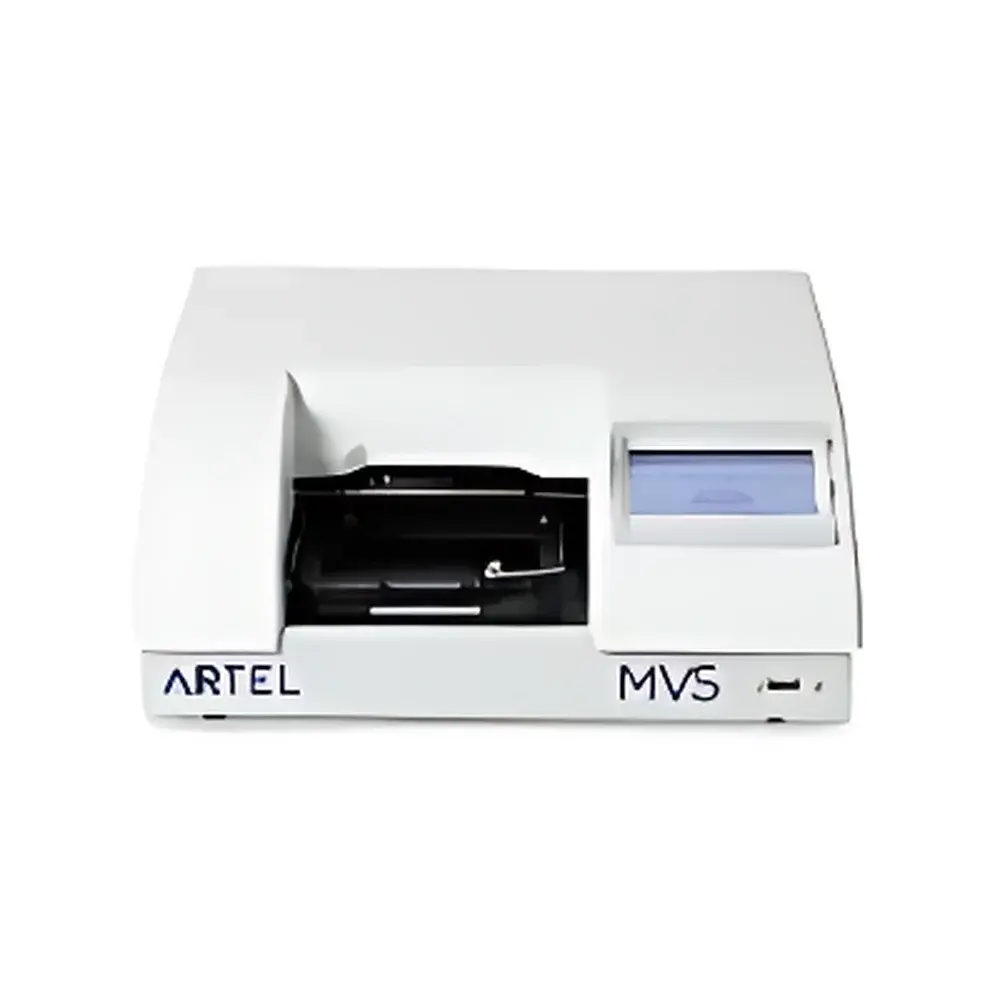
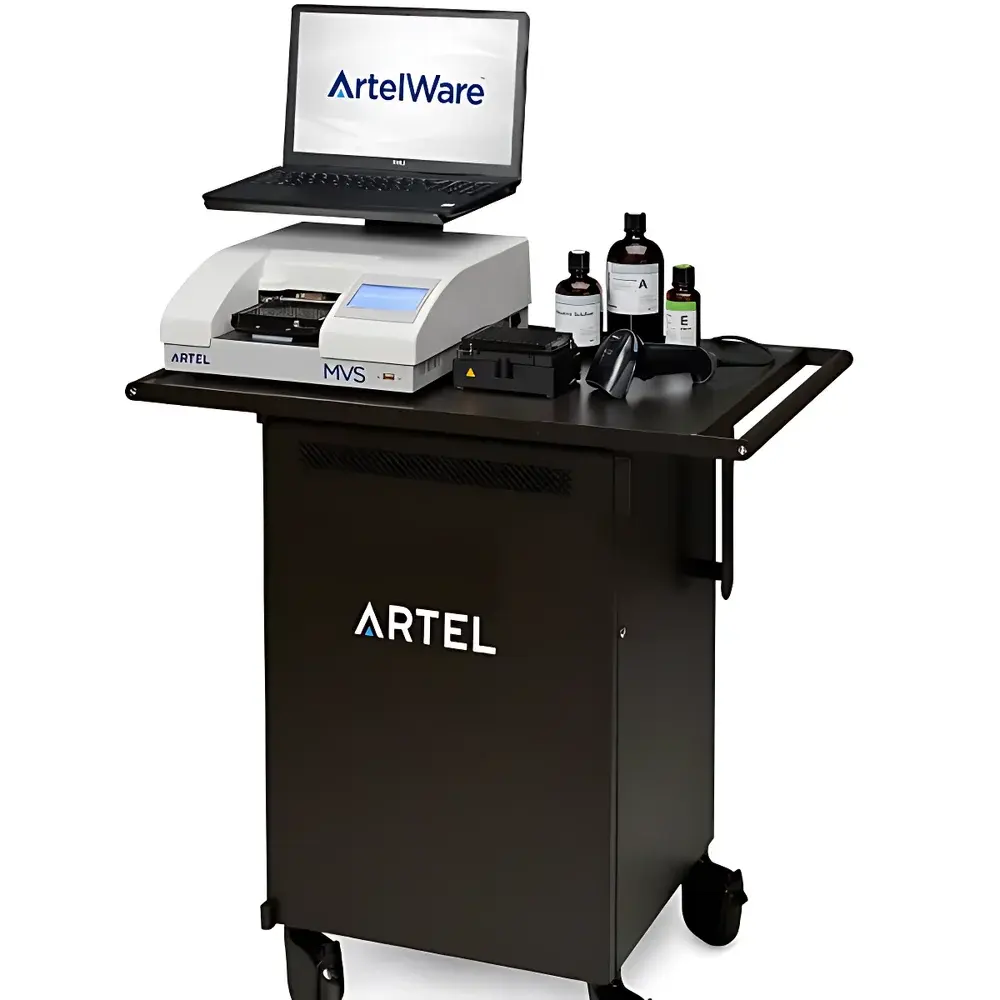
Artel MVS Multichannel Verification System
| Brand | Artel |
|---|---|
| Origin | USA |
| Manufacturer | Artel, Inc. |
| Type | Imported Instrument |
| Model | Artel MVS |
| Pricing | Upon Request |
Overview
The Artel MVS Multichannel Verification System is a traceable, photometric-based metrology platform engineered for rapid, high-accuracy volume verification of multichannel liquid handlers—including robotic liquid handling workstations, electronic multichannel pipettes, and manual multichannel pipettors. Unlike gravimetric methods that rely on balance-derived mass measurements subject to environmental drift and evaporation artifacts, the MVS employs dual-beam UV-Vis photometry to quantify the volume of dye solution dispensed into microplate wells. This principle leverages Beer–Lambert law compliance with a proprietary calibration-grade rhodamine B solution, enabling direct volumetric assessment independent of ambient humidity, temperature fluctuations, or operator technique. Designed for ISO/IEC 17025-accredited laboratories and GxP environments, the MVS delivers measurement uncertainty < ±0.8% CV across its operational range (1–1,000 µL), supporting rigorous method validation and routine performance qualification.
Key Features
- Photometric volume verification in under 10 minutes per assay—no balance stabilization delays or evaporation corrections required
- Full compatibility with 4-, 8-, 12-, 16-, 24-, 48-, 96-, and 384-channel liquid handlers, including Hamilton STAR, Tecan Freedom EVO, Agilent Bravo, Thermo Fisher Multidrop Combi, and Rainin/Labcyte handheld systems
- Integrated MVS Software v5.x with automated pass/fail reporting against user-defined acceptance criteria (e.g., ISO 8655-6, CLSI EP15-A3, USP <1251>)
- Traceable calibration via NIST-traceable spectrophotometer and certified reference materials; full audit trail compliant with FDA 21 CFR Part 11 and EU Annex 11
- Portable benchtop design with integrated touchscreen interface—enables on-site verification without dedicated lab space or infrastructure modifications
- Robust architecture with redundant optical path monitoring and real-time signal-to-noise ratio diagnostics to flag suboptimal dispensing events
Sample Compatibility & Compliance
The MVS operates exclusively with Artel-certified Verification Solutions (V-Solutions), formulated to meet strict absorbance linearity, stability, and lot-to-lot reproducibility specifications. Each solution batch undergoes independent verification per ISO/IEC 17025 requirements and ships with a Certificate of Analysis detailing molar absorptivity, purity, and shelf-life validation. The system supports standard SBS-format 96-well and 384-well microplates (flat-bottom, clear polystyrene), eliminating well geometry-related measurement bias. Regulatory alignment includes explicit support for ISO 8655 (Pipettes), ISO 20776-2 (Antimicrobial Susceptibility Testing), CLSI EP15-A3 (User Verification of Precision and Trueness), and ASTM E2758 (Standard Guide for Validation of Automated Liquid Handling Systems). All verification reports include metadata for GLP/GMP audits: operator ID, instrument serial number, environmental conditions (temperature/humidity logged at time of test), and raw photometric data export in CSV and PDF formats.
Software & Data Management
MVS Software provides a secure, role-based interface for protocol definition, result visualization, trend analysis, and electronic record retention. It features configurable user permissions (administrator, analyst, reviewer), automatic timestamping, and immutable audit trails meeting FDA 21 CFR Part 11 requirements—including electronic signatures, change history, and system access logs. Data exports are structured for LIMS integration via HL7 or RESTful API, and raw spectral data (absorbance vs. wavelength) is stored in vendor-neutral .jdx format. Historical performance dashboards enable longitudinal analysis of channel-to-channel variability, inter-operator consistency, and equipment aging trends—critical for preventive maintenance scheduling and CAPA documentation.
Applications
- Qualification and routine verification of automated liquid handlers in clinical diagnostics, biopharma QC, and academic core facilities
- Supporting ISO 15189 accreditation through documented traceability and uncertainty budgets for volume delivery
- Operator competency assessment and training feedback—quantitative metrics replace subjective “pipetting skill” evaluations
- Method transfer validation between labs or platforms, ensuring volumetric equivalence prior to assay deployment
- Root cause analysis of assay variability—correlating liquid handler performance deviations with downstream ELISA, qPCR, or NGS failure rates
FAQ
Is the Artel MVS compatible with non-Artel pipette tips or third-party microplates?
Yes—the MVS verifies volume delivery regardless of tip manufacturer or plate brand, provided the plate meets SBS footprint and optical clarity specifications.
Can MVS data be integrated into an existing LIMS or ELN?
Yes—via configurable CSV export, HL7 messaging, or REST API endpoints supporting OAuth 2.0 authentication.
Does the system require annual recalibration by Artel service engineers?
No—user-performed performance checks using included verification standards satisfy ISO/IEC 17025 interim verification requirements; full calibration is recommended every 12 months or after major hardware service.
What environmental conditions affect MVS measurement accuracy?
Ambient light exposure must be minimized; optimal operation occurs at 15–30 °C and 30–70% RH—built-in environmental sensors log deviations automatically.
How does MVS handle viscous or volatile samples?
The MVS validates only aqueous dye solutions; it does not measure sample liquids directly—it assesses the liquid handler’s ability to deliver calibrated volumes under standardized conditions.