
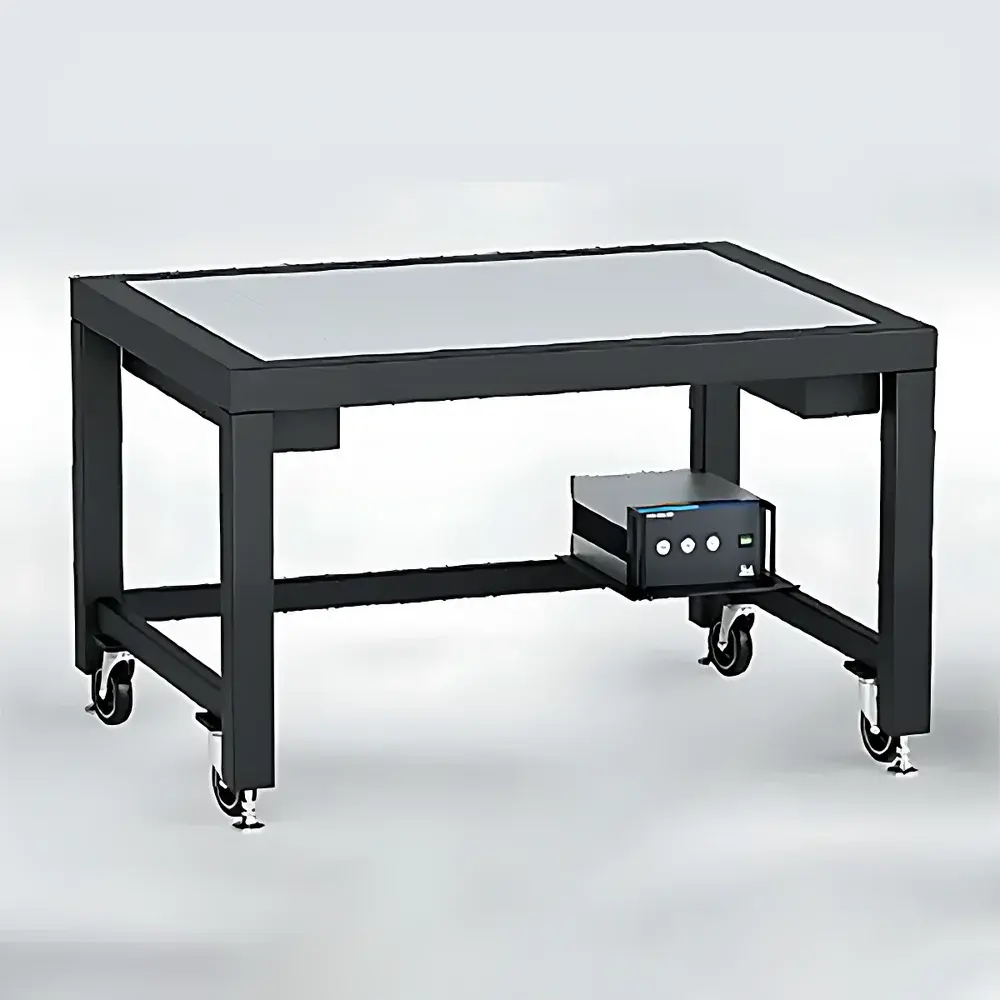
Accurion Workstation Vario Series Ergonomic Optical Workbench with Integrated Active Vibration Isolation
| Brand | Accurion |
|---|---|
| Origin | Beijing, China |
| Manufacturer Type | Authorized Distributor |
| Product Origin | Domestic (China) |
| Model | Vario Series |
| Pricing | Upon Request |
Overview
The Accurion Workstation Vario Series is a high-precision, ergonomically engineered optical workbench integrating real-time, six-degree-of-freedom (6-DOF) active vibration isolation. Designed specifically for demanding optical metrology and nanoscale characterization applications—including ellipsometry, 3D profilometry, scanning electron microscopy (SEM), and interferometric surface analysis—the system eliminates environmental mechanical disturbances that compromise measurement fidelity. Unlike passive air-isolation platforms, which rely on pneumatic compliance and suffer from low-frequency resonances (typically 1–3 Hz), the Vario platform employs a closed-loop electromechanical control architecture. It continuously monitors ground- and structure-borne vibrations—spanning vertical (5–30 Hz), horizontal (0.5–10 Hz), and acoustic (>20 Hz) domains—using ultra-sensitive piezoelectric accelerometers. Processed by a dedicated digital control unit, sensor data drives electromagnetic actuators to generate instantaneous counter-forces, achieving broadband attenuation from 0.6 Hz up to 200 Hz. This enables sub-nanometer positional stability and rapid settling (<0.3 s), critical for time-resolved optical measurements and high-magnification imaging where thermal drift and mechanical jitter must be minimized.
Key Features
- Six-axis active vibration isolation (vertical + lateral + rotational DOFs) with real-time feedback compensation
- Settling time ≤ 0.3 seconds—over 100× faster than conventional passive pneumatic isolators (30–60 s)
- Effective isolation bandwidth: 0.6 Hz (or 1 Hz, depending on configuration) to 200 Hz
- No compressed air required—operates solely on standard AC power (100–240 V, 50/60 Hz)
- Ergonomic height-adjustable frame with locking casters for flexible lab reconfiguration
- High static stiffness: ~20–30× greater than equivalent passive systems at 1 Hz, ensuring exceptional position retention under dynamic load
- Modular platform sizes: 600 × 600 mm (Vario 600), 780 × 600 mm (Vario 780), and 900 × 750 mm (Vario 900)
- Load capacity range: 0–320 kg (Vario 600), 0–310 kg (Vario 780), 0–290 kg (Vario 900)
- Integrated cable management, grounding provisions, and standardized M6/M8 tapped mounting patterns compliant with ISO 20957-3 for optical breadboard compatibility
Sample Compatibility & Compliance
The Workstation Vario Series supports a broad spectrum of high-resolution optical instruments requiring sub-micron mechanical stability. Verified integration includes Accurion’s i4 Large imaging ellipsometer, non-contact 3D optical profilers (e.g., Zygo NewView, Bruker Contour), and benchtop SEMs with integrated EDS detectors. Platform flatness (≤ ±5 µm over full surface) and surface finish (black anodized aluminum, Class 1000 cleanroom compatible) meet requirements for laser alignment, interferometry, and thin-film characterization. The system complies with ISO 10816-1 (vibration severity evaluation), ISO 20957-3 (fitness equipment—structural requirements), and conforms to CE marking directives (EMC 2014/30/EU, LVD 2014/35/EU). All firmware and control logic are designed to support GLP/GMP-aligned environments, including audit-trail-ready operation logs and user-access-level controls.
Software & Data Management
The Vario platform operates via a dedicated embedded controller with intuitive front-panel push-button interface—no PC dependency for basic activation or mode selection. For advanced diagnostics and performance monitoring, optional USB- or Ethernet-connected software provides real-time FFT spectral analysis, isolation efficiency plots (dB vs. frequency), and historical vibration event logging. Data export supports CSV and HDF5 formats for post-processing in MATLAB, Python (SciPy), or LabVIEW. Firmware updates are delivered via secure HTTPS; all communication adheres to TLS 1.2+ encryption. While not FDA 21 CFR Part 11 certified out-of-the-box, the system architecture supports validation protocols for regulated laboratories through configurable user authentication, electronic signatures, and immutable audit trails when deployed with validated third-party LIMS or ELN integrations.
Applications
- In-situ spectroscopic ellipsometry for real-time thin-film growth monitoring (e.g., ALD, CVD, spin-coating)
- Non-contact 3D surface topography mapping of microstructured optics, MEMS devices, and semiconductor wafers
- High-magnification optical coherence tomography (OCT) and confocal reflectance imaging
- Atomic force microscopy (AFM) auxiliary staging where coarse positioning requires vibration-free translation
- Calibration-grade interferometer setups (e.g., Twyman-Green, Mach-Zehnder) requiring long coherence-length stability
- Quantitative phase imaging (QPI) and digital holographic microscopy (DHM) systems sensitive to path-length fluctuations
FAQ
Does the Vario platform require external air supply or vacuum lines?
No—unlike pneumatic isolators, the Vario series uses electromagnetic actuators powered exclusively by standard AC mains.
Can it be used in multi-story laboratory buildings with known floor vibration modes?
Yes—the 0.6 Hz lower cutoff and adaptive control algorithm effectively suppress building sway and HVAC-induced resonances typical in reinforced concrete structures.
Is the platform compatible with existing optical tables or breadboards?
Yes—all models feature standardized M6 and M8 threaded holes on 25 mm grids, enabling direct bolt-down integration with Thorlabs, Newport, or Standa optical tables.
What maintenance is required for long-term performance stability?
None beyond periodic visual inspection of casters and electrical connections; no consumables, lubricants, or recalibration intervals are specified per manufacturer guidelines.
How is electromagnetic compatibility (EMC) ensured near sensitive detectors?
The actuator drive electronics incorporate multi-stage filtering and shielded cabling; radiated emissions are verified to meet CISPR 11 Class B limits for laboratory use.



