
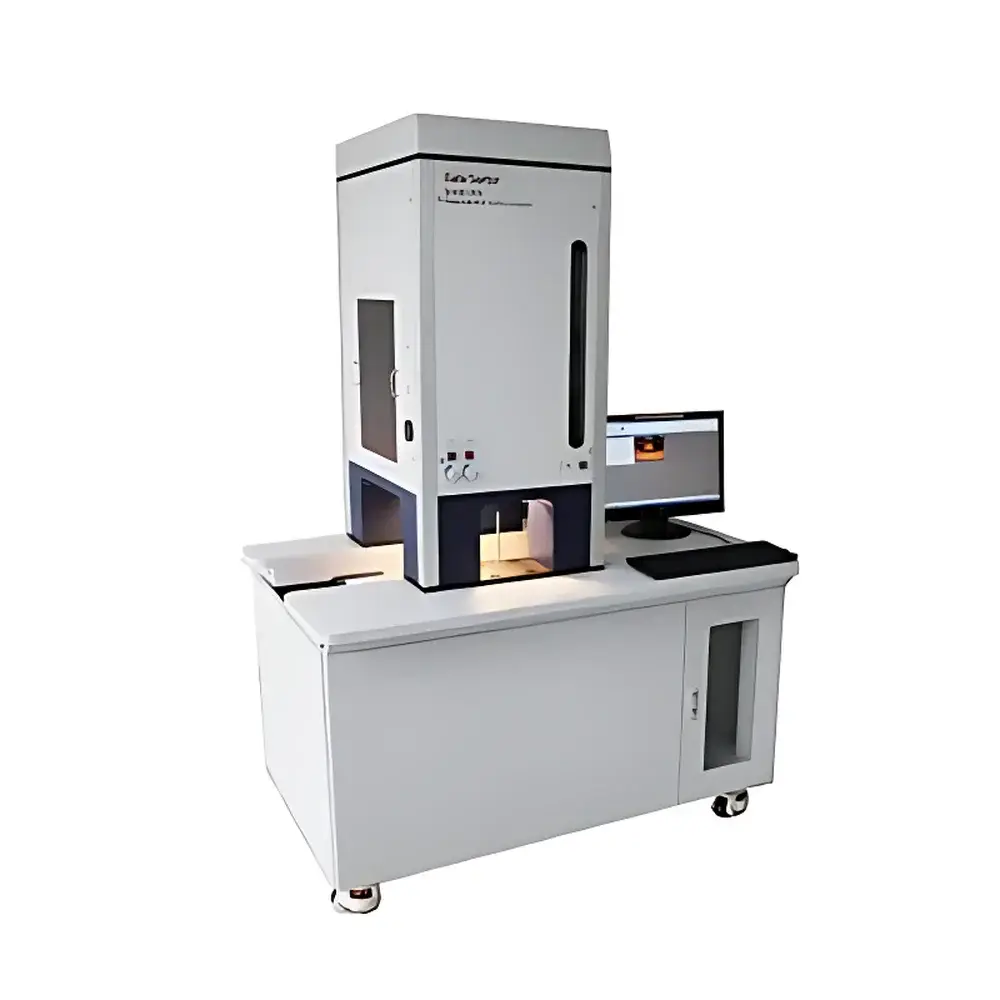
Dualix GaiaSorter Hyperspectral Sorting System
| Brand | Dualix Spectral Imaging |
|---|---|
| Origin | Sichuan, China |
| Manufacturer Type | Authorized Distributor |
| Country of Origin | China |
| Model | GaiaSorter |
| Price | USD 21,000 (FOB) |
| Operating Principle | Push-broom Hyperspectral Imaging |
| Imaging Mode | 3D Data Cube Acquisition |
| Deployment | Benchtop & Airborne-Compatible |
| Spectral Range | 350–2500 nm (configurable bands: 400–1000 nm, 900–1700 nm, 1000–2500 nm) |
| Spectral Resolution | ≤2.8 nm (FWHM) |
| Spatial Resolution (IFOV) | 30 µm / 50 µm (selectable via optics) |
| Detector Resolution | 1392 × 1040 pixels |
| Field of View (TFOV) | 20° |
| Frame Rate | 25–120 fps |
| Illumination Uniformity | ≥90% |
| Sample Chamber Max Dimensions | 300 × 300 × 200 mm |
| Working Distance Adjustment Range | 180–600 mm (dependent on sample height) |
| Power Input | AC 220 V ±10% |
| Light Source | DC 12 V adjustable-intensity uniform LED array (~200 W total) |
Overview
The Dualix GaiaSorter Hyperspectral Sorting System is a benchtop-engineered, push-broom hyperspectral imaging platform designed for non-destructive, label-free chemical and physical characterization of solid samples in industrial sorting, agricultural quality control, and laboratory research applications. It operates on the principle of spatial-spectral data acquisition: as a sample moves linearly under controlled illumination, the imaging spectrometer captures sequential line-scans—each containing full spectral information across the 350–2500 nm range—at high temporal resolution. The result is a three-dimensional (x, y, λ) hyperspectral data cube, where every pixel encodes both spatial coordinates and a continuous reflectance spectrum. This architecture enables quantitative analysis of compositional heterogeneity—including moisture content, soluble solids (Brix), acidity, chlorophyll distribution, surface defects, and material adulteration—without sample preparation or contact. Unlike conventional RGB or multispectral systems, the GaiaSorter resolves subtle spectral signatures with ≤2.8 nm spectral sampling, supporting robust chemometric modeling and spectral library matching.
Key Features
- Modular spectral configuration: Supports interchangeable spectral bands—400–1000 nm (VNIR), 900–1700 nm (SWIR I), and 1000–2500 nm (SWIR II)—to match application-specific absorption features (e.g., O–H, C–H, N–H bonds).
- High-fidelity optical train: Engineered for ≥90% illumination uniformity across the field of view; optimized working distance range (180–600 mm) accommodates variable sample heights (up to 200 mm) while maintaining consistent IFOV (30 µm or 50 µm selectable).
- Real-time acquisition capability: Frame rates from 25 to 120 fps enable synchronization with conveyor-based throughput up to 1.2 m/s, suitable for inline food grading and recycling stream analysis.
- Integrated hardware control: Unified software interface manages synchronized operation of the adjustable DC 12 V LED illumination system (~200 W), precision motorized stage (400 mm travel), and high-dynamic-range CMOS/InGaAs detector array (1392 × 1040 pixels).
- Benchtop flexibility with airborne scalability: Mechanical and electrical interfaces comply with standard UAV payload mounting protocols (e.g., M3/M4 fasteners, 24 V DC input option), allowing validation-grade field deployment without architectural redesign.
Sample Compatibility & Compliance
The GaiaSorter accommodates samples up to 300 × 300 × 200 mm in volume, including whole fruits, cut produce, granular commodities (nuts, grains), pharmaceutical tablets, plastic flakes, and mineral specimens. Its non-contact, reflection-mode geometry eliminates cross-contamination risk and preserves sample integrity. The system supports method development aligned with ASTM E1777 (Standard Guide for Use of Hyperspectral Imaging in Forensic Science), ISO 19995-2 (Food quality assessment using spectral imaging), and USP (Near-Infrared Spectroscopy). While not certified for GMP manufacturing environments out-of-the-box, its data logging architecture—timestamped raw cube export, metadata embedding (wavelength calibration, exposure, stage position), and audit-ready file naming—facilitates compliance with FDA 21 CFR Part 11 when integrated into validated workflows.
Software & Data Management
Control and analysis are executed via Dualix’s proprietary HyperStudio Suite, a Windows-based application supporting real-time preview, automated dark/white reference correction, spectral calibration (NIST-traceable lamp options available), and batch processing of large data cubes. Export formats include ENVI .hdr/.bin, HDF5, and TIFF stacks—ensuring compatibility with MATLAB, Python (scikit-learn, spectral, h5py), and commercial chemometrics platforms (Unscrambler X, Pirouette). The software includes embedded PCA, PLS-DA, and SVM classification modules, with optional integration into PLC-controlled sorting actuators (e.g., pneumatic ejectors) via TCP/IP or Modbus RTU. All acquisitions retain full traceability: each cube embeds instrument configuration, environmental timestamps, and user-defined sample IDs—critical for GLP documentation and method transfer.
Applications
- Agricultural post-harvest sorting: Discrimination of apple bruising (600–750 nm), citrus dry matter (1600–1700 nm), and strawberry sugar-acid ratio (800–950 nm).
- Recycling stream analytics: Polymer identification (PET vs. PVC at 1730 nm), contaminant detection in PET flake streams, and wood species classification in biomass preprocessing.
- Pharmaceutical QC: Coating thickness uniformity mapping (1450 nm OH overtone), API crystallinity assessment (1900–2200 nm), and counterfeit tablet screening via spectral fingerprinting.
- Geological & environmental lab use: Mineral phase identification (kaolinite, montmorillonite hydration bands), soil organic carbon estimation (1000–2500 nm), and microplastic spectral library expansion.
FAQ
What spectral calibration standards are supported?
The GaiaSorter accepts NIST-traceable tungsten-halogen and deuterium lamps for radiometric and wavelength calibration; factory calibration certificates are provided with each system.
Can the system operate in ambient light conditions?
Yes—its narrowband spectral filtering and high dynamic range detector enable stable operation under controlled ambient lighting; however, optimal SNR is achieved with the integrated uniform LED source in enclosed configurations.
Is third-party camera integration possible?
The GaiaSorter host platform is compatible with Dualix Image-λ “G” series and GaiaField cameras; custom integration of other push-broom cameras requires SDK licensing and mechanical/electrical interface verification.
What is the minimum detectable spectral feature width?
With ≤2.8 nm FWHM spectral resolution and sub-pixel interpolation, the system resolves absorption features ≥5 nm wide with statistical confidence in calibrated reflectance spectra.
Does the system support real-time decision output?
Yes—HyperStudio Suite provides binary trigger outputs (TTL) and Modbus register mapping for direct interfacing with industrial sorters, enabling closed-loop, pixel-level rejection decisions at up to 120 fps.



