
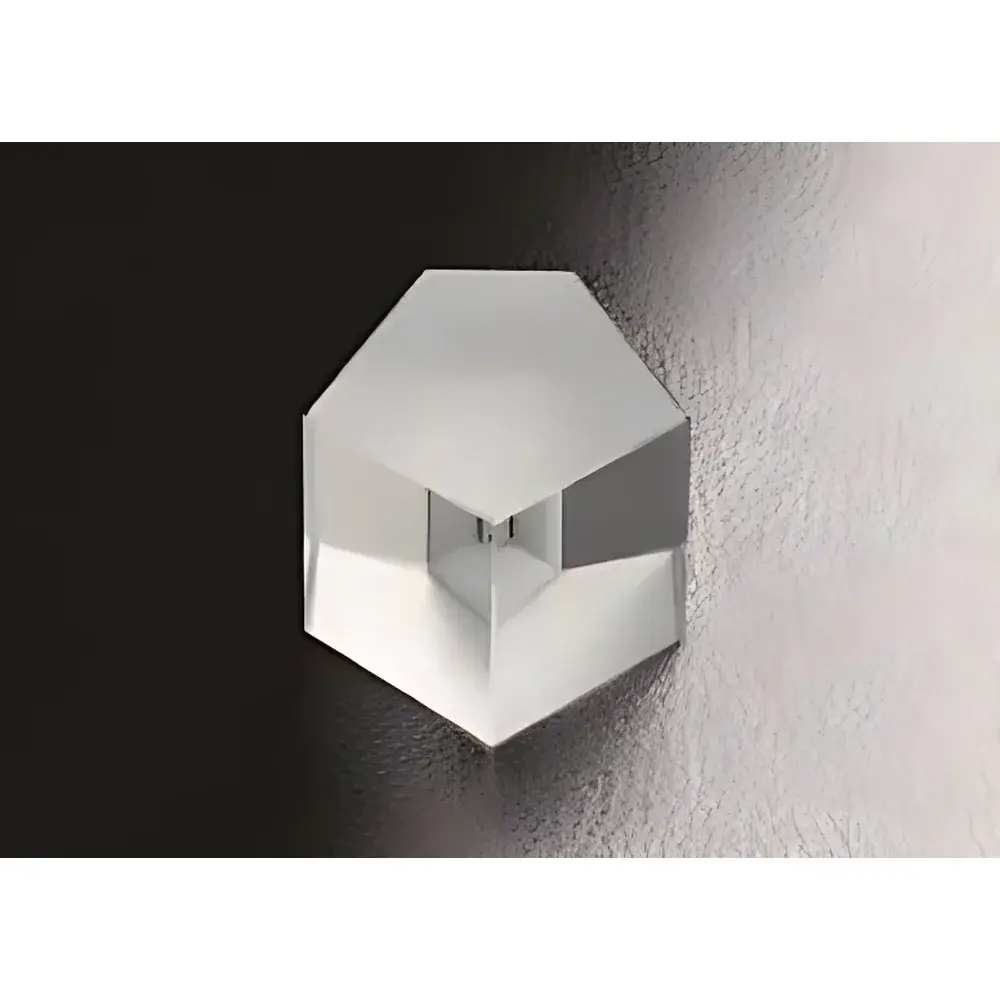
ZOLIX PPB Series Pentaprism
| Brand | ZOLIX |
|---|---|
| Origin | Beijing, China |
| Manufacturer Type | Direct Manufacturer |
| Product Category | Optical Component |
| Model | PPB Series |
| Price Range | USD 70 – 140 (per unit) |
| Compliance | ISO 10110-7 Compliant Surface Quality |
| Coating | Protected Aluminum (Internal Reflection) |
| Transmission Efficiency | ~77% (Two Internal Reflections) |
| Deviation Tolerance | ≤3 arcsec (90° Output Stability vs. Input Angle Variation) |
Overview
The ZOLIX PPB Series Pentaprism is a precision optical component engineered for stable, angle-insensitive 90° beam deviation with image erectness preservation. Unlike roof prisms or mirror-based right-angle reflectors, the pentaprism utilizes two total internal reflections (TIR) within a solid glass body—typically made from BK7 or fused silica—to achieve consistent orthogonal output regardless of minor angular misalignment in the incident beam. This intrinsic insensitivity to input angle variation (±1° typical) makes the PPB series especially suitable for alignment-critical applications such as DSLR viewfinder systems, laser beam steering in industrial marking platforms, and optical path folding in compact spectrometers or interferometric setups. The prism’s five-sided geometry ensures that the output beam remains spatially invariant in orientation—i.e., no image inversion or lateral reversal—while maintaining high wavefront fidelity per ISO 10110-7 specifications. Its monolithic construction eliminates air-gap interfaces, minimizing ghosting, polarization-dependent loss, and mechanical drift under thermal or vibrational stress.
Key Features
- Stable 90° beam deviation independent of ±0.5° incident angle variation—enabling robust optical alignment in dynamic or thermally fluctuating environments.
- Protected aluminum coating on internal reflecting surfaces optimized for broad spectral range (400–1100 nm), delivering consistent reflectance of ~88% per surface (theoretical); measured system transmission efficiency is ~77% after two reflections due to absorption and scattering losses.
- Surface quality rated at 20–10 scratch-dig per MIL-PRF-13830B; λ/8 surface flatness (peak-to-valley) over clear aperture, verified via phase-shifting interferometry.
- Beveled edges and black anodized aluminum housing (optional) suppress stray light; black paint finish on external non-optical faces meets RoHS-compliant solvent resistance standards—note: avoid acetone or strong ketones during cleaning to prevent coating delamination.
- Available in standard clear apertures from Ø12 mm to Ø50 mm; custom sizes and substrate materials (e.g., UV-grade fused silica for 193–400 nm operation) supported upon request.
Sample Compatibility & Compliance
The PPB Series is compatible with collimated or low-divergence beams (full divergence < 5 mrad) and integrates seamlessly into both free-space and fiber-coupled optical trains. It complies with ISO 10110-7 for surface imperfections and ISO 10110-3 for transmitted wavefront distortion. All units undergo 100% inspection for angular deviation accuracy (≤3 arcsec tolerance on 90° output), coating adhesion (per ASTM D3359), and environmental stability (operating temperature: −20 °C to +70 °C; humidity: ≤85% RH non-condensing). No regulatory certification (e.g., FDA, CE) is required for passive optical components; however, documentation supports traceability for ISO 9001:2015–certified manufacturing workflows.
Software & Data Management
As a passive optical element, the PPB Series requires no firmware, drivers, or software integration. However, ZOLIX provides downloadable optical prescription data (Zemax .zmx and Code V .seq files) and mechanical drawings (STEP/IGES) for system-level modeling. Calibration reports—including interferometric wavefront maps and spectral reflectance curves—are archived digitally and supplied with each shipment for GLP-compliant lab documentation.
Applications
- Single-lens reflex (SLR) and mirrorless camera viewfinder illumination paths requiring image-erect beam folding.
- Laser material processing systems—e.g., galvo-scanned CO₂ or fiber laser marking heads—where stable 90° redirection minimizes positional error across scan fields.
- Alignment reference optics in coordinate measuring machines (CMMs) and automated optical inspection (AOI) platforms.
- Beam combiners and retro-reflection stabilizers in Michelson or Mach–Zehnder interferometers.
- Educational optics kits for demonstrating ray tracing, reflection symmetry, and paraxial approximation limitations.
FAQ
What is the typical transmission efficiency of the PPB Series?
Measured average transmission is approximately 77% for visible-NIR wavelengths (550–850 nm), accounting for two internal aluminum reflections (~88% each), bulk absorption, and surface scattering.
Can the PPB Series be used with ultraviolet (UV) lasers?
Standard BK7 versions are not recommended below 350 nm; UV-grade fused silica variants are available with enhanced transmission down to 193 nm and improved LIDT (laser-induced damage threshold) up to 500 MW/cm² (10 ns, 1064 nm).
Is anti-reflective (AR) coating available on entrance/exit faces?
Yes—custom AR coatings (R<0.25% @ 532 nm or broadband 400–700 nm) can be applied upon request; this increases overall throughput by ~3–4% but does not affect internal reflection performance.
How is angular deviation accuracy verified?
Each unit is tested using a high-precision autocollimator (resolution: 0.1 arcsec) referenced to a stabilized HeNe laser, per ISO 10110-5 metrology protocol.
Does the prism introduce polarization-dependent effects?
Minimal—protected aluminum exhibits <0.5% s/p reflectance differential across 45°–55° incidence angles; for polarization-sensitive applications, retardation-compensated designs are available.




