
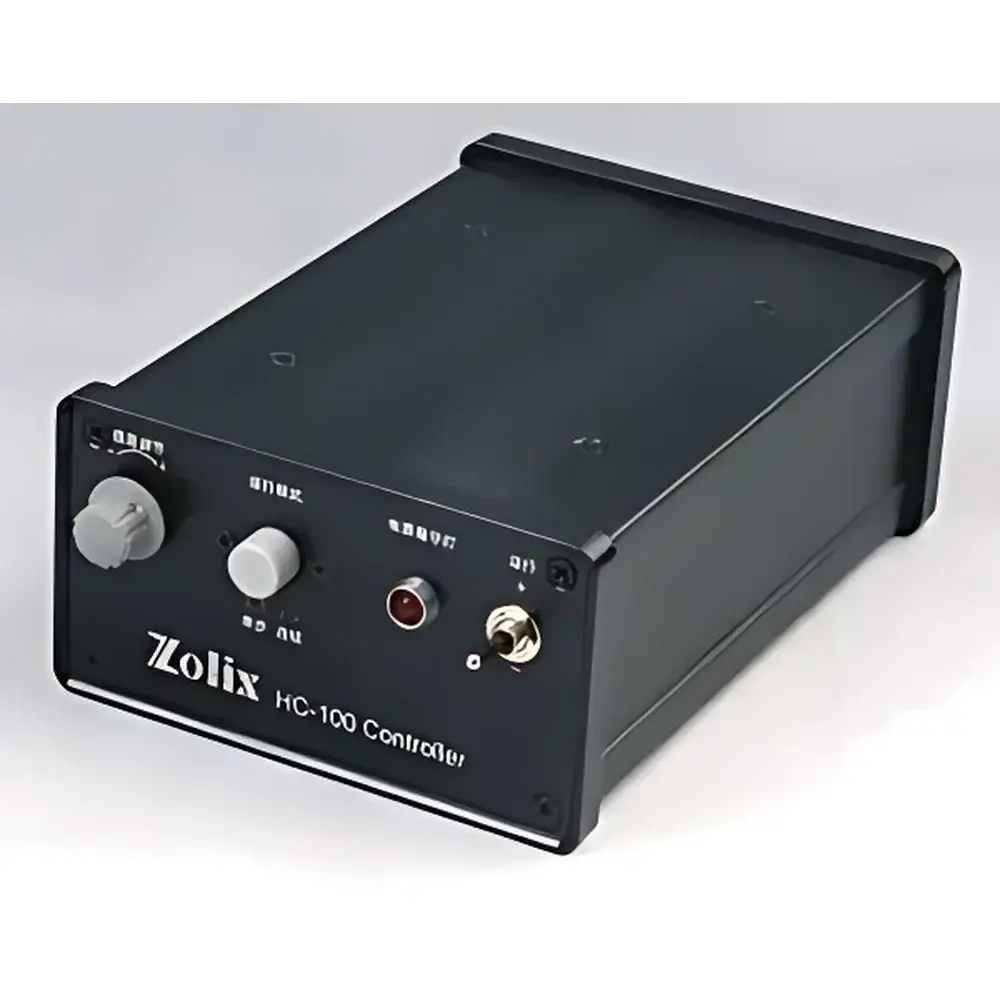
ZOLIX HC-100 Series Handheld Single-Axis Stepper Motor Controller
| Brand | ZOLIX |
|---|---|
| Model | HC-100 Series |
| Axis Count | 1 |
| Motor Type Support | Bipolar 2-phase (HC-100) / 3-phase (HC3P-100) |
| Max Output Pulse Frequency | 5 kHz |
| Power Input | AC 220 V → DC 24 V via external adapter |
| Operating Modes | Continuous motion & single-step mode |
| Drive Current Range | 0.5–3.5 A (HC-100) / 0.5–5.8 A (HC3P-100) |
| Microstepping Resolution | up to 128× (HC-100) / up to 51200 pulses per revolution (HC3P-100) |
| Physical Interface | Front-panel rotary knob, direction toggle switch, mode selector |
| Power Supply | External DC 24 V adapter (included) |
| Dimensions | Compact handheld form factor (approx. 120 × 80 × 45 mm) |
| Standalone Operation | Yes — no PC connection required or supported |
Overview
The ZOLIX HC-100 Series Handheld Single-Axis Stepper Motor Controller is a compact, self-contained motion control solution engineered for precise manual positioning of translation stages in optical laboratory environments. Designed specifically for integration with ZOLIX SC300-series motorized translation stages and compatible third-party linear or rotational stages, the HC-100 implements open-loop step-and-direction control using industry-standard bipolar 2-phase stepper motors (HC-100 model) or specialized 3-phase stepper motors (HC3P-100 variant). Its core architecture centers on an integrated driver IC with configurable current regulation and microstepping logic — identical in design to the driver modules used in ZOLIX’s SC300 stage controllers — ensuring consistent torque delivery and positional repeatability across the product ecosystem. Unlike PC-dependent motion controllers, the HC-100 operates entirely offline: all motion parameters are adjusted locally via front-panel controls and side-mounted DIP switches, making it ideal for rapid coarse alignment, setup verification, and teaching lab applications where simplicity, portability, and electrical isolation are prioritized over automated sequencing.
Key Features
- True standalone operation — no USB, RS-232, or Ethernet interface; eliminates software dependency and driver installation overhead
- Front-panel rotary speed control with tactile feedback and dual-direction toggle switch for intuitive forward/reverse jogging
- Dual motion modes: continuous jog (for rapid gross positioning) and discrete single-step (for sub-micron incremental adjustments)
- Side-mounted DIP switch bank enabling hardware-level configuration of motor current (in 0.1 A increments) and microstepping resolution (e.g., full-step, 2×, 4×, …, up to 128× for HC-100; up to 51200 pulses/rev for HC3P-100)
- DC 24 V input via included AC 220 V–to–DC 24 V switching adapter; low-noise power regulation minimizes electromagnetic interference near sensitive optical paths
- Rugged ABS enclosure with ergonomic grip and IP20-rated internal layout — optimized for benchtop and portable use in vibration-controlled optics labs
Sample Compatibility & Compliance
The HC-100 controller is mechanically and electrically compatible with ZOLIX SC300-series linear translation stages (e.g., SC300-XYZ, SC300-L), as well as any NEMA 17 or NEMA 23 stepper motor–driven stage meeting standard 2-phase (HC-100) or 3-phase (HC3P-100) wiring conventions. It complies with IEC 61000-6-3 (emission limits for industrial environments) and IEC 61000-6-2 (immunity to electrostatic discharge and fast transients). While not certified for medical or aerospace-grade applications, its design adheres to GLP-aligned documentation practices: all DIP switch configurations are logged in user manuals with traceable settings tables, supporting audit-ready lab notebooks. No firmware updates or cloud connectivity are implemented — ensuring deterministic behavior under ISO/IEC 17025-compliant calibration workflows.
Software & Data Management
The HC-100 does not incorporate embedded firmware with programmable memory or data logging capability. As a hardwired analog/digital hybrid controller, it generates no machine-readable output stream, nor does it support timestamped motion event capture. This absence of digital telemetry is intentional: it eliminates variables associated with USB latency, OS-level interrupt handling, or driver version mismatches — critical considerations in time-sensitive optical alignment tasks such as laser cavity optimization or interferometric path balancing. All operational states (mode, direction, speed range) are reflected solely through LED indicators on the front panel. Configuration persistence relies exclusively on physical DIP switch positions, enabling immediate reproducibility without software restoration steps.
Applications
- Coarse alignment of optical components (lenses, mirrors, fiber couplers) on breadboards prior to fine-tuning with piezoelectric or closed-loop stages
- Teaching laboratories requiring safe, low-voltage, plug-and-play motion control for undergraduate optics and photonics courses
- Field-deployable adjustment of spectroscopic sample holders or filter wheels where laptop-free operation is mandated
- Backup controller for redundancy during maintenance of networked motion systems in cleanroom environments
- Integration into custom optomechanical assemblies where space-constrained, low-EMI actuation is required without host PC overhead
FAQ
Can the HC-100 be connected to a computer for automated control?
No — the HC-100 has no digital communication interface. It is strictly a manual, stand-alone device.
Is the output current adjustable while the motor is running?
Current must be set via DIP switches before power-on; live adjustment is not supported.
What is the maximum compatible motor inductance?
Designed for motors with phase inductance ≤ 10 mH at rated voltage; consult datasheet Table 4 for L/R time constant validation.
Does it support homing or limit-switch inputs?
No — it lacks dedicated I/O terminals for sensors or end-stop detection.
Can it drive a servo motor?
No — it is engineered exclusively for open-loop stepper motor operation and lacks encoder feedback circuitry or PWM-based servo commutation logic.




