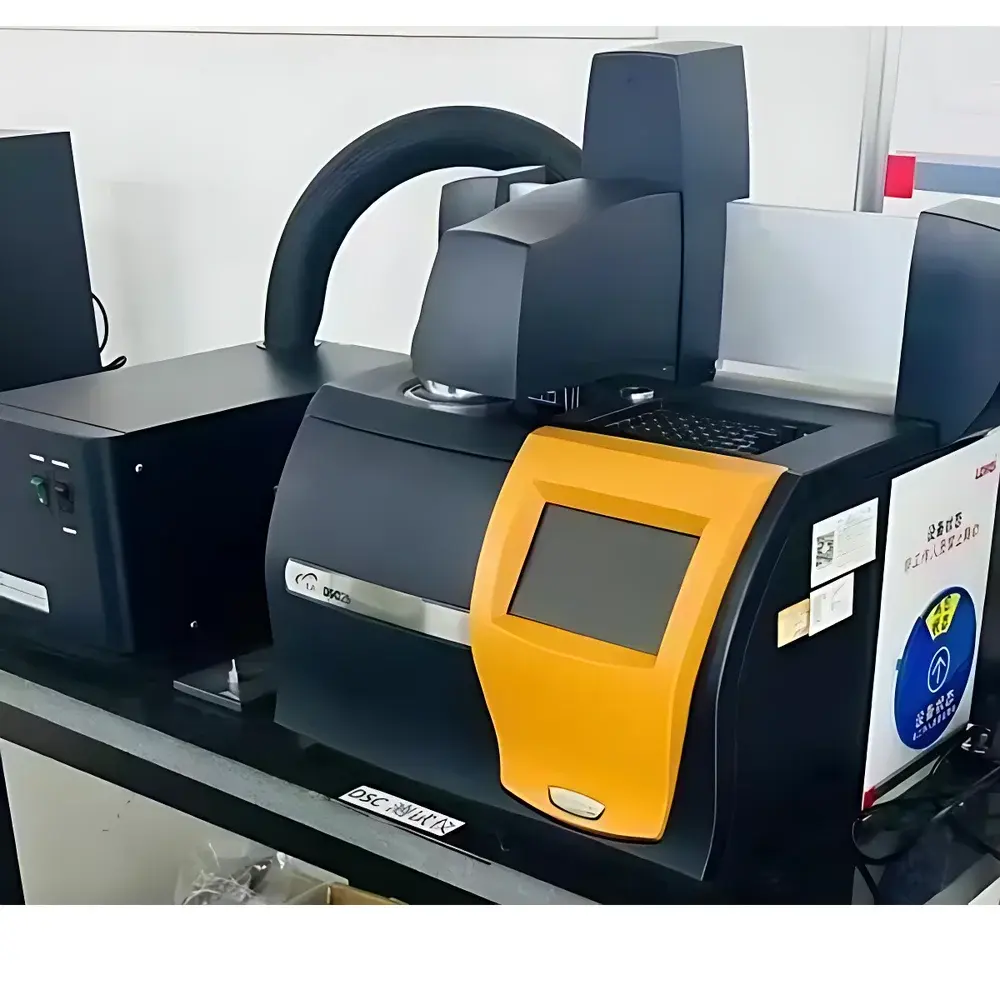
TA Instruments DSC-25 Used Differential Scanning Calorimeter
| Brand | TA Instruments |
|---|---|
| Origin | USA |
| Model | DSC-25 |
| Temperature Range | –180 °C to 725 °C |
| Baseline Flatness (–50 °C to 300 °C) | ≤100 µW |
| Baseline Repeatability (–50 °C to 300 °C) | <40 µW |
| Temperature Accuracy | ±0.1 °C |
| Temperature Precision | ±0.01 °C |
| Enthalpy Accuracy | ±0.1% |
| Operational Age | 2 years |
| Condition | Fully Functional |
Overview
The TA Instruments DSC-25 is a high-performance, power-compensated differential scanning calorimeter engineered for precise thermal analysis of solid and semi-crystalline materials. Operating on the principle of heat-flux compensation, the instrument maintains dynamic thermal equilibrium between sample and reference pans by continuously adjusting resistive heating power—enabling direct measurement of energy differentials associated with endothermic or exothermic transitions. This architecture delivers superior baseline stability and signal-to-noise ratio compared to traditional heat-flux DSC systems. Designed and manufactured in the United States, the DSC-25 supports a broad operational temperature range from –180 °C to 725 °C, making it suitable for characterizing low-Tg polymers, high-melting thermoplastics, metallic alloys, pharmaceutical intermediates, and inorganic phase-change materials. Its calibrated thermal response meets the foundational requirements of ASTM E794, ISO 11357, and USP <1163> for thermal transition analysis under regulated laboratory environments.
Key Features
- Power-compensation design ensures real-time thermal equilibrium between sample and reference, minimizing time-lag artifacts during rapid heating/cooling scans.
- High-stability furnace with dual-zone temperature control enables precise ramp rates from 0.1 °C/min to 100 °C/min and isothermal hold accuracy within ±0.01 °C.
- Baseline flatness ≤100 µW over –50 °C to 300 °C and repeatability <40 µW support detection of subtle thermal events—including cold crystallization, secondary relaxations, and weak oxidative onset.
- Temperature accuracy of ±0.1 °C and enthalpy accuracy of ±0.1% are traceable to NIST-certified standards, facilitating compliance with GLP and internal QA/QC protocols.
- Robust mechanical architecture includes quartz sensor assembly, hermetically sealed furnace chamber, and inert gas purging capability (N2, He, Ar) for oxidation-sensitive measurements.
- Fully refurbished unit with documented service history, verified calibration records, and functional validation across full temperature range.
Sample Compatibility & Compliance
The DSC-25 accommodates standard aluminum, gold-plated aluminum, and high-pressure stainless-steel crucibles (up to 70 bar), enabling analysis of volatile, reactive, or moisture-sensitive samples. It supports quantitative determination of glass transition temperature (Tg), melting point (Tm), crystallization onset (Tc), heat capacity (Cp), reaction enthalpy (ΔH), and purity estimation via van’t Hoff analysis. The system complies with key regulatory frameworks including ASTM E1356 (standard test method for assignment of glass transition temperatures), ISO 11357-1 through -7 (plastics — differential scanning calorimetry), and ICH Q5C (stability testing of biotechnological products). When operated with audit-trail-enabled software (e.g., TRIOS v5.x), it supports 21 CFR Part 11-compliant data integrity requirements for pharmaceutical and medical device development labs.
Software & Data Management
The instrument operates with TA Instruments’ TRIOS software platform (v5.2 or later), providing comprehensive data acquisition, peak deconvolution, kinetic modeling (e.g., Ozawa-Flynn-Wall, Kissinger), and multi-cycle comparison tools. All raw data files (.qdat) are stored in vendor-neutral binary format with embedded metadata (operator ID, timestamp, purge gas flow rate, calibration certificate ID). Software features include automated baseline correction, modulated DSC (MDSC®) compatibility (with optional hardware upgrade), and export to CSV, Excel, and ASTM E1445-compliant XML formats. Electronic records retain full audit trail functionality—including user login logs, parameter change history, and report generation timestamps—meeting ALCOA+ principles for data reliability and traceability.
Applications
- Thermal characterization of polymeric materials: Tg, Tm, degree of crystallinity, cold crystallization behavior, and thermal degradation onset.
- Pharmaceutical solid-state analysis: polymorph screening, hydrate/anhydrate transition, excipient compatibility, and stability-indicating assay development.
- Metallurgical phase mapping: eutectic temperature identification, solidus/liquidus determination, and latent heat quantification in solder alloys and shape-memory alloys.
- Food science applications: fat crystallization kinetics, starch gelatinization enthalpy, and protein denaturation profiling.
- Quality control in battery material R&D: SEI layer formation enthalpy, cathode decomposition pathways, and electrolyte thermal runaway thresholds.
FAQ
Is this DSC-25 unit factory-refurbished or dealer-refurbished?
This unit has undergone comprehensive technical refurbishment by an authorized TA Instruments service partner, including furnace recalibration, sensor verification, leak testing, and full functional validation per TA’s Service Manual SM-DSC-25 Rev. 4.
Does the system include original software licenses and documentation?
Yes—the unit ships with a fully licensed copy of TRIOS v5.4 software, electronic operation manual, calibration certificates (temperature and enthalpy), and service history log.
Can the DSC-25 be upgraded to support Modulated DSC (MDSC®)?
Yes—MDSC® capability is available as a hardware retrofit (requires installation of oscillatory drive module and updated firmware); compatibility is confirmed for all DSC-25 units manufactured after 2008.
What maintenance documentation is provided with purchase?
Buyers receive a completed Preventive Maintenance Report (PMR) dated within 30 days of shipment, detailing furnace performance, thermocouple linearity, cooling rate verification, and gas flow calibration.
Is remote technical support available post-purchase?
Yes—TA Instruments Global Support provides 12 months of complimentary remote diagnostics and application consultation for validated purchasers, subject to regional service agreement terms.