
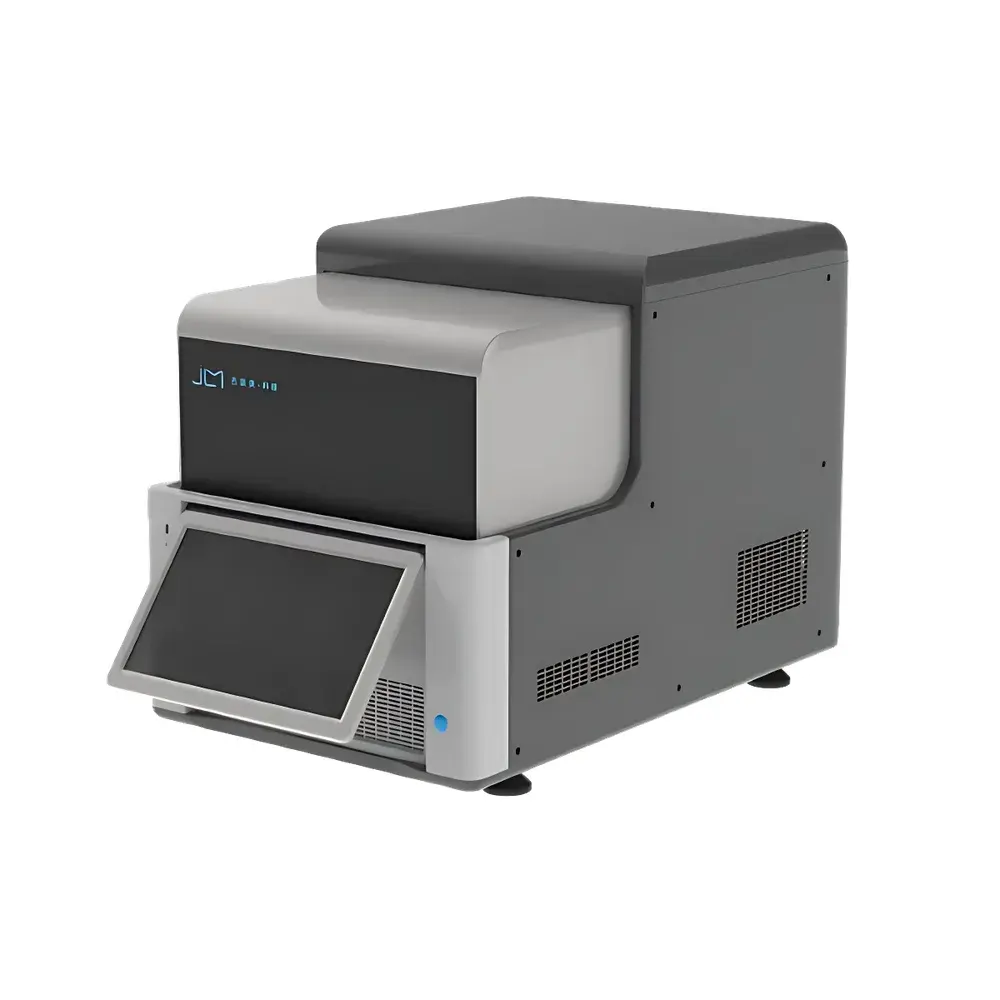
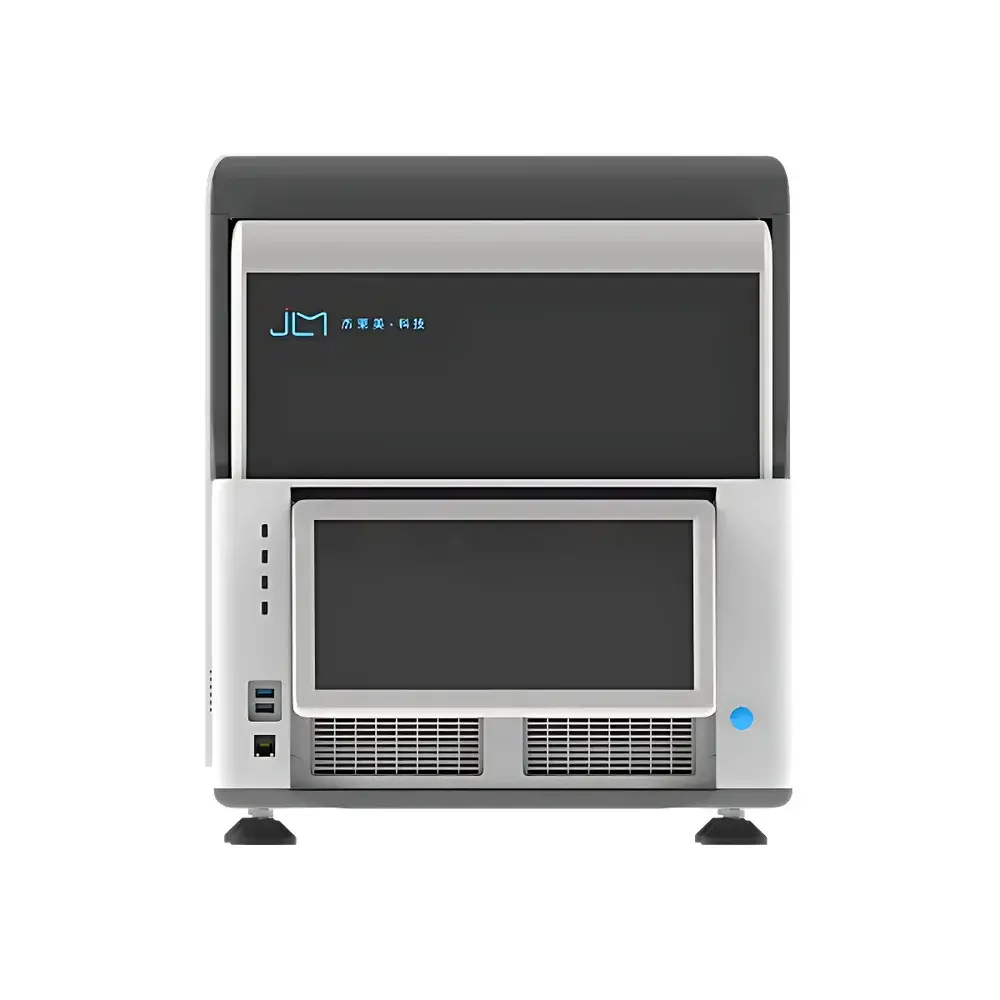
Genemeter DiOne Fully Automated Integrated Digital PCR System
| Brand | Genemeter |
|---|---|
| Model | DiOne |
| Instrument Type | Digital PCR System |
| Sample Throughput | 4–32 samples per run (integrated droplet generation, thermal cycling, and fluorescence readout) |
| Heating Rate | ≥8 °C/s |
| Temperature Accuracy | ±0.1 °C |
| Origin | Sichuan, China |
| Manufacturer Status | Original Equipment Manufacturer (OEM) |
| Regional Classification | Domestic (PRC-manufactured) |
Overview
The Genemeter DiOne Fully Automated Integrated Digital PCR System is an engineered platform for absolute nucleic acid quantification based on partitioned endpoint amplification and Poisson statistical modeling. Unlike quantitative PCR (qPCR), which relies on relative quantification via standard curves and Ct values, digital PCR (dPCR) partitions a single reaction into tens of thousands of nanoliter-scale compartments—here implemented via proprietary microfluidic droplet generation—enabling binary (positive/negative) detection of target molecules after thermal cycling. This binary readout, combined with statistical deconvolution, delivers absolute copy number concentration (copies/µL) with high precision, low inter-run variability, and exceptional resistance to PCR inhibitors commonly found in clinical or environmental matrices.
Key Features
- Fully Integrated Workflow: Combines droplet generation, thermal cycling, and fluorescence imaging in a single instrument—eliminating manual transfer steps, reducing hands-on time, and minimizing cross-contamination risk.
- High-Speed Thermal Control: Achieves heating rates ≥8 °C/s and maintains temperature accuracy within ±0.1 °C across the full operating range (typically 4–99 °C), ensuring stringent control over denaturation, annealing, and extension phases critical for multiplexed assays.
- Scalable Sample Processing: Supports batch processing of 4 to 32 samples simultaneously, with standardized microfluidic cartridge loading and automated calibration routines to ensure reproducibility across throughput levels.
- Multi-Channel Fluorescence Detection: Equipped with optical modules supporting ≥4 independent excitation/emission channels, enabling robust multiplex dPCR assays—including CNV analysis, co-detection of SNVs and indels, and dual-probe validation strategies.
- Closed-System Microfluidics: Utilizes sealed, single-use droplet cartridges with integrated oil-phase separation and chamber sealing—preventing aerosol contamination and eliminating post-amplification tube handling.
- Open Platform Architecture: Compatible with third-party master mixes, probes, and primers conforming to standard TaqMan or LNA-based chemistries; supports custom assay development without vendor lock-in.
Sample Compatibility & Compliance
The DiOne system demonstrates broad compatibility with diverse sample types—including plasma-derived cell-free DNA (cfDNA), FFPE tissue extracts, bacterial lysates, viral RNA (post-reverse transcription), and environmental water concentrates. Its partitioning strategy significantly mitigates inhibition from heparin, hemoglobin, humic acids, and other common interferents, making it suitable for direct analysis of minimally purified inputs. From a regulatory standpoint, the system’s firmware architecture supports audit trail logging, user access controls, and electronic signature capability—aligning with principles outlined in FDA 21 CFR Part 11 for electronic records and signatures. While not pre-certified as GMP-compliant, its design facilitates integration into GLP- or ISO/IEC 17025-aligned laboratory workflows where traceability, repeatability, and instrument qualification are required.
Software & Data Management
The DiOne Control & Analysis Suite provides a unified interface for experimental setup, real-time monitoring, and post-run data interpretation. Raw fluorescence images are processed using adaptive thresholding and spatial clustering algorithms to classify droplets and compute copy number concentrations via maximum likelihood estimation under Poisson assumptions. Export formats include CSV, FCS (Flow Cytometry Standard), and MIAME-compliant metadata templates. Data integrity is reinforced through version-controlled method files, encrypted project archives, and optional network-based backup to secure NAS or LIMS endpoints. The software adheres to FAIR data principles (Findable, Accessible, Interoperable, Reusable) and supports batch re-analysis across updated algorithms without raw data reacquisition.
Applications
- Liquid Biopsy & Minimal Residual Disease (MRD) Monitoring: Detection of sub-1% allele frequency variants in plasma cfDNA with single-molecule sensitivity.
- CNV and Gene Fusion Quantification: Precise ratio determination between reference and target loci without reliance on diploid assumptions.
- NGS Library Quantification: Accurate measurement of adapter-ligated DNA fragments prior to sequencing—critical for cluster density optimization on Illumina platforms.
- Pathogen Load Assessment: Absolute quantification of viral/bacterial genomes in clinical specimens (e.g., HIV, HBV, SARS-CoV-2) and food/water safety testing.
- Low-Biomass Environmental Testing: Enumeration of microbial markers in soil, air, or wastewater where background noise and inhibitor load challenge conventional qPCR.
- Reference Material Characterization: Certified reference material (CRM) development and validation per ISO Guide 34 and ISO/IEC 17025 requirements.
FAQ
What sample preparation is required before loading onto the DiOne system?
Minimal preprocessing is needed: DNA must be fragmented to ≤500 bp (if required by assay design), quantified via fluorometry, and diluted into a compatible master mix. No purification beyond standard column- or bead-based cleanup is mandated.
Can the DiOne perform reverse transcription digital PCR (RT-dPCR)?
Yes—when paired with validated RT enzymes and appropriate thermal cycling profiles, the system supports one-step or two-step RT-dPCR for RNA targets.
Is the droplet cartridge reusable?
No. Cartridges are single-use, sterilized, and pre-packaged to ensure consistency and prevent carryover contamination.
How does the DiOne handle data export for regulatory submission?
It generates timestamped, digitally signed PDF reports and structured CSV exports containing raw droplet counts, confidence intervals, and QC metrics—fully traceable to instrument logs and user actions.
Does the system support custom assay development?
Yes. Open API access (via RESTful endpoints) enables integration with in-house bioinformatics pipelines and LIMS automation frameworks.





