
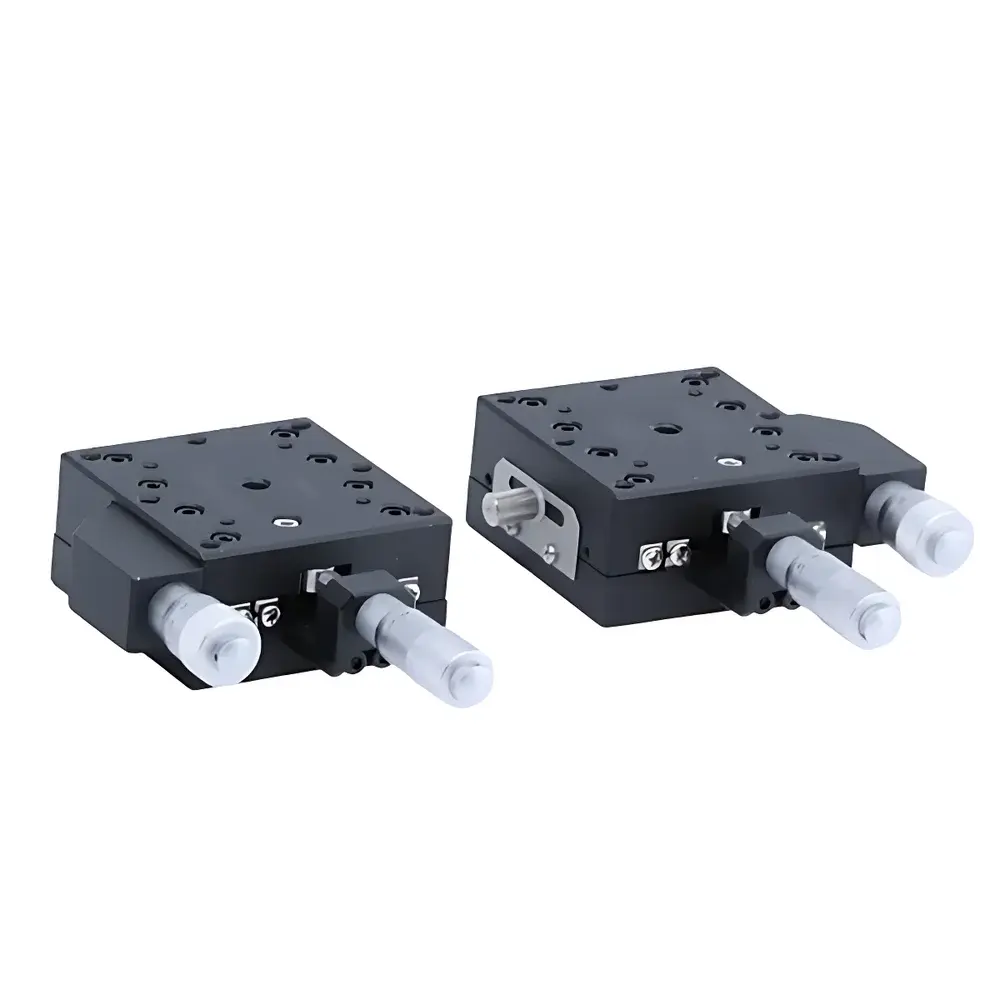
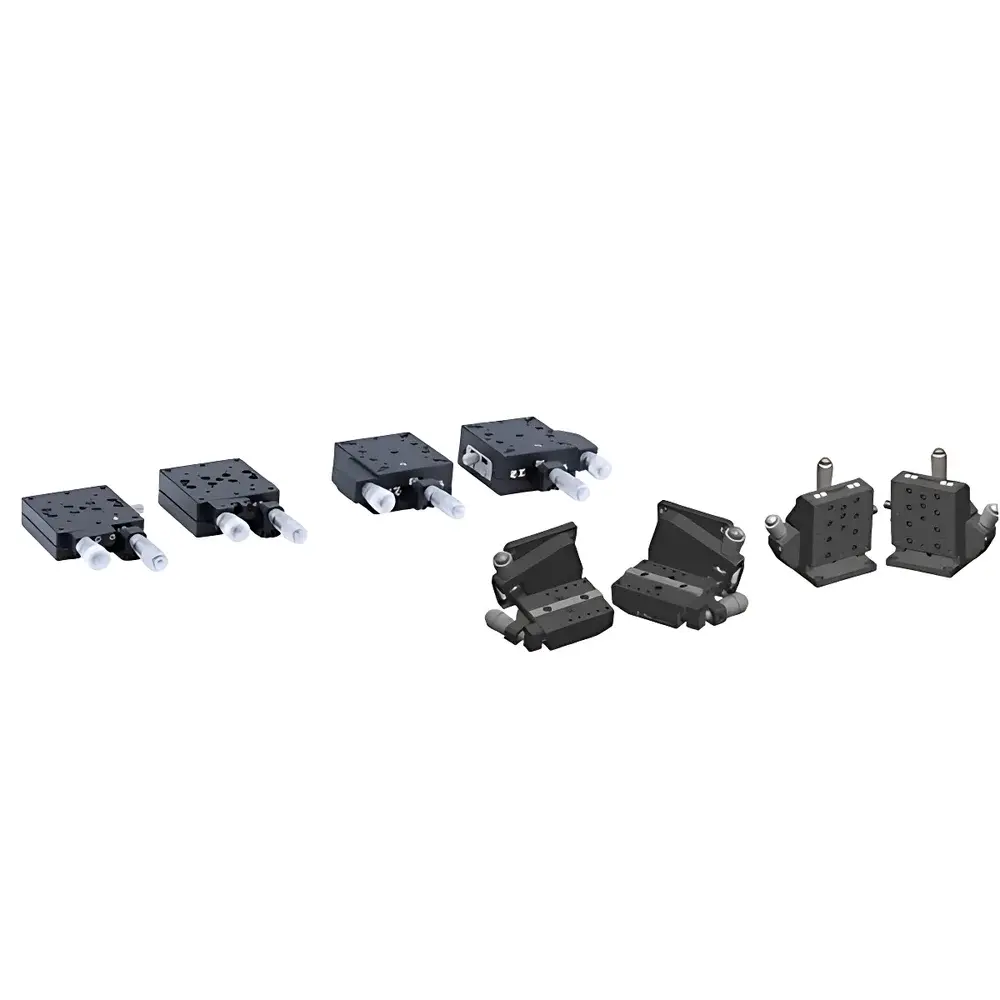
ZOLIX uFP Series High-Sensitivity Manual Translation Stage
| Brand | ZOLIX |
|---|---|
| Origin | Beijing, China |
| Manufacturer Type | Direct Manufacturer |
| Product Category | Domestic |
| Model | uFP Series |
| Price Range | USD 270 – 555 (FOB) |
| Product Type | Manual Translation Stage |
| Travel Mechanism | Coarse + Fine Adjustment |
| Coarse Travel | ±6.5 mm |
| Fine Travel | ±0.3 mm |
| Angular Adjustment (θx/θy) | ±3° |
| Resolution (Coarse) | ≤10 µm/div |
| Resolution (Fine) | ≤0.5 µm/div |
| Angular Resolution (θx) | ≤29.4 arcsec/div |
| Angular Resolution (θy) | ≤27.7 arcsec/div |
| Guide Mechanism | Linear Ball Slides / Crossed Roller Bearings / Arc Guides |
| Drive Mechanism | Micrometer Knob |
| Base Material | Anodized Aluminum Alloy (Black) |
| Table Dimensions | 60×60 mm or 60×42 mm |
| Table Thickness | 20–40 mm |
| Mass | 0.28–0.43 kg |
| Load Capacity | 1.5–6 kg |
| Static Parallelism | ≤60 µm |
| Motion Parallelism | ≤10 µm |
| Motion Straightness | ≤4 µm |
| Table Play (Axial) | ≤8 µm |
| Table Play (Lateral) | ≤8 µm |
Overview
The ZOLIX uFP Series High-Sensitivity Manual Translation Stage is a precision-engineered optical positioning platform designed for demanding alignment and fine-adjustment tasks in research-grade optical laboratories, laser beam steering setups, interferometry configurations, and micro-optical assembly workflows. Built upon a dual-stage mechanical architecture—integrating coarse translation with sub-micron fine adjustment—the uFP stage delivers deterministic, repeatable, and drift-resistant motion control without reliance on electronic actuation. Its measurement principle is rooted in mechanical amplification via high-ratio micrometer-driven translation and angular kinematics governed by precision-ground arc or crossed-roller bearing guides. This architecture ensures traceable displacement resolution down to ≤0.5 µm per fine-adjustment division and angular sensitivity below 30 arcseconds, making it suitable for applications requiring passive stability, EMI immunity, and long-term zero-drift performance—critical in ultra-stable interferometric cavities or vacuum-compatible optical benches.
Key Features
- Dual-resolution adjustment system: Independent coarse travel (±6.5 mm) and fine travel (±0.3 mm) enable rapid gross positioning followed by nanoscale refinement.
- High-fidelity angular control: θx and θy tilt adjustments up to ±3° with angular resolution ≤29.4″ and ≤27.7″ respectively—optimized for collimation and wavefront alignment.
- Low-play mechanical design: Axial and lateral table play constrained to ≤8 µm ensures minimal hysteresis and positional uncertainty during repositioning cycles.
- Rigorous motion fidelity: Motion straightness ≤4 µm and motion parallelism ≤10 µm over full travel—validated under ISO 230-2 methodology for linear axes.
- Material and finish integrity: Structural components fabricated from aerospace-grade aluminum alloy, finished with hard black anodization (Type III, ASTM B580) for wear resistance, non-magnetic operation, and compatibility with cleanroom environments.
- Modular mounting interface: Standard M4 and M6 tapped holes conform to ISO 841 coordinate system conventions, enabling seamless integration into multi-axis stacks or custom optical breadboards.
Sample Compatibility & Compliance
The uFP series is compatible with standard optical components including mirrors (up to Ø50 mm), lens mounts, fiber couplers, and photodetector carriers. Its passive, non-powered design eliminates electromagnetic interference—ensuring safe operation near sensitive detectors (e.g., single-photon avalanche diodes) or cryogenic systems. All models comply with RoHS 2011/65/EU directives and meet mechanical safety requirements per ISO 12100 for manually operated laboratory equipment. While not certified to ISO 9001 at the unit level, ZOLIX maintains ISO 9001:2015 certification for its manufacturing quality management system (Certificate No. 00122Q30584R0M). The stages are routinely deployed in GLP-aligned optical characterization labs where mechanical traceability, repeatability logs, and calibration history documentation are maintained per internal SOPs.
Software & Data Management
As a fully manual, non-electronic positioning device, the uFP stage does not incorporate embedded firmware, sensors, or digital interfaces. Consequently, it requires no driver installation, firmware updates, or software licensing. Position data is recorded manually via calibrated micrometer scale reading or integrated into lab notebooks using standardized observation templates. For labs implementing digital lab notebooks (e.g., LabArchives, Benchling), users may log position values alongside experimental metadata—including timestamp, operator ID, environmental conditions (temperature/humidity), and associated optical measurements—to satisfy audit trails required under 21 CFR Part 11 when used in regulated R&D environments. Calibration certificates (available upon request) include as-delivered resolution verification and motion error mapping per ANSI/NCSL Z540-1.
Applications
- Laser cavity alignment and mode matching in Ti:sapphire and diode-pumped solid-state laser systems
- Fiber-to-waveguide coupling optimization in photonic integrated circuit (PIC) testing
- Reference mirror positioning in Michelson and Mach–Zehnder interferometers
- Micro-optical component alignment during prototype assembly of objective lenses or spectral filters
- Stable sample carrier support in confocal Raman and fluorescence lifetime imaging (FLIM) setups
- Vacuum-compatible optical path adjustment in UHV spectroscopy chambers (optional vacuum-rated variants available)
FAQ
Is the uFP stage compatible with vacuum environments?
Standard uFP models are suitable for low-vacuum (<10⁻² mbar) use; vacuum-compatible versions with vented screws and dry-lubricated guides can be configured for UHV (≤10⁻⁹ mbar) applications.
What is the recommended recalibration interval?
No scheduled recalibration is required; however, periodic verification of resolution and play (e.g., annually or after 10,000 actuation cycles) is advised using gauge blocks and autocollimators per ISO 230-2 Annex C.
Can multiple uFP stages be stacked to form XYZ or tip-tilt-z configurations?
Yes—standardized baseplate dimensions and orthogonal mounting patterns allow rigid, low-coupling stacking; ZOLIX provides mechanical drawings and stack tolerance analysis upon request.
Does ZOLIX provide metrology reports for individual units?
Yes—traceable metrology reports (including motion error maps and resolution verification) are available as optional deliverables with NIST-traceable instrumentation calibration records.
Are replacement micrometer knobs or guide rails available as spare parts?
All mechanical subassemblies—including micrometer mechanisms, cross-roller cartridges, and anodized top plates—are stocked and supplied with full dimensional drawings and RoHS-compliant material certifications.



