
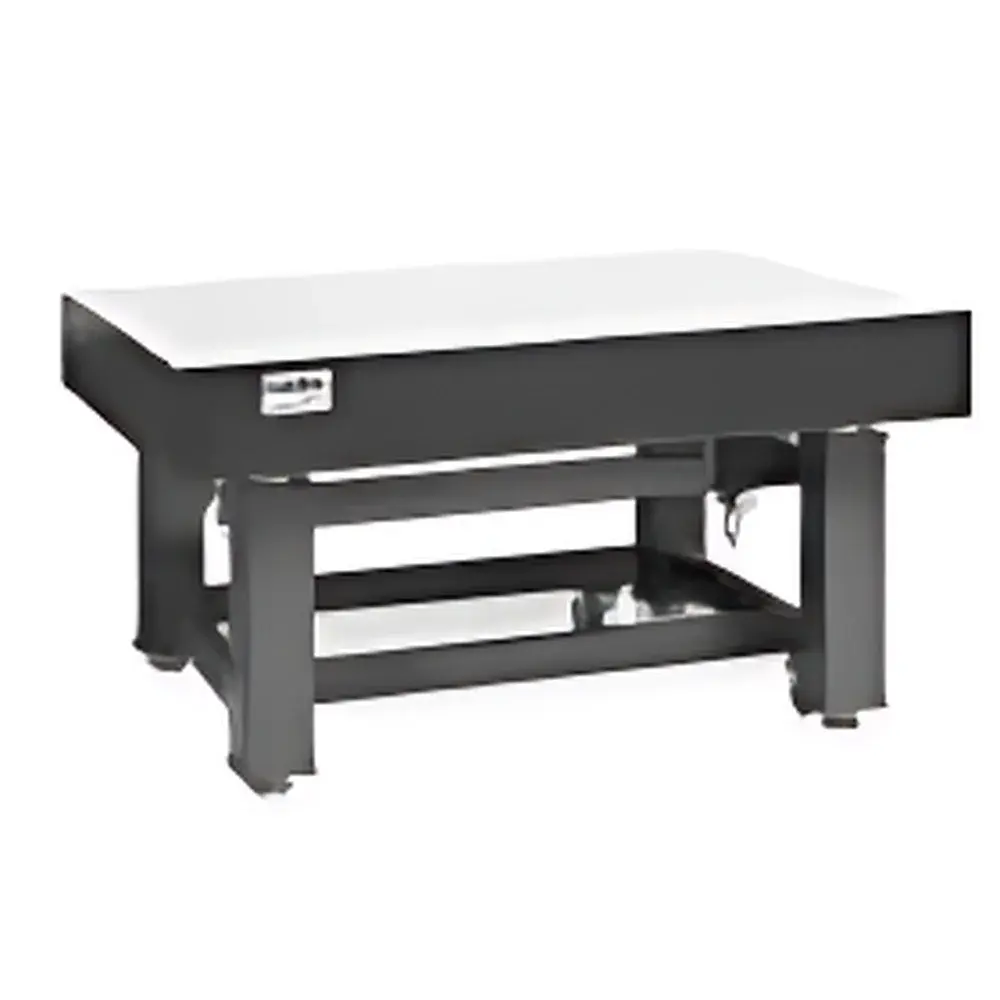
DVIO-I Automatic Leveling Pneumatic Optical Table
| Origin | South Korea |
|---|---|
| Manufacturer Type | Authorized Distributor |
| Origin Category | Imported |
| Model | DVIO-I |
| Pricing | Available Upon Request |
| Natural Frequency | Vertical 1.2–1.5 Hz, Horizontal 1.5–1.7 Hz |
| Operating Pressure | 3–7 kgf/cm² (43–100 psi) |
| Pneumatic System | Dual-chamber air chamber with four or six high-stability elastomeric air springs |
| Leveling Mechanism | Three vacuum-actuated horizontal adjustment valves with sub-second response time |
| Table Structure | Triple-layer honeycomb core sandwich construction |
| Top Surface | 4.0 mm thick ASTM A240 430-series ferromagnetic stainless steel (low thermal expansion, μm/°C coefficient < 10.5) |
| Core | Steel hexagonal honeycomb with 0.25 mm wall thickness, 3.2 cm² cell area |
| Base Plate | 4.0 mm carbon steel with black oxide finish |
| Perimeter Walls | 2.0 mm carbon steel clad with high-damping polyethylene |
| Flatness | ±0.1 mm over 600 mm × 600 mm |
| Mounting Pattern | M6 threaded holes on 25 mm × 25 mm grid (edge offset: 37.5 mm), each with cylindrical isolation cup seal |
| Thickness Options | 50 / 100 / 200 / 300 mm |
| Optional Configurations | Imperial hole pattern (¼"-20), custom dimensions up to 3600 mm × 1500 mm |
Overview
The DVIO-I Automatic Leveling Pneumatic Optical Table is an engineered vibration isolation platform designed for high-sensitivity optical and precision metrology applications where sub-micron stability and long-term mechanical repeatability are critical. Built upon the principles of passive pneumatic isolation, the system employs a dual-chamber air spring architecture coupled with real-time three-axis leveling feedback to maintain consistent load distribution and dynamic equilibrium across variable environmental conditions. Unlike manually adjusted platforms, the DVIO-I integrates pressure-regulated air supply logic and vacuum-assisted tilt compensation—enabling autonomous correction of static deflection and thermal drift without operator intervention. Its fundamental design targets resonant frequency suppression below 1.7 Hz in both vertical and horizontal axes, meeting the baseline isolation requirements for interferometric alignment, laser cavity stabilization, quantum optics experiments, and nanoscale surface profiling.
Key Features
- Triple-layer sandwich construction: 4.0 mm 430-series ferromagnetic stainless steel top plate bonded to a precision-welded steel honeycomb core (0.25 mm wall thickness, 3.2 cm² hexagonal cells), capped by a 4.0 mm oxidized carbon steel base—delivering exceptional stiffness-to-mass ratio and broadband damping.
- Integrated automatic leveling system: Three independently actuated vacuum control valves respond within <1 second to angular perturbations, enabling continuous self-correction of platform tilt under asymmetric loading or floor settlement.
- M6 mounting grid with sealed isolation cups: Uniform 25 mm × 25 mm pitch, with each threaded insert housed in a removable cylindrical cup that prevents particulate ingress into the honeycomb core—critical for cleanroom-compliant maintenance and ISO Class 5–7 environments.
- Dual-chamber pneumatic support: Four or six high-cycle elastomeric air springs arranged in a symmetrical load-bearing configuration, each isolated within a hermetically sealed secondary chamber to minimize cross-talk and improve low-frequency transmissibility.
- Modular height-adjustable legs: Integral cast-aluminum support columns with integrated swivel casters and fine-threaded vertical adjustment screws (±15 mm range per leg), allowing precise gross leveling prior to pneumatic activation.
- Perimeter damping enhancement: 2.0 mm steel side walls fully encapsulated with viscoelastic polyethylene—reducing edge-mode excitation and improving attenuation above 10 Hz.
Sample Compatibility & Compliance
The DVIO-I platform accommodates standard optical components including translation stages, kinematic mounts, lens holders, beam splitters, and detector assemblies—provided total distributed load remains within the specified pressure envelope (3–7 kgf/cm²). It complies with ISO 10816-1 (mechanical vibration evaluation), ASTM E1776 (laboratory vibration criteria for optical systems), and supports GLP/GMP-aligned installation protocols when paired with validated compressed air sources meeting ISO 8573-1 Class 2 particulate/oil/water specifications. The non-magnetic top surface enables compatibility with magnetic shielding enclosures and electron beam instrumentation. Surface flatness (±0.1 mm over 600 mm × 600 mm) satisfies alignment tolerances for Michelson interferometers, optical coherence tomography (OCT) systems, and scanning probe microscopy (SPM) integration.
Software & Data Management
While the DVIO-I operates as a standalone passive-isolation system, its pneumatic interface is compatible with third-party pressure monitoring modules (e.g., SMC ITV series or Parker AC10) that support analog 4–20 mA or digital RS-485 output. Integration with LabVIEW, MATLAB, or Python-based DAQ environments enables logging of chamber pressure differentials, leveling valve actuation cycles, and ambient temperature correlation—supporting FDA 21 CFR Part 11-compliant audit trails when deployed in regulated QC laboratories. No proprietary firmware or cloud dependency is required; all calibration and operational parameters remain user-accessible via mechanical adjustment and analog sensor inputs.
Applications
- Laser interferometry and gravitational wave detector prototype staging
- Ultrafast spectroscopy setups requiring femtosecond pulse synchronization
- Atomic force microscopy (AFM) and scanning tunneling microscopy (STM) base platforms
- Photolithography mask alignment stations in semiconductor R&D labs
- Optical coherence tomography (OCT) and adaptive optics test benches
- Quantum computing hardware integration involving trapped-ion or superconducting qubit arrays
- Calibration of coordinate measuring machines (CMMs) and laser trackers under ISO 10360 standards
FAQ
Is an external air compressor required?
Yes. The DVIO-I requires a clean, oil-free compressed air source delivering 3–7 kgf/cm² (43–100 psi) with filtration to ISO 8573-1 Class 2. Compressor selection must account for duty cycle and peak flow demand across all air springs.
Can the platform be installed in a cleanroom environment?
Yes. The sealed isolation cup design, non-outgassing elastomeric air springs, and oxidized carbon steel base meet ISO 14644-1 Class 5 particulate limits when installed with appropriate air filtration and periodic cup cleaning.
What is the maximum allowable payload for a 1500 mm × 1500 mm × 200 mm DVIO-I table?
Payload capacity is pressure-dependent and geometry-specific. For standard configurations, maximum uniform load is 800 kg at 5 kgf/cm² operating pressure. Point-load limits should be verified using local deflection modeling per ASTM E1776 Annex B.
Are imperial-threaded mounting options available?
Yes. Optional ¼”-20 UNC threaded inserts are available upon request, with identical 25 mm (≈0.984″) grid spacing maintained for backward compatibility with legacy optical hardware.
Does the system support remote monitoring or IoT integration?
The platform itself has no embedded electronics. However, analog pressure sensors and vacuum valve position feedback signals can be routed to external PLCs or SCADA systems via standard industrial I/O interfaces for centralized facility monitoring.



