
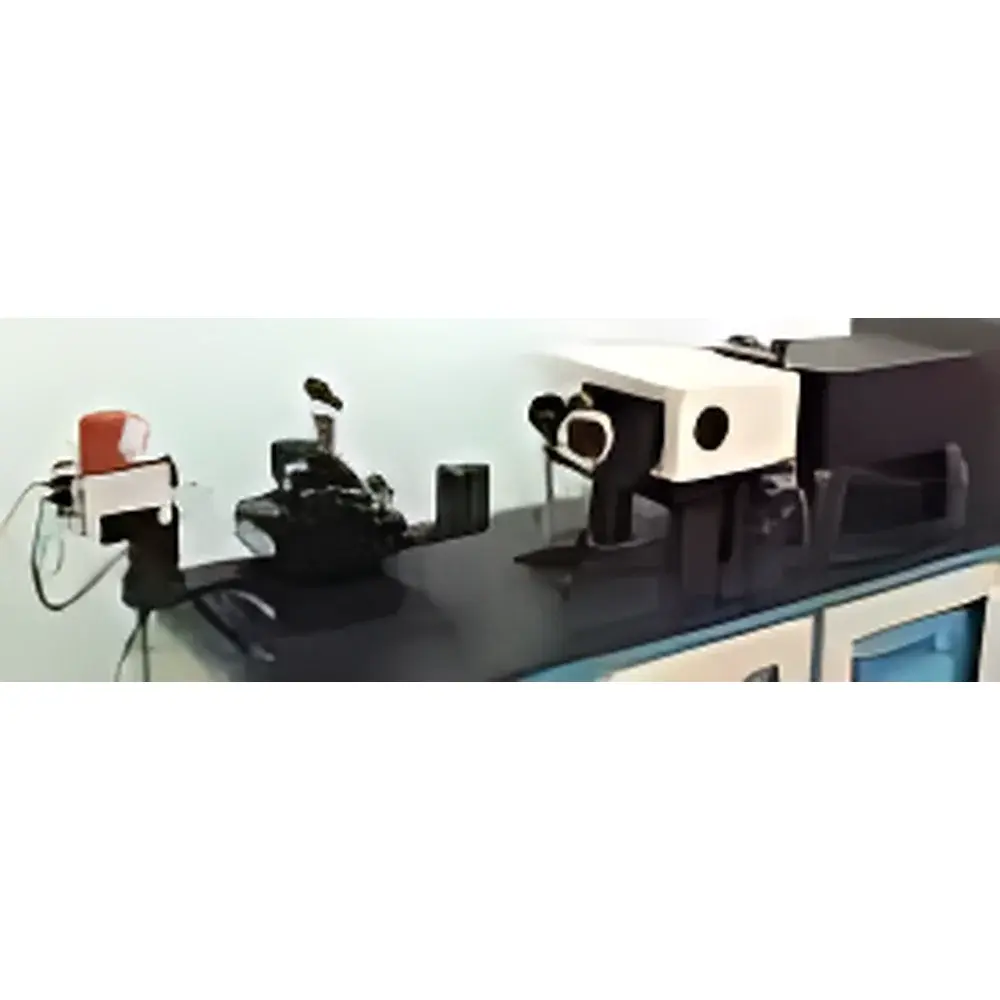
ZOLIX Spectral Angular Distribution Measurement System
| Brand | ZOLIX |
|---|---|
| Origin | Beijing, China |
| Manufacturer Type | OEM Manufacturer |
| Origin Category | Domestic (China) |
| Model | Spectral Angular Distribution System |
| Wavelength Range | 200 nm – IR |
| Angular Positioning Repeatability | ±0.005° |
| Angular Resolution | 0.00125° |
| Optional Functionality | Diffraction Efficiency Measurement of Gratings |
Overview
The ZOLIX Spectral Angular Distribution Measurement System is a precision-engineered optical characterization platform designed for quantitative, angle-resolved spectral analysis of transmission, reflection, and diffraction phenomena across the ultraviolet–visible–near-infrared (UV–Vis–NIR) to mid-infrared (MIR) spectrum. Based on collimated beam illumination and goniometric detection geometry, the system implements a dual-stage rotational architecture compliant with ISO 9211-4 (optics and photonics — specifications for optical coatings) and ASTM E275 (standard practices for describing and measuring performance of spectrophotometers). It enables full angular mapping of spectral response—i.e., wavelength-dependent intensity as a function of incident and/or detection angle—making it essential for R&D and quality control in thin-film optics, photonic crystal design, anti-reflective coating validation, and grating performance certification.
Key Features
- Dual independent high-precision rotational stages: upper stage for sample mounting and lower stage for detector positioning, each driven by stepper motors with closed-loop feedback and calibrated encoders.
- Angular repeatability of ±0.005° and resolution of 0.00125°, enabling sub-millidegree angular sampling required for narrow-linewidth interference filter characterization and Bragg condition verification.
- Modular optical path configuration supports interchangeable light sources (deuterium, tungsten-halogen, or broadband IR emitters) and detectors (Si, InGaAs, or MCT), optimized per spectral band (200 nm–2500 nm standard; extended IR options available).
- Integrated five-axis kinematic mirror mount allows precise XYZ translation plus tip/tilt adjustment, ensuring accurate alignment of the sample surface normal with the stage rotation axis—a prerequisite for valid angular distribution data per CIE 110 and ISO/CIE 13370 standards.
- Motorized shutter, polarization control options (rotatable linear polarizers or λ/4 plates), and optional fiber-coupled illumination facilitate polarization-resolved and spatially filtered measurements.
Sample Compatibility & Compliance
The system accommodates flat, rigid samples up to Ø100 mm and thickness ≤25 mm, including optical filters, coated substrates, microstructured surfaces, and ruled or holographic diffraction gratings. Sample mounting uses vacuum chucks or mechanical clamps with thermal expansion compensation. All mechanical and optical components are constructed from low-outgassing, non-magnetic stainless steel and fused silica to ensure stability under cleanroom or controlled-environment operation. The system complies with electromagnetic compatibility (EMC) directive 2014/30/EU and meets mechanical safety requirements per EN 61000-6-2/6-4. Data acquisition workflows support audit trails and electronic signatures per FDA 21 CFR Part 11 when integrated with validated software environments.
Software & Data Management
Control and analysis are executed via ZOLIX’s proprietary SpectraGoni™ software (v4.2+), a Windows-based application supporting real-time angular scanning, multi-wavelength synchronization, and automated calibration routines (e.g., dark current subtraction, lamp intensity normalization, and stage zero-point referencing). Raw data are stored in HDF5 format with embedded metadata (wavelength grid, angular coordinates, instrument configuration, timestamp, user ID). Export options include CSV, MATLAB (.mat), and industry-standard JCAMP-DX for spectral interoperability. Software modules support ISO 15529-compliant uncertainty propagation modeling and generate reports conforming to GLP documentation templates.
Applications
- Angle-dependent transmittance/reflectance mapping of AR/HR coatings for laser optics and display technologies.
- Characterization of angular selectivity in dichroic mirrors, edge filters, and structural color surfaces.
- Diffraction efficiency profiling of transmission/reflection gratings versus wavelength and incidence angle—critical for monochromator and spectrometer design.
- Validation of bidirectional reflectance distribution function (BRDF) models for remote sensing calibration targets and spacecraft thermal control surfaces.
- Development and metrology of metasurfaces and plasmonic absorbers where resonance angles shift with nanostructure periodicity.
FAQ
What wavelength ranges does the base configuration cover?
The standard configuration spans 200 nm to 2500 nm using Si and InGaAs detectors; extension to 12 µm is possible with liquid-nitrogen-cooled MCT detectors and appropriate source optics.
Can the system measure both s- and p-polarized responses?
Yes—when equipped with motorized rotating polarizers or photoelastic modulators, the system acquires polarization-resolved angular spectra synchronized with stage motion.
Is BRDF data export compatible with optical simulation tools?
Yes—measured BRDF datasets can be exported in ASCII or XML formats directly importable into LightTools, TracePro, and ASAP for ray-tracing validation.
Does the system support automated calibration traceable to NIST standards?
Factory calibration includes angular encoder linearity verification against autocollimator references and spectral responsivity calibration using NIST-traceable standard lamps (FEL, SL2, or SRM 2065).
What is the typical measurement time for a full 2D angular scan at 1 nm wavelength steps?
A 10° × 10° scan at 0.1° angular increment and 1 nm spectral resolution requires approximately 8–12 minutes, depending on integration time and signal-to-noise requirements.




