
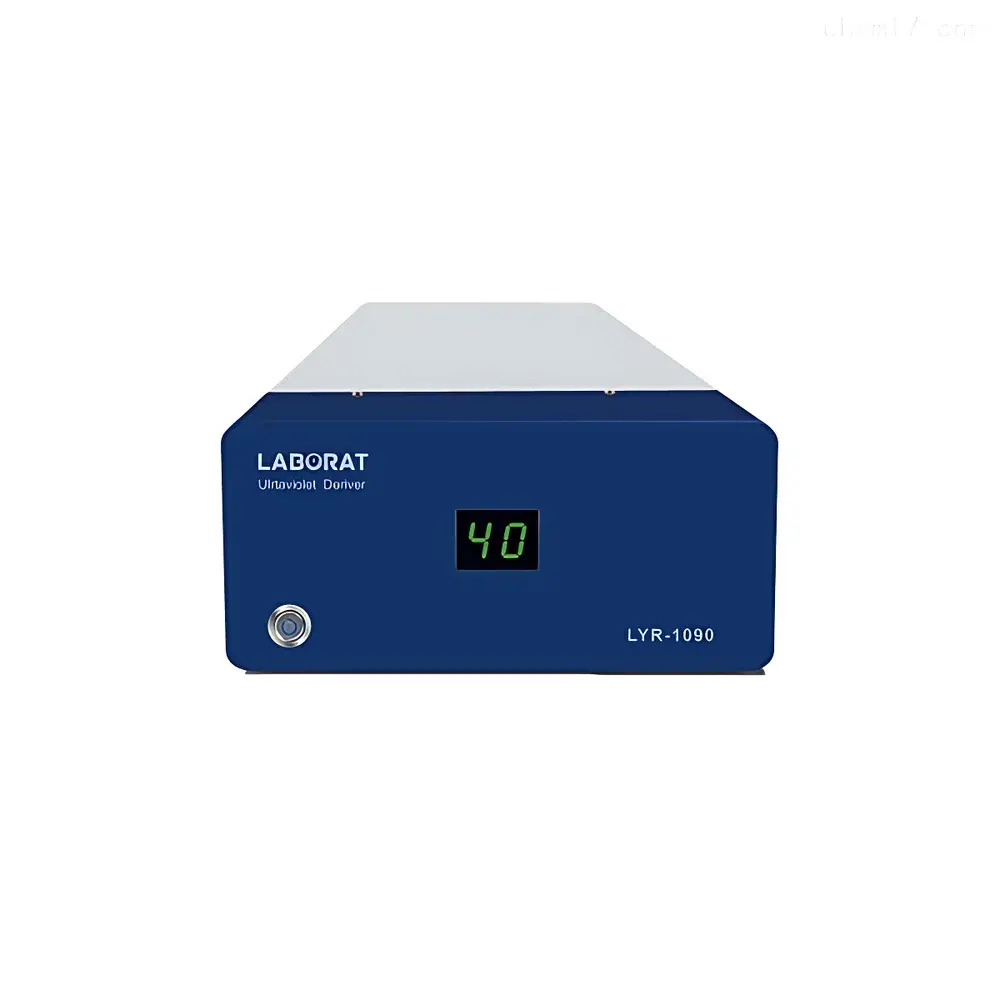
Laborator LYR-1090 Post-Column Photochemical Derivatization System
| Brand | Laborator |
|---|---|
| Model | LYR-1090 |
| Light Source Wavelength | 253.7 nm |
| Derivatization Cell Volume | 1 mL |
| UV Lamp Lifetime | 7,000 h |
| Temperature Monitoring | Yes |
| UV Intensity Monitoring | Yes |
| Compliance | Designed for USP <621>, ISO/IEC 17025, and GLP-aligned workflows |
| Software Audit Trail | Not included (available in LYR-2094 variant) |
| Origin | China |
Overview
The Laborator LYR-1090 Post-Column Photochemical Derivatization System is an engineered solution for enhancing the fluorescence detection sensitivity of analytes with native or latent fluorophores—particularly aflatoxins B₁ and G₁—during reversed-phase high-performance liquid chromatography (RP-HPLC). It operates on the principle of low-pressure mercury vapor UV irradiation at a precisely stabilized 253.7 nm wavelength, inducing photochemical cleavage of non-fluorescent precursors or restoration of quenched fluorophores via bond dissociation and electronic state reconfiguration. Unlike thermal or chemical derivatization methods, photochemical derivatization avoids reagent addition, column contamination, and post-column reaction byproducts, thereby preserving chromatographic integrity and baseline stability. The LYR-1090 integrates real-time monitoring of both derivatization chamber temperature and incident UV irradiance—critical parameters influencing quantum yield and photoreaction kinetics—ensuring analytical reproducibility across multi-day validation runs and inter-laboratory method transfers.
Key Features
- Stabilized 253.7 nm low-pressure mercury UV lamp with rated lifetime of 7,000 hours under continuous operation at nominal intensity
- Fixed-volume 1 mL fused-silica or quartz-based photochemical reaction cell, optimized for laminar flow and uniform photon flux distribution
- Dual-parameter environmental monitoring: digital PT100 temperature sensor (±0.3 °C accuracy) and calibrated silicon photodiode UV intensity detector (range: 0–5 mW/cm², resolution: 0.01 mW/cm²)
- Passive thermal management architecture minimizing external cooling requirements; ambient operating range: 15–30 °C
- Modular design compliant with standard 1/16″ OD stainless steel or PEEK tubing interfaces (e.g., 0.005″ ID), enabling seamless integration downstream of HPLC columns and upstream of fluorescence detectors
- CE-marked electrical safety enclosure with interlocked UV shielding and fail-safe lamp cutoff upon door opening
Sample Compatibility & Compliance
The LYR-1090 is validated for use in regulatory-compliant workflows targeting mycotoxin analysis—including AFB₁, AFG₁, sulfonamides, and polycyclic aromatic hydrocarbons—where enhanced fluorescence signal recovery is required. It supports methodologies referenced in Chinese Pharmacopoeia (ChP) 2020, GB 5009.22–2016, GB/T 30955–2014, LS/T 6122–2017, and SN/T 3868–2014. While not inherently 21 CFR Part 11–compliant, its operational parameters (temperature, UV intensity, runtime) are recordable via external data acquisition systems to support GLP documentation. The system meets IEC 61000-6-3 (EMC) and IEC 61000-6-2 (immunity) standards. Derivatization efficiency remains stable across mobile phases containing ≤60% acetonitrile or methanol in aqueous buffer (pH 2.5–7.5), with no observed photolytic degradation of common HPLC column packings (C18, phenyl-hexyl) under recommended flow rates (0.8–1.2 mL/min).
Software & Data Management
The LYR-1090 operates as a standalone hardware module without embedded firmware or proprietary software. All monitoring outputs—temperature (4–20 mA analog) and UV intensity (0–5 V DC)—are provided via industrial-grade analog signals compatible with third-party data loggers (e.g., LabVIEW, DeltaV, or Chromatography Data Systems such as Empower or Chromeleon). No local storage, user accounts, or audit trail functionality is integrated; these capabilities are available in the higher-tier LYR-2094 model. Laboratories implementing electronic records must configure external timestamping and metadata linkage per ALCOA+ principles to satisfy ISO/IEC 17025 Clause 7.5.2 and FDA expectations for raw data integrity.
Applications
Primary applications include quantitative determination of aflatoxin B₁ and G₁ in food, feed, and pharmaceutical excipients using HPLC-FLD. The system restores native fluorescence by reversing solvent-induced quenching mechanisms—specifically vibrational coupling and inner-filter effects arising from acetonitrile/water or methanol/water mobile phases. It is also employed in residue analysis of sulfonamide antibiotics in animal tissues and detection of benz[a]anthracene and benzo[a]pyrene in environmental water extracts. Method transfer studies confirm <2.5% RSD (n=6) for peak area response when coupled with standardized HPLC conditions (e.g., Waters XBridge C18, 150 × 4.6 mm, 3.5 µm; gradient elution; excitation/emission: 365/425 nm).
FAQ
What analytes are most commonly derivatized using the LYR-1090?
Aflatoxin B₁ and G₁ are the primary targets; secondary applications include sulfonamides, ochratoxin A (under modified protocols), and select polycyclic aromatic hydrocarbons.
Is the 1 mL derivatization cell volume fixed or interchangeable?
The standard configuration uses a fixed 1 mL cell; custom volumes (e.g., 0.5 mL or 2 mL) are available upon request and require recalibration of residence time and photon fluence.
Does the LYR-1090 require routine lamp alignment or optical recalibration?
No—optical path geometry is factory-sealed and thermally stabilized; only annual verification of UV output intensity using a NIST-traceable radiometer is recommended.
Can the LYR-1090 be used with UHPLC systems?
Yes, provided flow rate is maintained within 0.5–1.5 mL/min and backpressure remains below 15 bar; optional low-dead-volume adapters are available for sub-2 µm particle columns.
How does temperature monitoring contribute to method robustness?
Derivatization quantum yield exhibits temperature dependence between 20–40 °C; active monitoring enables correction of drift during long sequences and supports bracketed system suitability testing per ICH Q2(R2).
Related Products





