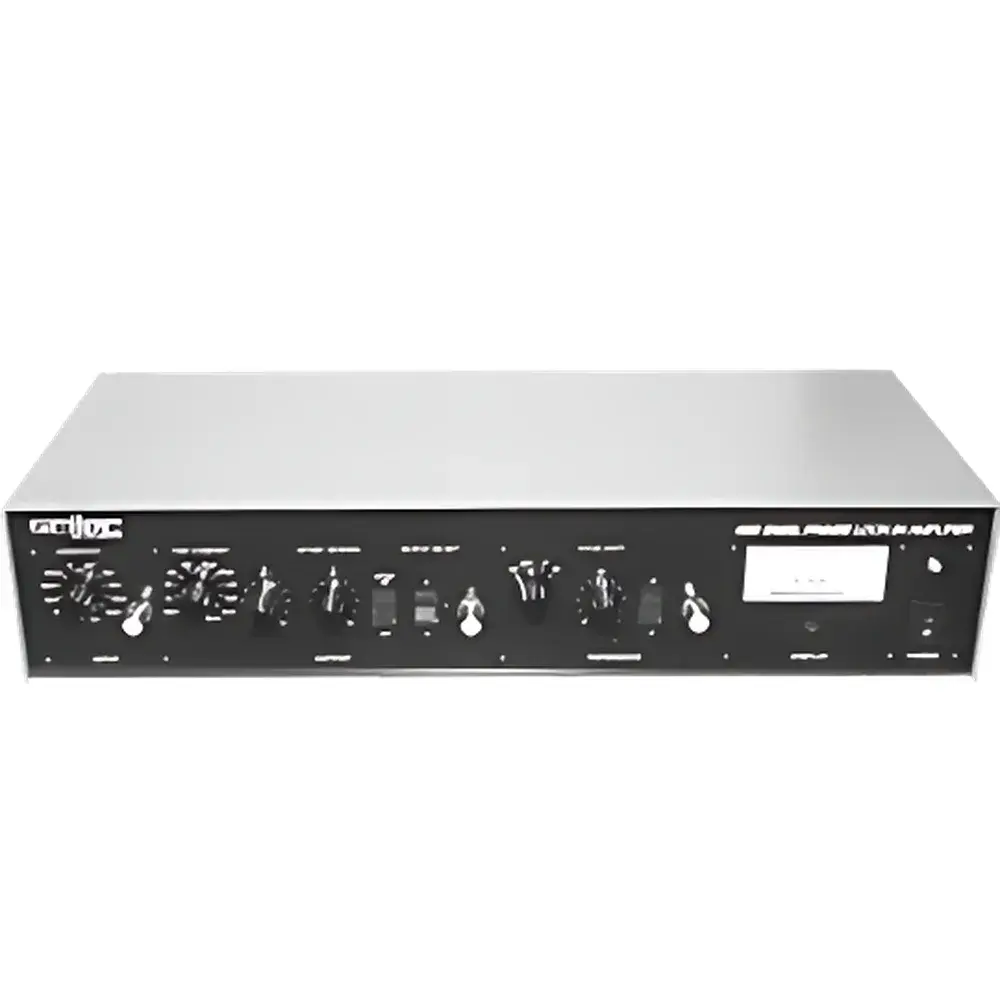
Scitec Instruments Model 420 Dual-Phase Analog Lock-in Amplifier
| Origin | UK |
|---|---|
| Manufacturer Type | Authorized Distributor |
| Origin Category | Imported |
| Model | Model 410 (Single-Phase) / Model 420 (Dual-Phase) |
| Dynamic Reserve | 60 dB |
| Frequency Range | 10 Hz – 100 kHz |
| Input Sensitivity | 3 µV – 1 V (full-scale output) |
| Input Impedance | 10¹² Ω ║ 1 nF (DC-coupled) |
| Output Time Constant | 100 µs – 30 s |
| Gain Accuracy | ±1% |
| Gain Stability | 200 ppm/°C |
| Max Output Voltage | ±16 V (pre-clamp) |
| Phase Adjustment | 90° coarse steps + 0–100° fine adjustment |
| Reference Input | TTL or sine wave, 100 mV rms min (sine), 5 V min (pulse) |
| Power | 115/230 V AC, 50–60 Hz, ≤10 VA |
Overview
The Scitec Instruments Model 420 Dual-Phase Analog Lock-in Amplifier is a precision-engineered instrument designed for high-fidelity detection and demodulation of low-amplitude AC signals embedded in high-noise environments. Operating on the principle of synchronous demodulation—where an input signal is multiplied by a phase-coherent reference and subsequently low-pass filtered—the Model 420 enables accurate extraction of both amplitude (R) and phase (θ) information with exceptional signal-to-noise rejection. Its analog architecture ensures minimal latency, deterministic response, and immunity to digital sampling artifacts, making it especially suitable for real-time feedback loops, ultra-low-frequency impedance spectroscopy, and time-resolved optical measurements where phase stability and analog integrity are critical. With a dynamic reserve of 60 dB, the amplifier reliably recovers signals buried under noise up to 1,000× greater in RMS amplitude—enabling robust operation in demanding laboratory and industrial settings including cryogenic systems, scanning probe microscopy, and magneto-optic Kerr effect (MOKE) experiments.
Key Features
- Dual-phase demodulation architecture with orthogonal X (cosine) and Y (sine) channels, enabling simultaneous amplitude (R = √(X² + Y²)) and phase (θ = arctan(Y/X)) computation via onboard analog circuitry
- Wide input sensitivity range: 3 µV to 1 V full-scale output, selectable in decade steps (1×, 3×, 10×, etc.) with ±1% gain accuracy and 200 ppm/°C thermal stability
- 10 Hz – 100 kHz operational bandwidth, compatible with fundamental (1F) and second-harmonic (2F) reference modes
- Configurable input topology: switchable between differential and single-ended BNC inputs; jumper-selectable DC/AC coupling, high-impedance (10¹² Ω ║ 1 nF) or low-impedance modes
- Low-pass filtering with continuously adjustable time constants from 100 µs to 30 s (decade-step selection), ensuring optimal noise bandwidth control per application
- Front-panel triple-output selector (X/Y/R) and rear-panel dedicated X, Y, and R BNC outputs, each calibrated to ±1 V full scale with overvoltage protection
- Reference channel supporting TTL pulses or sine-wave inputs (100 mV rms minimum), with 90° coarse phase stepping and 0–100° fine analog adjustment (0.1°/°C drift)
- Robust analog signal path: no ADC/DAC conversion, no firmware dependencies—designed for long-term calibration stability and GLP-compliant traceability
Sample Compatibility & Compliance
The Model 420 interfaces seamlessly with a broad spectrum of transducers and detector systems—including photodiodes, lock-in thermography sensors, piezoelectric actuators, SQUID-based magnetometers, and RF/microwave bridge networks. Its high-input impedance and low-noise front-end support direct connection to high-impedance sources such as vacuum photomultipliers or electrochemical cells without signal degradation. While the instrument itself does not carry CE/UKCA certification out-of-box (as distributor-supplied units require end-user site validation), its design conforms to IEC 61000-4 electromagnetic compatibility standards for laboratory equipment. When deployed in regulated environments—including ISO/IEC 17025-accredited testing labs or GMP-aligned R&D facilities—the analog signal chain supports audit-ready documentation of gain linearity, phase fidelity, and time-constant repeatability. Full calibration records—including factory-traceable gain and phase error maps across frequency and sensitivity ranges—are available upon request and align with ASTM E178 guidelines for precision analog instrumentation.
Software & Data Management
As a fully analog instrument, the Model 420 requires no embedded firmware, drivers, or host software for core functionality—eliminating cybersecurity risks, versioning conflicts, and OS dependency. All control and readout are performed via front-panel knobs, switches, and BNC analog outputs, ensuring deterministic behavior and uninterrupted operation during extended data acquisition campaigns. For integration into automated test systems, the ±1 V X/Y/R outputs are directly compatible with standard DAQ hardware (e.g., National Instruments PXI, Keysight U2300A) and support real-time streaming into MATLAB, Python (via PyVISA or analog input libraries), or LabVIEW. Optional analog-to-digital interface modules—available through Scitec’s authorized distribution network—provide synchronized timestamped digitization while preserving native signal integrity. Audit trails for measurement parameters (e.g., time constant, sensitivity, reference phase) are maintained manually in lab notebooks or digitally via external logging of front-panel state changes—a practice consistent with FDA 21 CFR Part 11 Annex 11 expectations for analog-based critical measurements.
Applications
- Modulation spectroscopy: recovery of weak photoluminescence or electroluminescence signals under intense broadband excitation
- Impedance characterization of superconducting thin films, ferroelectric capacitors, and battery electrode interfaces using bridge-null or current-voltage vector analysis
- Phase-sensitive detection in atomic force microscopy (AFM) lock-in amplification modes, including bimodal and higher-harmonic imaging
- Real-time monitoring of Faraday rotation or Voigt effect in magneto-optical materials under variable magnetic fields
- Low-frequency dielectric spectroscopy of polymer electrolytes and colloidal dispersions (10 mHz–100 kHz range)
- Null-balance measurements in precision resistance bridges and quantum Hall effect calibration setups
FAQ
What distinguishes the Model 420 from the Model 410?
The Model 420 incorporates dual-phase demodulation with orthogonal X and Y channels and onboard analog R/θ computation, whereas the Model 410 provides only single-phase (X-channel) demodulation requiring manual phase alignment for accurate amplitude measurement.
Can the Model 420 operate at frequencies below 10 Hz?
No—the specified lower limit is 10 Hz due to analog filter design constraints; for sub-Hz applications, consider Scitec’s Model 450S (100 dB dynamic reserve, 1 mHz–200 kHz range).
Is the input protected against electrostatic discharge (ESD)?
Yes—BNC input connectors are rated to withstand destructive ESD events per IEC 61000-4-2 Level 4 (8 kV contact, 15 kV air), verified during production testing.
Does the instrument support harmonic detection beyond 2F?
No—only 1F and 2F reference modes are implemented in hardware; higher harmonics require external frequency synthesis and separate reference routing.
How is calibration traceability maintained?
Each unit ships with a factory calibration certificate referencing NPL-traceable standards; annual recalibration services—including gain flatness, phase linearity, and time-constant verification—are offered through Scitec’s global distributor network.