
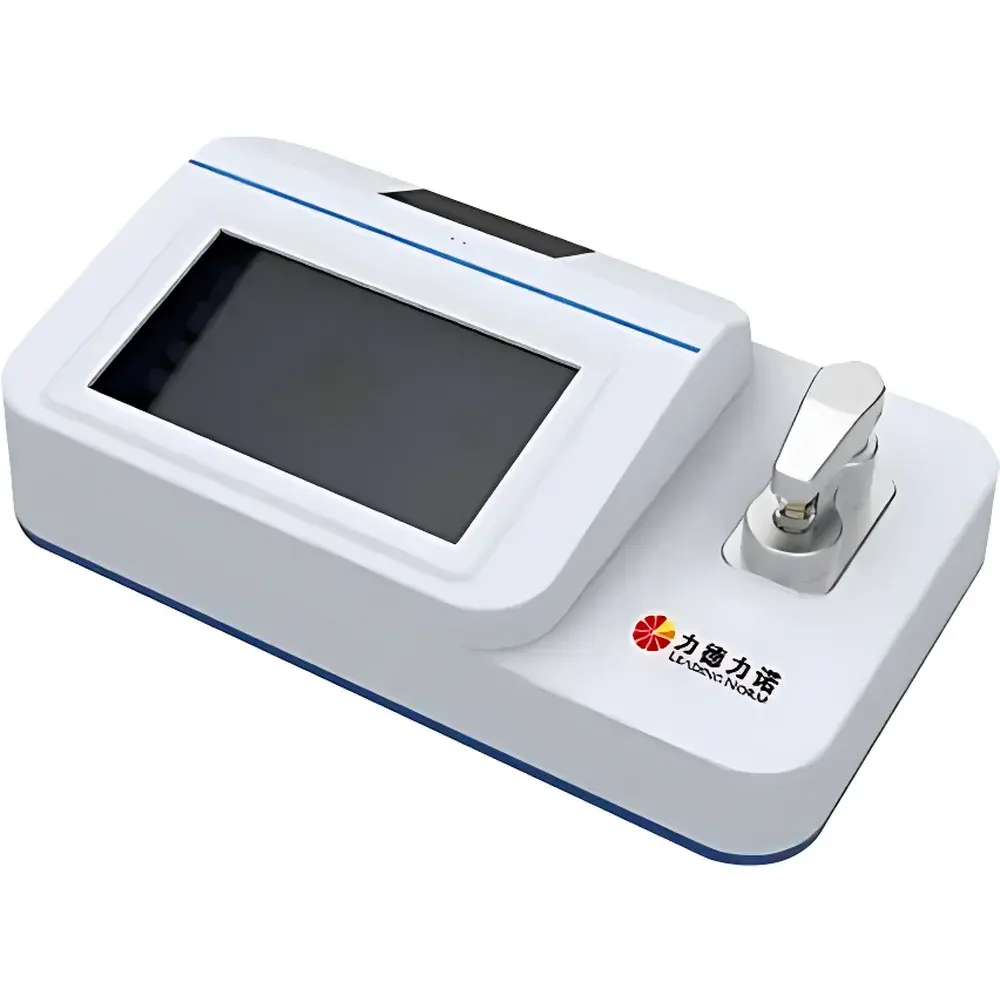
LeadingNorm LDN-ZD200 Portable Heavy Metal Analyzer for Grain and Oil Testing
| Brand | LeadingNorm |
|---|---|
| Origin | Beijing, China |
| Manufacturer Type | Authorized Distributor |
| Country of Origin | China |
| Model | LDN-ZD200 |
| Price | USD 10,800 (FOB Beijing) |
| Detection Principle | Anodic Stripping Voltammetry (ASV) |
| Target Analytes | Pb²⁺, Cd²⁺, As³⁺, Hg²⁺, Cu²⁺, Zn²⁺ |
| Sample Throughput | ≤8 samples/hour (with parallel electrode use) |
| Detection Limit | Sub-ppb to low-ppb range (matrix-dependent) |
| Electrode Type | Disposable Screen-Printed Electrodes (SPEs) |
| Power Supply | Rechargeable Li-ion battery (≥8 h continuous operation) |
| Data Output | USB 2.0 & Bluetooth 4.2 |
| Compliance | Designed to support ISO 17025-compliant workflows |
Overview
The LeadingNorm LDN-ZD200 Portable Heavy Metal Analyzer is a field-deployable electrochemical instrument engineered for rapid, on-site quantification of toxic heavy metals—including lead (Pb), cadmium (Cd), arsenic (As), mercury (Hg), copper (Cu), and zinc (Zn)—in grain, oilseed, rice, flour, and related agricultural commodities. It operates on the principle of anodic stripping voltammetry (ASV), a well-established electroanalytical technique recognized in AOAC Official Method 2019.01 and referenced in ISO/IEC 17025:2017 Annex A for trace metal analysis in food matrices. ASV enables high sensitivity through pre-concentration of metal ions onto a working electrode surface under controlled potential, followed by oxidative stripping and current measurement. This method delivers reliable sub-part-per-trillion (sub-ppt) detection limits in optimized aqueous extracts—critical for meeting stringent regulatory thresholds such as EU Commission Regulation (EC) No. 1881/2006 (Pb: 0.1–0.3 mg/kg in cereals; Cd: 0.1 mg/kg) and China’s GB 2762-2022 (Pb: 0.2 mg/kg in rice). The LDN-ZD200 eliminates dependence on centralized lab infrastructure, reducing turnaround time from days to minutes while maintaining metrological integrity suitable for screening-level compliance verification.
Key Features
- Integrated ASV platform with temperature-controlled cell (±0.5 °C stability) to ensure reproducible deposition kinetics across variable ambient conditions.
- Pre-calibrated, lot-certified screen-printed electrodes (SPEs) with carbon working electrode, Ag/AgCl reference, and auxiliary electrode—all disposable and matrix-optimized for grain digests (e.g., HNO₃/H₂O₂ microwave-assisted extraction).
- On-board calibration verification using certified multi-element standard solutions (traceable to NIST SRM 3108); automatic drift correction via internal reference peak normalization.
- Ruggedized IP54-rated enclosure with shock-absorbing silicone bumper; operational in 5–40 °C ambient range and 30–85% RH non-condensing environment.
- Embedded 7-inch capacitive touchscreen with intuitive wizard-guided assay protocols—no software installation or PC dependency required.
- Battery-powered operation (12 V / 8,000 mAh Li-ion) supports ≥8 hours of continuous analysis or >200 test cycles per charge, validated per IEC 62133-2.
Sample Compatibility & Compliance
The LDN-ZD200 is validated for use with homogenized, acid-digested grain samples prepared per AOAC 999.10 or GB/T 5009.12–2017 protocols. It accepts liquid extracts from rice, wheat, corn, soybean, peanut, and edible oils following standardized dilution (1:10 to 1:100 v/v) and pH adjustment (pH 4.5 ± 0.2 with acetate buffer). Matrix interference mitigation is achieved via built-in standard addition mode and optional internal standard (In³⁺ or Bi³⁺) spiking. The system meets essential performance criteria outlined in ISO 11843-2 (detection capability estimation) and supports audit-ready data export compliant with FDA 21 CFR Part 11 requirements—including electronic signatures, operator ID logging, and immutable audit trails stored locally and via encrypted USB transfer.
Software & Data Management
Firmware v3.2 includes embedded data management tools enabling real-time calibration curve generation, QC flagging (e.g., recovery <80% or >120%), and automated report generation in PDF/CSV formats. All measurement metadata—including timestamp, electrode lot number, operator ID, sample ID, and raw voltammogram traces—are embedded in each export file. Cloud synchronization (optional) uses TLS 1.2-secured API endpoints compatible with LIMS integration (HL7 v2.5, ASTM E1384). Software validation documentation (IQ/OQ/PQ templates) and electronic record retention logs are provided to support GLP/GMP laboratory accreditation processes.
Applications
- Field-based screening of harvested grains at collection points, silos, and border inspection posts to prevent non-conforming lots from entering supply chains.
- QC/QA verification during milling, refining, and packaging operations where rapid feedback on raw material safety is mission-critical.
- Regulatory surveillance by provincial food safety bureaus conducting routine monitoring under China’s Food Safety Law Article 112.
- Research applications in agronomy labs assessing soil-to-grain metal translocation under phytoremediation trials or fertilizer amendment studies.
- Emergency response deployment during contamination incidents (e.g., industrial runoff, mining leachate exposure) requiring immediate triage of staple food stocks.
FAQ
What sample preparation is required prior to analysis?
Grain samples must be dried, ground to ≤250 µm particle size, and subjected to microwave-assisted acid digestion (typically 5 mL 65% HNO₃ + 1 mL 30% H₂O₂). The digest is diluted to 50 mL with ultrapure water (18.2 MΩ·cm), filtered (0.45 µm PVDF), and buffered to pH 4.5 before loading.
Can the instrument quantify total arsenic or only inorganic species?
The LDN-ZD200 measures electroactive inorganic arsenic (As³⁺) directly. For total arsenic assessment, a pre-reduction step (e.g., KI/L-ascorbic acid) is required to convert As⁵⁺ to As³⁺; method validation per AOAC 2019.01 is recommended.
Is method validation support available for regulatory submission?
Yes—LeadingNorm provides application notes, spike recovery data (n = 12 per matrix), LOD/LOQ determination reports, and inter-laboratory comparison summaries aligned with ISO/IEC 17025 Clause 7.2.1.
How often must electrodes be replaced?
Each SPE is single-use per sample. Electrode lot certificates include shelf-life (24 months unopened), storage conditions (4–25 °C, dry), and batch-specific calibration slopes.
Does the device require annual recalibration by a service center?
No—field recalibration is performed in <90 seconds using included 10 µg/L multi-metal standard. Full system verification (including potentiostat linearity and temperature sensor accuracy) is recommended every 12 months or after 500 analyses, using NIST-traceable reference materials.
Related Products







