
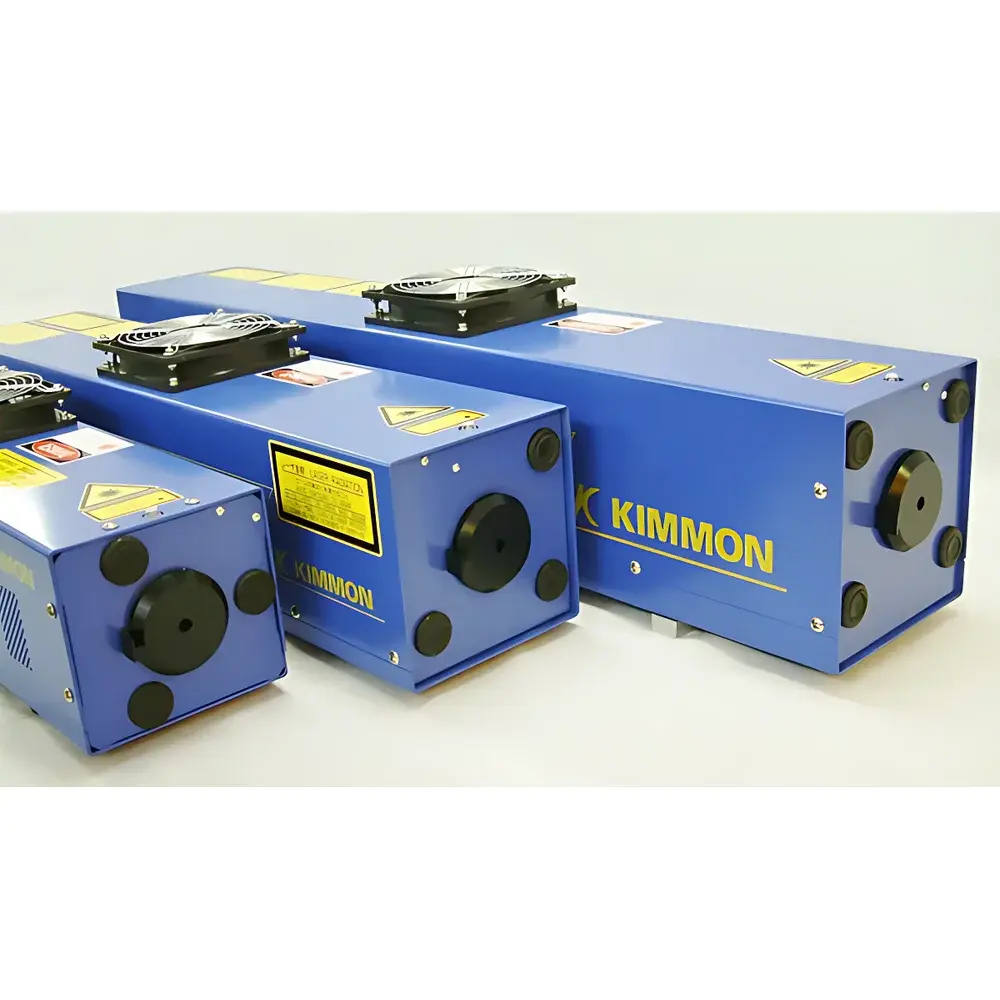
Kimmon IK3301R-G 325 nm Helium-Cadmium Laser System
| Brand | Kimmon |
|---|---|
| Origin | Japan |
| Model | IK3301R-G |
| Wavelength | 325 nm |
| Output Power | 35 mW |
| Transverse Mode | TEM₀₀ |
| Polarization | Linear, >500:1 |
| Beam Diameter (1/e²) | <1.2 × 1 mm |
| Beam Divergence | <0.5 mrad |
| Beam Pointing Stability | ≤±25 µrad (at 25 °C, stabilized) |
| Power Stability | ≤±2% (4 h, 25 °C), <20% (10–40 °C) |
| RMS Noise (30 kHz–2 MHz) | <15% peak-to-peak |
| Warm-up Time to 90% Power | 20 min |
| Operating Temperature | 10–40 °C |
| Storage Temperature | −10–50 °C |
| Humidity | ≤90% RH (non-condensing) |
| Shock Resistance (packaged) | 20 g × 3 shocks |
| Dimensions (W×H×L) | 146 × 197 × 1420 mm |
| Weight | 23.5 kg |
| Laser Class | 3B (IEC 60825-1) |
Overview
The Kimmon IK3301R-G is a continuous-wave (CW), gas-discharge helium-cadmium (HeCd) laser engineered for high-stability ultraviolet (UV) emission at 325 nm. As one of the few commercially available narrow-linewidth CW UV lasers, it operates on the Cd⁺ ion transition within a sealed He–Cd plasma tube, delivering exceptional spectral purity and long-term power consistency. Its 325 nm output resides in the deep UV range—critical for resonance-enhanced spectroscopic techniques where electronic transitions in wide-bandgap semiconductors, molecular sieves, and luminescent materials are selectively excited. Unlike solid-state or diode-pumped UV sources, the HeCd laser provides intrinsic TEM₀₀ spatial mode quality, low spatial noise, and minimal thermal lensing—making it indispensable for confocal microspectroscopy, UV Raman excitation, and photoluminescence mapping requiring diffraction-limited focusability and shot-noise-limited signal fidelity.
Key Features
- Stable 325 nm UV output with nominal power of 35 mW (measured at aperture, after warm-up)
- TEM₀₀ transverse mode with M² < 1.1, enabling efficient coupling into single-mode fibers and high-NA microscope objectives
- Linear polarization ratio >500:1, supporting polarization-resolved measurements without external waveplates
- Beam pointing stability ≤±25 µrad under temperature-controlled conditions (25 °C ambient), critical for long-duration spectral acquisitions
- Power stability ≤±2% over 4 hours (at constant 25 °C), and <20% across full operational temperature range (10–40 °C)
- Low amplitude noise (<15% p-p, 30 kHz–2 MHz bandwidth), minimizing baseline fluctuations in photon-counting detection schemes
- Compact yet robust mechanical design: aluminum alloy housing with integrated cooling fins and vibration-damped baseplate
- Compliant with IEC 60825-1:2014 Class 3B laser safety requirements; includes interlock connector, key switch, and emission indicator
Sample Compatibility & Compliance
The IK3301R-G is routinely deployed in analytical configurations compliant with ASTM E1840 (Raman spectroscopy), ISO 17025 (testing laboratory competence), and USP (laser-based instrumentation validation). Its 325 nm wavelength enables resonance Raman enhancement in wide-bandgap oxides (e.g., ZnO, TiO₂), aluminophosphates (AlPO-5), and carbon nanotubes—where fluorescence background from organic contaminants or matrix absorption is suppressed relative to visible excitation (e.g., 532 nm). The laser’s narrow linewidth (250 h) and spectral verification; each shipped system includes a NIST-traceable calibration certificate for wavelength and power.
Software & Data Management
While the IK3301R-G operates as a standalone analog laser source, its electrical interface (TTL-ready enable/disable, analog power modulation input, and status monitoring pins) supports integration into automated platforms governed by LabVIEW, Python (PyVISA), or MATLAB-based control frameworks. Optional RS-232 or USB-to-serial adapters enable remote power ramping, interlock state logging, and runtime diagnostics. When deployed in GLP/GMP environments—for example, in pharmaceutical photostability testing or semiconductor wafer metrology—the laser’s power history, on/off cycles, and thermal logs can be archived alongside spectral datasets to satisfy FDA 21 CFR Part 11 audit trail requirements. Firmware updates (if applicable) are distributed via secure vendor portal with version-controlled release notes.
Applications
- UV Resonance Raman Spectroscopy: Selective enhancement of vibrational modes in catalysts (e.g., AlPO-5), perovskites, and 2D materials with Eg symmetry
- Micro-Photoluminescence (µ-PL): High-resolution mapping of defect-related emissions in ZnO-based heterostructures and nitride semiconductors
- Fluorescence Lifetime Imaging (FLIM): Excitation source for time-correlated single-photon counting (TCSPC) systems targeting UV-emitting fluorophores
- Lithography & Mask Alignment: Precision alignment beam in UV stepper systems due to stable collimation and low divergence
- Calibration Source: Reference emitter for UV spectroradiometer and monochromator linearity verification (traceable to NIST SRM 2032)
- Optical Trapping & Manipulation: Used in dual-beam UV optical tweezers for dielectric nanoparticle handling in aqueous media
FAQ
What is the typical lifetime of the IK3301R-G laser tube?
Kimmon guarantees ≥70% of rated output power for 2,500 operating hours or 12 months—whichever occurs first—under specified environmental conditions (25 °C ±2 °C, ≤60% RH). Actual tube lifetimes often exceed 5,000 h with proper warm-up/cool-down cycling.
Can this laser be fiber-coupled?
Yes; the TEM₀₀ beam profile and <1.2 mm 1/e² diameter allow efficient coupling into UV-grade fused silica fibers (e.g., 50–105 µm core) using AR-coated aspheric lenses. Coupling efficiency typically exceeds 65% with optimized alignment.
Is active cooling required?
No. The IK3301R-G uses passive convection cooling with integrated heat sinks. Forced-air cooling is not recommended, as airflow-induced vibrations degrade beam pointing stability.
How does 325 nm excitation reduce fluorescence interference compared to 532 nm?
Many organic matrices and impurities exhibit strong visible fluorescence but negligible UV fluorescence. At 325 nm, electronic transitions in inorganic hosts (e.g., AlPO-5) are resonantly enhanced while parasitic organic emission remains weak—improving Raman signal-to-background ratios by 10–100×.
Does the system include beam-shaping optics?
No. The IK3301R-G delivers a raw collimated beam. Users must supply UV-optimized beam expanders, irises, or focusing optics compatible with 325 nm transmission and damage thresholds (≥500 MW/cm² for pulsed equivalent, >10 W/cm² for CW).



