
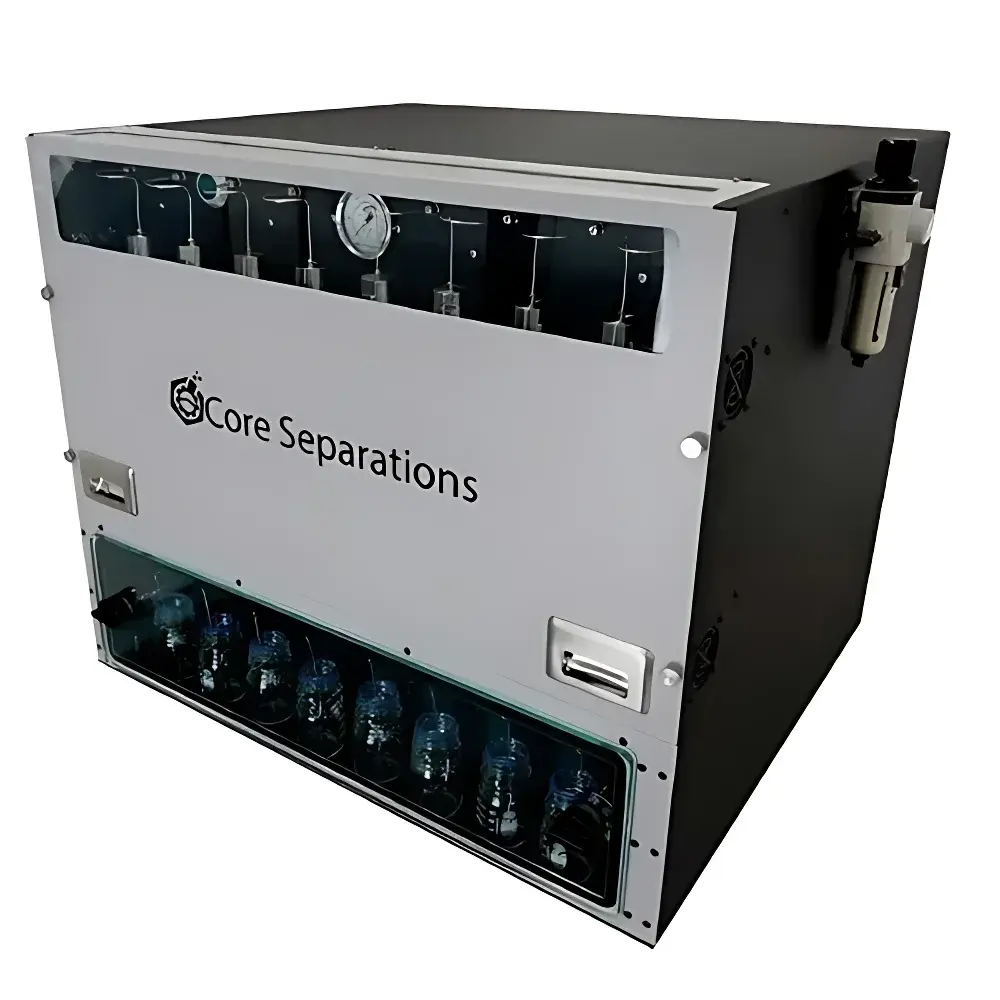
Core Separations ESS Automated Supercritical Fluid Extraction System
| Brand | Core Separations |
|---|---|
| Origin | USA |
| Manufacturer Type | Authorized Distributor |
| Product Origin | Imported |
| Model | ESS |
| Price Range | USD 210,000 – 280,000 |
| Max Temperature | 100 °C |
| Number of Channels | 8 |
| Extraction Volumes | 10 mL, 25 mL, or 50 mL per vessel |
| Max Pressure | 600 bar (8700 psi) |
| Max CO₂ Flow Rate | 15 g/min |
Overview
The Core Separations ESS Automated Supercritical Fluid Extraction System is an engineered platform for high-throughput, condition-optimized sample preparation in analytical and process development laboratories. It operates on the principle of supercritical fluid extraction (SFE), leveraging carbon dioxide (CO₂) — and optionally co-solvents — in its supercritical state (above 31.1 °C and 73.8 bar) to achieve selective, tunable solvation power. The system’s modular architecture supports precise control over pressure, temperature, flow rate, and dynamic/static extraction timing — parameters that directly govern solute solubility, mass transfer kinetics, and selectivity. Designed for reproducible method development rather than routine production-scale operation, the ESS enables parallel screening of up to eight independent extraction conditions in a single run, significantly accelerating optimization workflows for applications ranging from natural product isolation to pesticide residue cleanup prior to GC or HPLC analysis.
Key Features
- Eight independently programmable extraction channels, each with dedicated pressure/temperature control and discrete collection routing
- Standardized, interchangeable extraction vessels available in three nominal volumes: 10 mL, 25 mL, and 50 mL — all rated for continuous operation at 600 bar and 100 °C
- Integrated high-pressure CO₂ delivery system with mass-flow-controlled pumping (0–15 g/min), featuring real-time density compensation and thermal stabilization
- Automated sequential or concurrent operation modes, supporting both dynamic (flow-through) and static (soak-and-extract) protocols
- Modular solvent handling for liquid co-solvent addition (e.g., methanol, ethanol) with precision metering and post-mixing homogenization
- Rugged stainless-steel fluidic path compliant with ASTM D7575 and ISO 14852 standards for SFE-based environmental and food testing
Sample Compatibility & Compliance
The ESS accommodates solid, semi-solid, and powdered matrices including plant tissues, soil, sediment, food composites, and polymer-bound residues. Its low-thermal-degradation profile makes it especially suitable for thermolabile analytes such as carotenoids, cannabinoids, essential oils, and organophosphate pesticides. All wetted components meet USP Class VI biocompatibility requirements, and the system architecture supports GLP-compliant data integrity through hardware-enforced audit trails, electronic signatures, and secure user access levels. Method parameters and run logs are timestamped and exportable in CSV or PDF formats, aligning with FDA 21 CFR Part 11 readiness when deployed with validated software configurations.
Software & Data Management
The ESS is operated via a Windows-based control interface with intuitive graphical workflow builder. Users define multi-step methods — including pre-heating, pressurization ramping, static dwell, dynamic elution, depressurization, and purge cycles — with granular setpoint resolution (±0.1 bar, ±0.5 °C). Real-time monitoring includes pressure transducer readings, temperature profiles across all eight zones, mass flow rates, and system status flags. All operational data are stored locally with optional network backup; raw datasets include full metadata (operator ID, method version, calibration timestamps) required for regulatory submissions. Export modules support direct integration with LIMS platforms and chromatographic data systems (CDS) via standardized API endpoints.
Applications
- Method scouting for SFE-based cleanup in multiresidue pesticide analysis (e.g., EN 15662, AOAC 2007.01)
- Extraction and fractionation of bioactive compounds from botanicals under GRAS-compliant conditions
- Decontamination and recovery of additives or plasticizers from polymeric packaging materials
- Pre-concentration of persistent organic pollutants (POPs) from environmental solids prior to GC–MS quantification
- Process parameter mapping for scale-up studies, generating empirical solubility isotherms across pressure–temperature–density space
FAQ
What solvents are compatible with the ESS system?
Carbon dioxide is the primary supercritical fluid; methanol, ethanol, acetone, and isopropanol may be introduced as liquid co-solvents via the integrated modifier pump.
Can the ESS be integrated into an automated laboratory workflow?
Yes — the system supports RS-232, Ethernet, and OPC UA communication protocols for bidirectional integration with robotic sample handlers and enterprise LIMS.
Is validation documentation available for GxP environments?
IQ/OQ documentation packages are provided; PQ protocol templates and calibration certificates traceable to NIST standards are included with purchase.
What maintenance intervals are recommended?
Preventive maintenance is advised every 1,000 operating hours or annually, whichever occurs first, focusing on seal integrity, pressure transducer verification, and pump calibration.
Does the system support gradient pressure or temperature programming?
No — each channel maintains constant setpoints during a given step, but multi-step methods allow discrete transitions between defined pressure/temperature states.



