
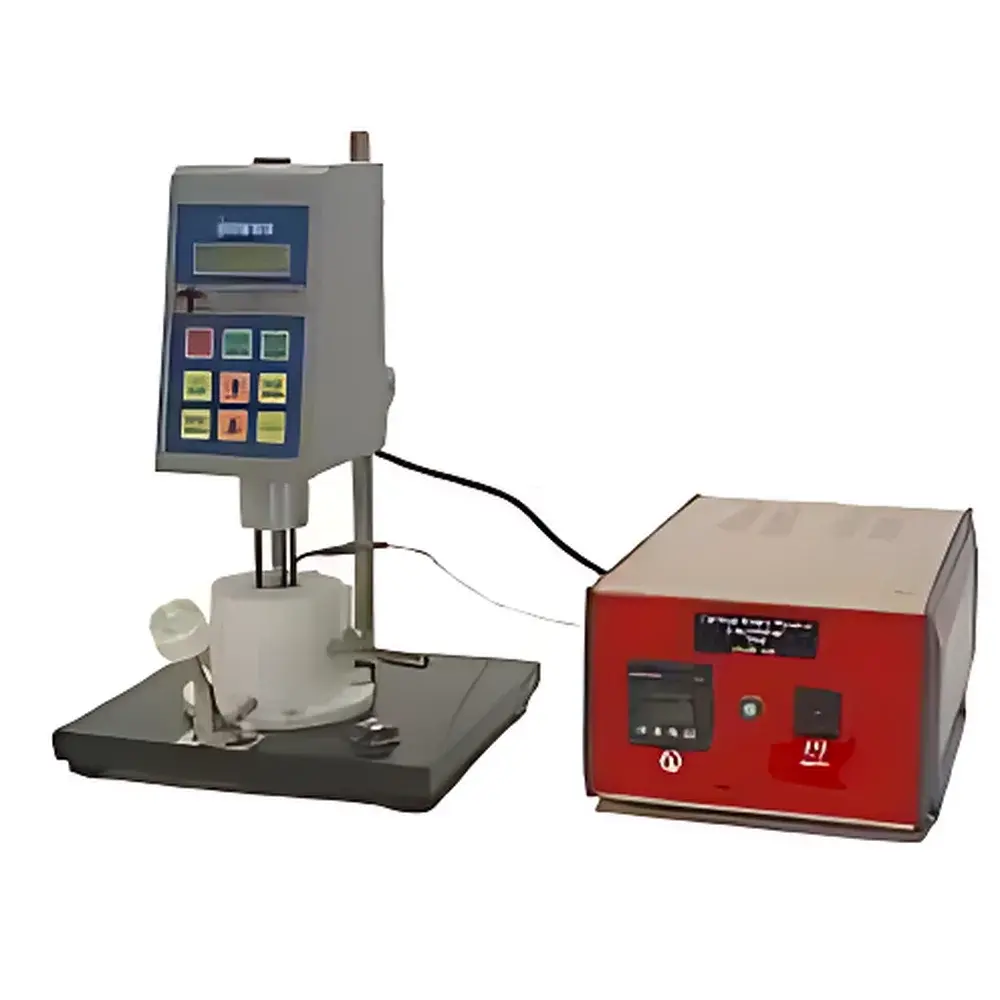
Tannas TBR High-Temperature Low-Shear Rotational Viscometer
| Brand | Tannas & King |
|---|---|
| Origin | USA |
| Manufacturer Status | Authorized Distributor |
| Origin Category | Imported |
| Model | TBR |
| Pricing | Upon Request |
Overview
The Tannas TBR High-Temperature Low-Shear Rotational Viscometer is an engineered solution for precise dynamic viscosity (η) measurement of engine oils, base stocks, and high-viscosity petroleum fluids under controlled low-shear conditions. Unlike capillary or oscillatory methods that yield kinematic viscosity (ν) — a density-dependent parameter — the TBR employs Couette flow geometry with concentric cylindrical sensors to directly quantify shear stress versus shear rate, delivering true dynamic viscosity in centipoise (cP) across a defined shear rate range of 1–200 s⁻¹. This principle aligns with ASTM D445 (kinematic), ASTM D7042 (high-shear), and ISO 3104/ISO 6271 standards, while its low-shear capability addresses critical gaps in evaluating non-Newtonian behavior relevant to engine start-up, oil film formation, and pumpability at low temperatures. Designed for operation from 20 °C up to >200 °C, the instrument supports multi-point thermal profiling without repeated calibration — a feature enabled by integrated platinum resistance thermometry (Pt100) and thermally stable sensor architecture.
Key Features
- Low-shear rotational measurement platform optimized for shear rates between 1 and 200 s⁻¹, enabling accurate characterization of viscous and shear-thinning lubricants
- Extended temperature operating range: 20 °C to over 200 °C, with programmable ramping and ±0.1 °C thermal stability
- Dynamic viscosity measurement capability spanning 1–35,000 cP, validated per ASTM D2983 (low-temperature torque) and ASTM D4683 (HTHS)
- Robust sensor design resistant to particulate contamination — suitable for used engine oils, soot-laden samples, and heavily additive-formulated fluids
- Single-point calibration protocol valid across full temperature and shear-rate ranges, reducing operational variability and maintenance overhead
- Modular bath integration support for external thermostatic control (e.g., Julabo or Huber chillers) and compliance with ASTM D5293 cold-cranking simulation requirements
Sample Compatibility & Compliance
The TBR accommodates neat and service-aged engine oils (SAE 0W–60), transmission fluids, gear oils, and synthetic ester-based lubricants. Its stainless-steel measurement geometry tolerates suspended contaminants up to 5% v/v without sensor fouling or torque drift. The system meets material compatibility requirements outlined in ASTM D892 (foaming tendency) and ISO 12156-1 (injector nozzle coking). For regulatory traceability, data acquisition supports GLP-compliant audit trails when paired with optional time-stamped logging firmware. While not inherently 21 CFR Part 11 compliant, the instrument’s analog/digital output architecture allows integration into validated LIMS or ELN environments meeting FDA and EU Annex 11 requirements.
Software & Data Management
The TBR operates via dedicated PC-based control software supporting real-time viscosity vs. temperature and shear rate sweeps. Raw torque and angular velocity data are logged at ≥10 Hz resolution, exportable in CSV or ASTM E1447-compliant .trc format. Software includes built-in calculation modules for HTHS (High-Temperature High-Shear) viscosity estimation per ASTM D4683, as well as Arrhenius and Walther equation fitting for viscosity-temperature modeling. All calibration coefficients, operator IDs, and environmental metadata (ambient pressure, humidity) are embedded in output files to satisfy ISO/IEC 17025 documentation requirements. Optional API integration enables automated reporting to enterprise QA systems.
Applications
- Engine oil formulation development: evaluation of VI improvers, dispersants, and anti-wear additives under realistic low-shear startup conditions
- In-service oil analysis: monitoring viscosity degradation, soot thickening, and oxidation-induced shear thinning in diesel and gasoline engines
- Base stock qualification: comparative assessment of Group II, III, and PAO synthetics across thermal gradients
- Regulatory testing support: preparation of data packages for ACEA, API, and OEM specifications including GM dexos1™ and Ford WSS-M2C945-A
- Research on nanofluid lubricants and bio-derived engine oils where non-Newtonian rheology dominates performance metrics
FAQ
What distinguishes dynamic viscosity measured by the TBR from kinematic viscosity?
Dynamic viscosity (cP) reflects absolute resistance to shear flow, independent of fluid density; kinematic viscosity (cSt) is the ratio of dynamic viscosity to density and is primarily used in flow-through applications such as capillary viscometry.
Can the TBR be used for ASTM D4683 HTHS simulation?
While not a direct replacement for the standardized THT (Thin-Film High-Temperature) viscometer, the TBR provides low-shear baseline data essential for interpreting HTHS trends and identifying formulations prone to shear-induced thinning.
Is third-party calibration certification available?
Yes — NIST-traceable calibration services are offered through authorized Tannas service centers, including certificate of conformance with uncertainty budgets per ISO/IEC 17025.
Does the system support automated sample handling?
The base TBR model requires manual loading; however, it is compatible with third-party autosamplers equipped with high-temperature syringe manifolds and inert gas purging for oxidation-sensitive samples.
How is thermal equilibrium verified during multi-point temperature tests?
The system logs real-time bath and sensor temperatures with dual Pt100 sensors; equilibrium is confirmed when ΔT ≤ 0.05 °C over a 60-second window, satisfying ASTM D445 stabilization criteria.




