
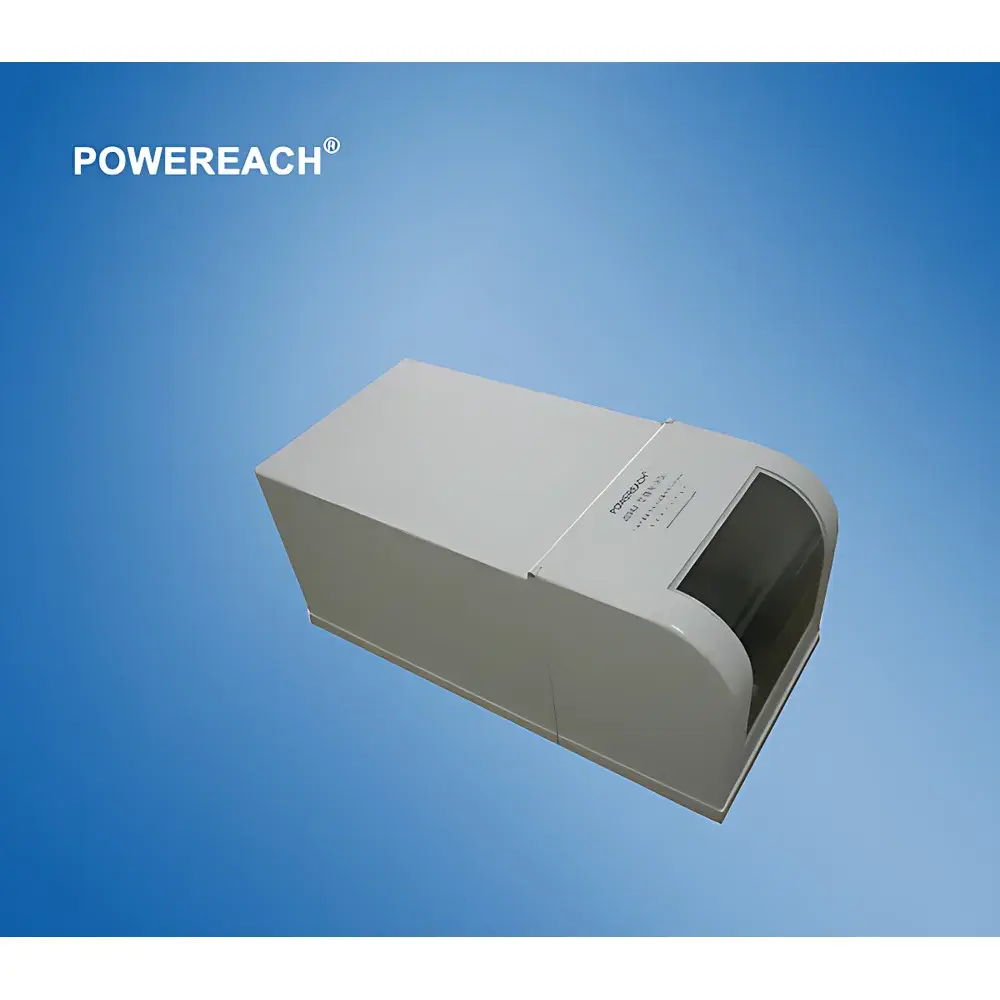
POWEREACH JS94K2-3H20X Microelectrophoresis Analyzer (Zeta Potential Analyzer)
| Brand | POWEREACH |
|---|---|
| Origin | Shanghai, China |
| Model | JS94K2-3H20X |
| Zeta Potential Range | ±200 mV (typical, system-limited) |
| pH Range | 1.6–13.0 (standard operation 2.0–12.0, resolution 0.1) |
| Temperature Range | Ambient to 35 °C (readout resolution 0.1 °C) |
| Particle Size Compatibility | 0.2–50 µm |
| Optical Resolution | 1.93–12 pixels/µm (motorized zoom optical system) |
| Power Consumption | <150 W |
| Compliance | GB/T 32668–2016 (General Rules for Zeta Potential Analysis of Colloidal Particles by Electrophoresis) |
| System Accuracy | ±5% relative error (per certified reference dispersions under controlled conditions) |
| Sample Volume per Measurement | 0.5 mL |
| Voltage Polarity Switching Interval | 0.30–1.20 s (adjustable) |
| Measurement Time per Cycle | 3–10 s |
| Light Source | Low-power semiconductor blue/green LED (non-thermal, near-field illumination) |
Overview
The POWEREACH JS94K2-3H20X Microelectrophoresis Analyzer is a high-precision, microscope-based zeta potential measurement instrument engineered for direct visualization and quantitative electrophoretic mobility analysis of colloidal particles and dispersed droplets in liquid media. It operates on the principle of microelectrophoresis—capturing real-time particle motion under a controlled electric field via high-magnification digital microscopy, then calculating zeta potential using the Henry equation with Smoluchowski or Hückel approximations as appropriate for particle size and medium conductivity. Unlike laser Doppler electrophoresis (LDE) systems, this instrument provides “what-you-see-is-what-you-measure” spatial resolution, eliminating ensemble averaging artifacts and enabling unambiguous identification of heterogeneous populations, agglomerates, or interfacial anomalies. Its design conforms strictly to GB/T 32668–2016—the People’s Republic of China National Standard for Zeta Potential Analysis by Electrophoresis—which was developed in parallel with the JS94 series instrumentation and references its software interface and methodology on page 16. The system is optimized for aqueous and organic dispersions, including emulsions, suspensions, nanomaterials, and biological colloids.
Key Features
- Motorized continuous-zoom optical system (1.93–12 pixels/µm resolution) with short-wavelength blue/green LED illumination—minimizes thermal perturbation and enhances contrast for sub-micron particles.
- Patented open-cell electrophoresis chamber: 0.5 mm thick borosilicate glass cell with integrated Ag, Pt, and POM electrodes; eliminates dead-volume and electrode polarization through low-frequency bipolar voltage switching (0.30–1.20 s adjustable).
- Real-time temperature compensation: embedded thermistor probe continuously feeds ambient temperature data to the acquisition software for automatic dielectric constant and viscosity correction in zeta potential calculation.
- Minimal sample consumption: only 0.5 mL required per measurement; rapid rinse-and-reuse protocol enables high-throughput screening of formulation variants.
- Calibration-integrated imaging workflow: precision “crosshair grid” (micrometer-scale reticle) mounted on a motorized XYZ stage ensures reproducible field-of-view positioning and eliminates stagnant layer interference.
- Dedicated acquisition terminal preloaded with proprietary firmware and driver stack—optimized for synchronized 1200× magnified grayscale image capture at user-defined frame intervals.
Sample Compatibility & Compliance
The JS94K2-3H20X supports broad material compatibility across industrial and academic research domains. It accommodates particles from 0.2 µm to 50 µm in diameter—including metal oxides (TiO₂, SiO₂), polymeric nanoparticles (PLGA, PS), liposomes, protein aggregates, clay minerals, and pigment dispersions—in both aqueous buffers (pH 1.6–13.0) and low-conductivity organic solvents (e.g., ethanol, THF, DMF). Its methodology satisfies metrological traceability requirements outlined in GB/T 32668–2016 and aligns with internationally recognized principles referenced in ISO 13099-2 (Colloidal systems — Methods for zeta-potential determination — Part 2: Optical methods). While not inherently 21 CFR Part 11 compliant out-of-the-box, audit trails, electronic signatures, and raw data export (TIFF, CSV, XML) are supported via optional software modules suitable for GLP/GMP environments upon validation.
Software & Data Management
The instrument is operated via POWEREACH’s proprietary ZetaView™ acquisition and analysis suite, installed on a factory-configured Dell workstation (Windows OS, Intel Core i5 or higher, 16 GB RAM, SSD). The software implements automated particle tracking across four sequential bidirectional frames, computes electrophoretic mobility histograms, applies Smoluchowski correction for aqueous systems (κa > 20), and exports zeta potential distributions with statistical descriptors (mean, SD, PDI). All raw image sequences, parameter logs, and calibration records are stored in timestamped project folders with MD5 checksums. Batch processing, report generation (PDF/DOCX), and export to LIMS-compatible formats (ASTM E1447, ISO/IEC 17025 metadata schema) are supported. Software updates are provided free of charge for the lifetime of the instrument.
Applications
This analyzer serves critical roles in formulation science and interfacial characterization workflows. In cosmetics R&D, it quantifies surface charge stability of nanoemulsions and polymeric micelles across pH gradients. In mineral processing, it determines optimal dispersant dosage for flotation slurries by mapping zeta potential vs. reagent concentration. In pharmaceutical development, it assesses colloidal stability of mRNA-LNPs and predicts aggregation onset during lyophilization cycle design. Academically, it is widely adopted for teaching electrokinetics, colloid chemistry, and soft matter physics—particularly where visual verification of electrophoretic behavior is pedagogically essential. Additional use cases include inkjet ink rheology optimization, battery slurry zeta mapping, membrane fouling mechanism studies, and environmental colloidal transport modeling.
FAQ
What is the minimum particle size resolvable by the JS94K2-3H20X?
Particles as small as 0.2 µm can be reliably tracked under optimal contrast conditions (e.g., TiO₂ in water at pH 4–9); detection sensitivity depends on refractive index mismatch and staining—not instrument hardware limits.
Does the system require external calibration standards?
Yes—certified polystyrene latex (PSL) standards (e.g., Duke Scientific NIST-traceable 1.0 µm and 3.0 µm) are recommended for mobility calibration prior to routine use.
Can the instrument measure zeta potential in non-aqueous media?
Yes—provided the solvent exhibits sufficient conductivity (>10 µS/cm) and optical clarity; common organic media include ethanol/water mixtures, acetone, and low-viscosity esters.
Is the software compatible with macOS or Linux?
No—the ZetaView™ suite is Windows-only; virtualization or dual-boot configurations are unsupported and invalidate warranty coverage.
How is temperature controlled during measurement?
The system monitors ambient temperature only; active thermostating requires an external recirculating chiller or climate-controlled lab environment (20–25 °C recommended).



