
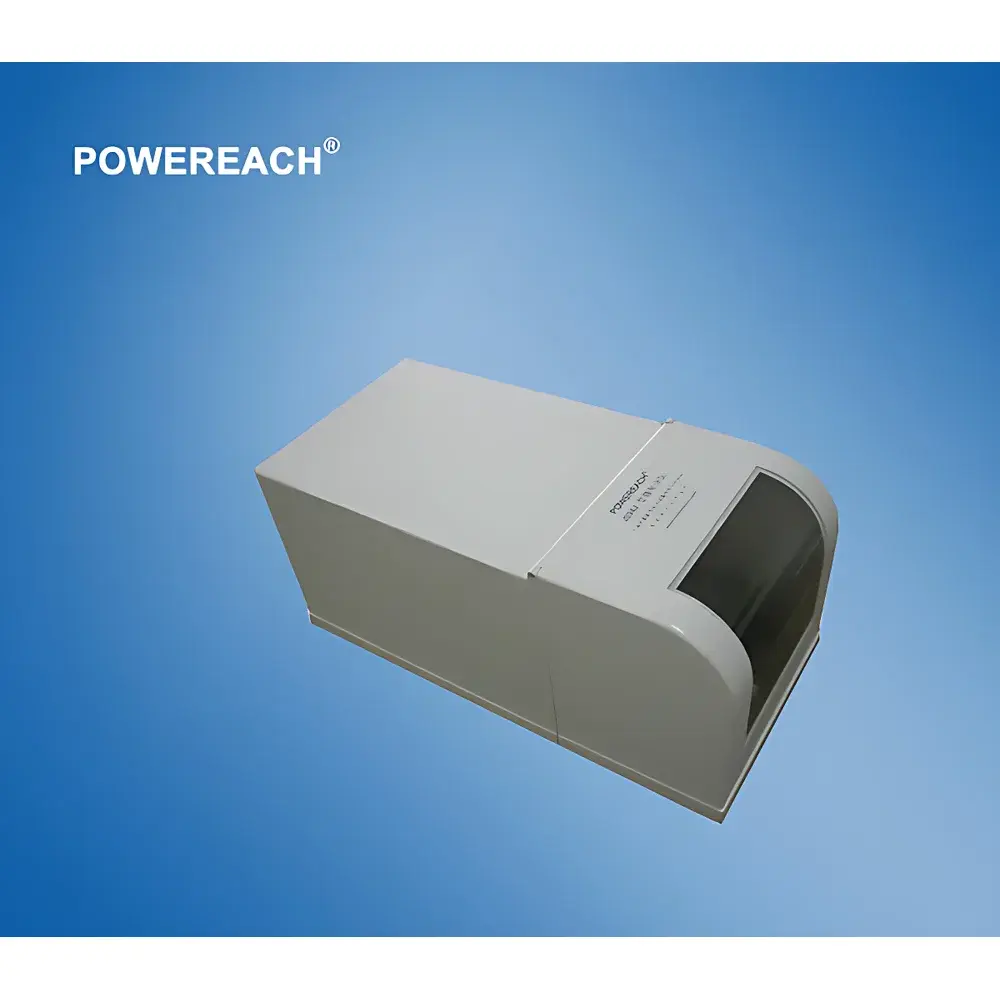
POWEREACH JS94H-3H10X Microelectrophoresis Zeta Potential Analyzer
| Brand | POWEREACH |
|---|---|
| Origin | Shanghai, China |
| Model | JS94H-3H10X |
| Zeta Potential Range | ±200 mV (typical, dependent on sample conductivity) |
| pH Range | 1.6–13.0 (optimal 2.0–12.0) |
| Operating Temperature | 20–35 °C |
| Temperature Resolution | 0.1 °C |
| Optical Resolution | 3 pixels/µm |
| System Accuracy | ±5% relative error (per GB/T 32668-2016 validation protocol) |
| Particle Size Applicability | 0.5–20 µm (aqueous dispersions) |
| Power Consumption | <150 W |
| Input Voltage | 220 V AC, 50 Hz |
Overview
The POWEREACH JS94H-3H10X Microelectrophoresis Zeta Potential Analyzer is a precision optical-electrophoretic instrument engineered for direct, visual measurement of electrophoretic mobility and subsequent calculation of zeta potential (ζ) in colloidal and dispersed systems. It implements the standardized microelectrophoresis method defined in GB/T 32668–2016, “General Rules for Zeta Potential Analysis of Colloidal Particles by Electrophoresis”, the first national standard for zeta potential determination in China. Unlike laser Doppler electrophoresis (LDE) or phase analysis light scattering (PALS), this system relies on real-time microscopic observation of particle motion under controlled DC electric fields—enabling direct visualization of electrophoretic velocity, elimination of electro-osmotic flow artifacts via precise field alignment, and unambiguous identification of stationary layer boundaries using calibrated micrometer-scale reference optics.
The instrument operates on the principle of measuring particle displacement over time within a defined electric field gradient, using high-magnification (1200×), short-wavelength (blue/green) semiconductor illumination with sub-mW optical power to avoid thermal convection or photophoretic disturbance. Velocity data are extracted from sequential grayscale image pairs captured at programmable intervals (3–10 s per measurement), with bidirectional field reversal (0.30–1.20 s polarity switching) to suppress electrode polarization and ensure stable current delivery. All raw displacement and field parameters are fed into an ISO/IEC 17025-aligned computational engine compliant with Smoluchowski and Henry correction models for aqueous media.
Key Features
- Open-cell microelectrophoresis chamber with integrated Ag/AgCl and Pt/Ti electrodes, fabricated from 0.5 mm precision-ground borosilicate glass to minimize edge effects and electro-osmosis.
- Optimized electrode geometry and surface passivation ensure long-term stability and reproducible current density across repeated measurements.
- Dedicated USB digital CCD camera (1280 × 1024 resolution) synchronized with low-frequency constant-voltage power supply for high signal-to-noise velocity tracking.
- Calibrated “rice-pattern” (crosshair + concentric grid) reference target enabling rapid, operator-independent positioning of the measurement plane within the electroosmotic null region.
- Real-time temperature monitoring via embedded thermistor probe; automatic thermal compensation applied during ζ calculation per IUPAC-recommended Debye–Hückel and viscosity corrections.
- Modular software architecture supporting hardware-agnostic configuration—same interface and algorithm core adapts seamlessly across JS94 series variants without retraining.
Sample Compatibility & Compliance
The JS94H-3H10X is validated for use with aqueous suspensions and emulsions containing particles or droplets sized between 0.5 µm and 20 µm, including metal oxides, polymer latices, silica nanoparticles, biological vesicles, and pharmaceutical colloids. It accommodates wide pH operation (1.6–13.0), though optimal accuracy is maintained between pH 2.0 and 12.0 where buffer capacity and electrode stability are maximized. The system meets functional equivalence requirements outlined in ASTM D7825–15 (Standard Guide for Zeta Potential Measurement) and supports GLP-compliant data recording through timestamped audit trails, user-access controls, and exportable raw image + metadata bundles. While not FDA 21 CFR Part 11-certified out-of-the-box, its software architecture permits integration with validated LIMS environments via CSV/JSON export and configurable electronic signature workflows.
Software & Data Management
The proprietary acquisition and analysis suite runs natively on Windows-based industrial terminals preinstalled with all drivers, calibration files, and application modules. It provides synchronized video capture, automated frame registration, manual or auto-threshold particle selection, dual-directional velocity vector averaging, and built-in reporting templates aligned with GB/T 32668–2016 Annex B. All measurement sessions are logged with full parameter traceability—including voltage, field strength, temperature, exposure time, pixel scale, and user ID. Raw image sequences (.tiff), processed velocity tables (.csv), and summary reports (.pdf) are stored in hierarchical project folders with SHA-256 checksums. Software updates are delivered free-of-charge for life and include backward-compatible firmware patches for sensor calibration drift compensation.
Applications
This instrument serves as a primary tool for interfacial charge characterization in R&D and QC laboratories across multiple regulated and industrial domains. In pharmaceutical development, it supports formulation stability assessment of liposomal drug carriers and protein therapeutics by mapping isoelectric points and pH-dependent charge inversion. In materials science, it enables optimization of dispersant selection for ceramic slurries, battery cathode precursors, and pigment dispersions used in coatings and displays. Environmental labs apply it to evaluate coagulant efficiency in wastewater treatment and nanoparticle fate modeling in aquatic systems. Academic users leverage its pedagogical clarity for teaching colloid electrokinetics, DLVO theory validation, and surface modification kinetics—supported by comprehensive lab manuals and curriculum-aligned experiment protocols.
FAQ
What measurement principle does the JS94H-3H10X employ?
It uses direct optical microelectrophoresis—tracking individual particle displacement under a known electric field using high-resolution microscopy and digital image correlation.
Is the instrument compatible with non-aqueous solvents?
No. It is designed exclusively for aqueous or low-conductivity polar media (e.g., water/ethanol mixtures up to 30% v/v); organic solvents require alternative instrumentation due to dielectric breakdown and electrode compatibility constraints.
How is electro-osmotic flow corrected during measurement?
By combining precise optical alignment of the measurement plane with the rice-pattern reference target and bidirectional field reversal, the system isolates true particle mobility from bulk fluid motion.
Does the system support automated batch analysis?
Yes—through scriptable macros and scheduled measurement queues; however, each sample requires manual loading and focus adjustment due to open-cell design.
What is the minimum required sample volume per test?
0.5 mL per measurement cycle; reusable electrokinetic cells allow sequential testing of multiple formulations with minimal cross-contamination risk when rinsed with deionized water and ethanol.



