
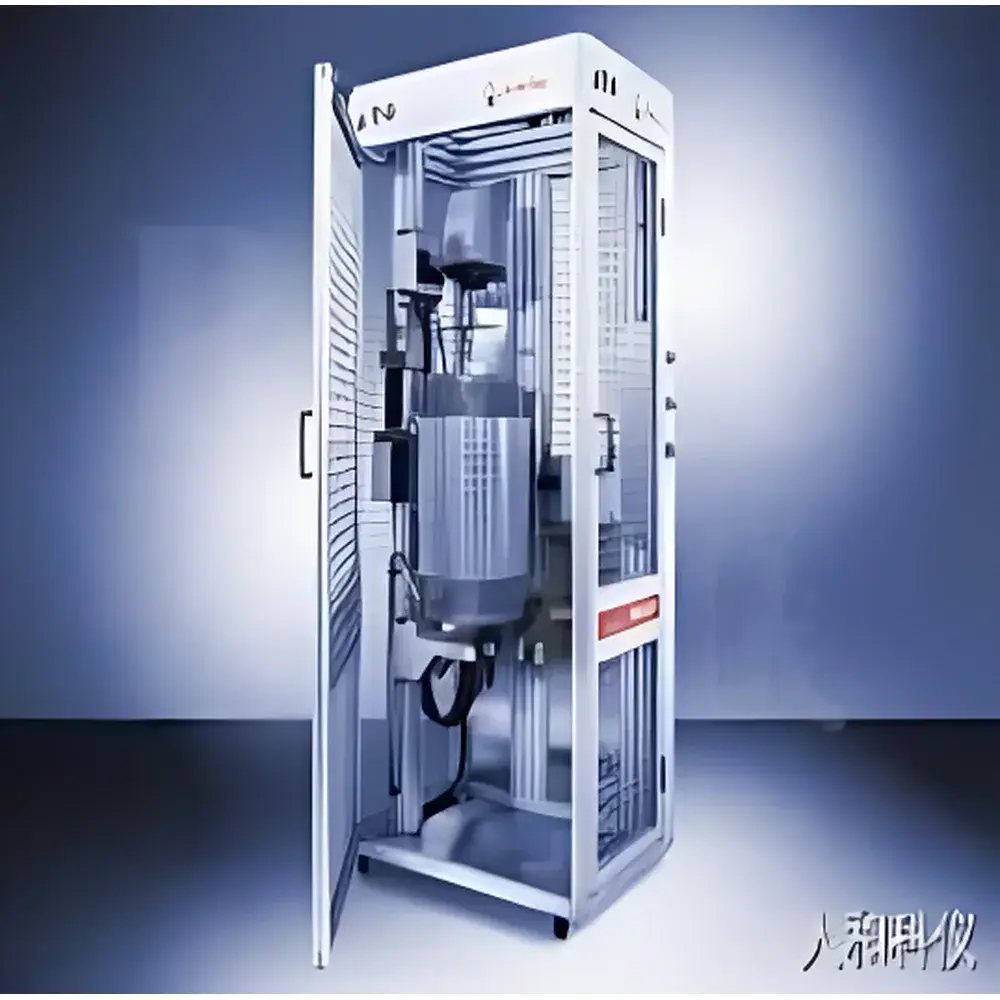
Anton Paar FRS 1600 High-Temperature Furnace Rheometer System
| Brand | Anton Paar |
|---|---|
| Origin | Austria |
| Instrument Type | Rotational Rheometer |
| Model | FRS 1600 |
| Sample State | Liquid (molten) |
| Bearing Type | Air-bearing |
| Minimum Rotational Speed | 10⁻⁹ rpm |
| Frequency Range | 10⁻⁷ – 628 rad/s |
| Maximum Rotational Speed | 300 rpm |
| Maximum Torque | 230 mNm |
| Torque Resolution | 1 nNm |
| Temperature Range | 300–1600 °C |
| Compliance | ASTM C965, ISO 7884-2 |
Overview
The Anton Paar FRS 1600 High-Temperature Furnace Rheometer System is an engineered solution for precise rheological characterization of inorganic melts—including silicate glasses, metallurgical slags, molten metals, and ceramic precursors—under controlled high-temperature conditions up to 1600 °C. Based on the Couette principle, the system integrates a high-performance air-bearing rotational rheometer with a programmable laboratory furnace (Carbolite STF16/180), enabling direct measurement of dynamic viscosity, storage modulus (G′), loss modulus (G″), and complex viscosity (η*) across both steady-state and oscillatory shear regimes. Unlike conventional viscometers limited to low-temperature liquids or empirical capillary methods, the FRS 1600 delivers quantitative, traceable rheological data under industrially relevant thermal profiles—critical for process design, quality control, and fundamental research in glass manufacturing, metallurgy, nuclear fuel processing, and advanced ceramics development.
Key Features
- Air-bearing measurement head with active air/water cooling, ensuring mechanical stability and minimal thermal drift during extended high-temperature operation.
- EC motor drive with high-resolution optical encoder, supporting both controlled shear rate (CSR) and controlled shear stress (CSS) modes with torque resolution down to 1 nNm and angular velocity resolution as low as 10⁻⁹ rpm.
- Integrated pneumatic positioning system for precise, repeatable immersion of concentric cylinder geometries into molten samples—enabling automated pre-heating, measurement, and retraction sequences.
- Furnace chamber with programmable temperature ramping (up to 1600 °C), dual-zone heating, and optional inert gas purging (N₂, Ar) to prevent oxidation of reactive melts.
- Modular geometry support: interchangeable Al₂O₃, graphite, Pt, and custom-fabricated concentric cylinder systems (rotor diameters 11–27.6 mm; cup height up to 100 mm), selected per sample reactivity and thermal expansion compatibility.
- Factory-calibrated temperature monitoring via S- or B-type thermocouples embedded directly in the sample cup or furnace zone—ensuring ±0.1 °C accuracy at operating temperatures.
Sample Compatibility & Compliance
The FRS 1600 is designed for high-temperature liquid-phase materials exhibiting Newtonian or non-Newtonian behavior under shear, including but not limited to soda-lime and borosilicate glasses, blast furnace slags, aluminum and copper alloys, uranium dioxide slurries, and phosphate-based bioactive melts. All contact components are chemically inert and thermally stable within the operational range. The system complies with ASTM C965 (Standard Test Method for Viscosity of Glass Melts) and ISO 7884-2 (Glass — Determination of Viscosity — Part 2: Rotational Methods), supporting audit-ready documentation required for GLP and GMP environments. Optional DMA™ module enables time-temperature superposition (TTS) analysis for viscoelastic modeling of glass transition behavior.
Software & Data Management
RheoCompass™ software provides unified control of both rheometer and furnace subsystems, offering intuitive workflow configuration for multi-step temperature sweeps, frequency sweeps, amplitude sweeps, and creep-recovery protocols. All raw data—including torque, angular displacement, temperature, and normal force—are timestamped and stored in vendor-neutral HDF5 format. Software supports full audit trail logging per FDA 21 CFR Part 11 requirements, including user authentication, electronic signatures, and change history tracking. Export options include CSV, Excel, and graphical reports compliant with internal QA/QC templates. Remote monitoring and script-based automation (via Python API) are available for integration into centralized lab informatics platforms.
Applications
- Optimization of glass melting and fining processes through real-time melt viscosity mapping versus temperature and composition.
- Slag viscosity modeling for blast furnace and electric arc furnace operations to improve slag-metal separation efficiency.
- Thermal stability assessment of refractory linings via in-situ melt interaction studies.
- Development of low-viscosity glass-ceramic precursors for additive manufacturing and precision casting.
- Fundamental investigation of structural relaxation kinetics in oxide melts using time-resolved oscillatory measurements.
- Validation of computational fluid dynamics (CFD) models with experimentally derived rheological inputs at elevated temperatures.
FAQ
What sample volume is required for a typical FRS 1600 measurement?
Typical sample volumes range from 5 mL to 25 mL depending on geometry selection; minimum fill height is 15 mm to ensure full rotor immersion and avoid edge effects.
Can the FRS 1600 measure yield stress in semi-molten or crystallizing systems?
Yes—using controlled stress ramping and creep recovery protocols, the system quantifies apparent yield behavior in partially crystallized slags or glass-forming melts near the liquidus temperature.
Is calibration traceable to national standards?
Torque and angular displacement calibrations are performed using NIST-traceable reference standards; temperature calibration follows ITS-90 via certified thermocouple verification.
How is sample contamination minimized during repeated high-temperature runs?
The furnace features a removable crucible platform and dedicated cleaning cycles; all geometries are individually labeled and stored in inert-atmosphere cabinets to prevent cross-contamination.
Does the system support long-term isothermal stability testing?
Yes—the air-bearing architecture and active cooling enable uninterrupted 72+ hour isothermal measurements at 1500 °C with torque drift < 0.5% of full scale.



