
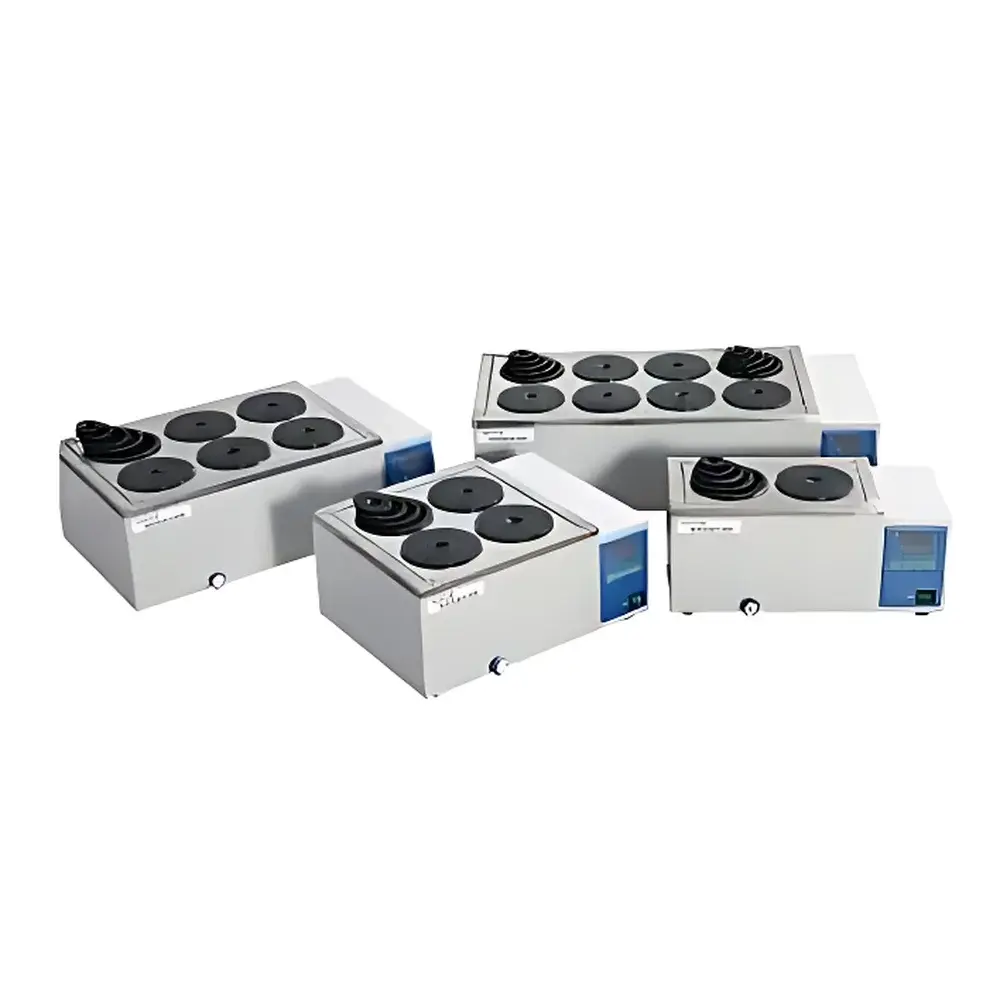
Shanghai Yiheng HWS-Series Precision Water Bath Circulator (Non-Circulating, Heating-Only)
| Key | Brand: Shanghai Yiheng |
|---|---|
| Origin | Shanghai, China |
| Model | HWS-12 / HWS-24 / HWS-26 / HWS-28 |
| Power Consumption | 500 W / 1000 W / 1500 W / 2000 W |
| Temperature Range | RT+5 °C to 99 °C |
| Temperature Stability | ±0.5 °C |
| Bath Volume | 4.9 L / 9.9 L / 14.8 L / 19.8 L |
| Inner Chamber Dimensions (W×D×H, mm) | 347×201×155 / 376×347×165 / 496×347×165 / 600×300×110 |
| External Dimensions (W×D×H, mm) | 455×201×183 / 483×347×194 / 603×347×194 / 752×345×210 |
| Timer Range | 0–999 min |
| Alarm Threshold | +2 °C above setpoint |
| Chamber Material | Stainless Steel 304 |
| Well Configurations | 2-, 4-, 6-, or 8-hole dual-row layout |
| Well Diameters | Ø32 / Ø52 / Ø72 / Ø92 / Ø112 mm |
Overview
The Shanghai Yiheng HWS-Series Precision Water Bath is a benchtop, non-circulating, heating-only thermal management system engineered for stable, uniform temperature control in laboratory environments. Designed according to fundamental principles of conductive heat transfer and passive thermal equilibrium, the unit maintains setpoint temperatures via resistive heating elements embedded beneath a stainless steel bath chamber, coupled with high-resolution PID-based microprocessor control. Unlike circulating baths that rely on forced convection for homogeneity, the HWS-Series achieves thermal consistency through optimized chamber geometry, low-thermal-mass construction, and precise feedback regulation—making it suitable for applications where gentle, non-turbulent thermal exposure is required, such as enzyme incubation, sample equilibration prior to analysis, dissolution testing preparation, and low-shear stability studies. Its operational envelope spans from ambient +5 °C to 99 °C, with a certified temperature stability of ±0.5 °C under steady-state conditions—a performance level aligned with routine QC/QA requirements in academic, industrial, and pharmaceutical laboratories.
Key Features
- Stainless steel 304 inner tank ensures corrosion resistance, ease of cleaning, and long-term compatibility with aqueous and mild organic media.
- Modular well configuration supports flexible vessel integration: dual-row layouts accommodate 2, 4, 6, or 8 vessels; individual well diameters are user-selectable (Ø32, Ø52, Ø72, Ø92, or Ø112 mm) via interchangeable inserts.
- Microprocessor-based temperature controller delivers repeatable setpoint accuracy, real-time digital display, and programmable timer functionality (0–999 minutes) with automatic shutdown.
- Dual-stage overtemperature protection includes both electronic tracking alarm (+2 °C deviation from setpoint) and independent mechanical cut-off to safeguard samples and equipment integrity.
- Low electromagnetic interference design minimizes impact on adjacent sensitive instrumentation, supporting co-location in shared analytical workspaces.
- Energy-efficient heating architecture—power ratings scale precisely with bath volume (500 W to 2000 W)—reducing standby thermal load without compromising ramp rate or stability.
Sample Compatibility & Compliance
The HWS-Series accommodates standard laboratory glassware including test tubes, centrifuge tubes, volumetric flasks, and beakers up to 1000 mL capacity. Its open-bath architecture permits direct visual monitoring and manual intervention during thermal protocols. While not certified for GMP manufacturing environments, the system conforms to general-purpose laboratory safety standards (IEC 61010-1:2010) and supports documentation workflows compatible with GLP-compliant recordkeeping. Temperature calibration traceability can be established using NIST-traceable reference thermometers, enabling alignment with internal SOPs for method validation and equipment qualification (IQ/OQ). The absence of fluid circulation eliminates cross-contamination risk between wells—critical for parallel assays requiring isolation.
Software & Data Management
The HWS-Series operates as a standalone instrument with no embedded data logging or remote interface capability. All operational parameters—including set temperature, elapsed time, and alarm status—are displayed locally via LED readout. For laboratories requiring audit trails or electronic records, external data acquisition is supported through analog voltage output (0–5 V DC proportional to bath temperature) available on select configurations, compatible with third-party DAQ systems or SCADA platforms. When integrated into validated processes, users may apply 21 CFR Part 11-compliant software solutions to capture, timestamp, and archive temperature profiles—provided the external system implements appropriate access controls, electronic signatures, and change history.
Applications
- Precise pre-warming of reagents and standards prior to HPLC, GC, or spectrophotometric analysis.
- Controlled solubilization of temperature-sensitive compounds in formulation development.
- Thermal conditioning of biological samples (e.g., serum, cell suspensions) before centrifugation or dilution.
- Calibration bath for probe verification across multiple temperature points within the 5–99 °C range.
- Supporting ASTM D1500 (petroleum color), USP <797> (compounding sterility), and ISO 8573-1 (compressed air testing) preparatory steps.
- Use in teaching laboratories for thermodynamics experiments involving heat capacity, phase transition observation, and Arrhenius kinetics modeling.
FAQ
Is the HWS-Series suitable for oil bath applications?
Yes—the stainless steel chamber and heating system are chemically resistant to common silicone and mineral oils; however, maximum operating temperature must remain within the specified 99 °C limit, and viscosity-dependent heat transfer efficiency should be verified empirically for each oil type.
Can the unit maintain temperature during power interruptions?
No—this is a non-buffered, line-powered device with no battery backup or thermal inertia retention; temperature drift begins immediately upon loss of AC supply.
Does it support external temperature probe input for chamber monitoring?
Not natively; chamber temperature is measured exclusively by the built-in PT100 sensor. External probe integration requires third-party signal conditioning hardware.
What maintenance is required to ensure long-term accuracy?
Annual verification using a calibrated reference thermometer is recommended; cleaning of the stainless steel bath and inspection of heater insulation integrity should occur after every 500 operational hours or per institutional preventive maintenance schedule.
Are replacement well inserts available separately?
Yes—Shanghai Yiheng supplies OEM-compatible well inserts in all five standard diameters (Ø32 to Ø112 mm), sold individually or in configurable kits matching HWS-12 through HWS-28 chassis dimensions.



