
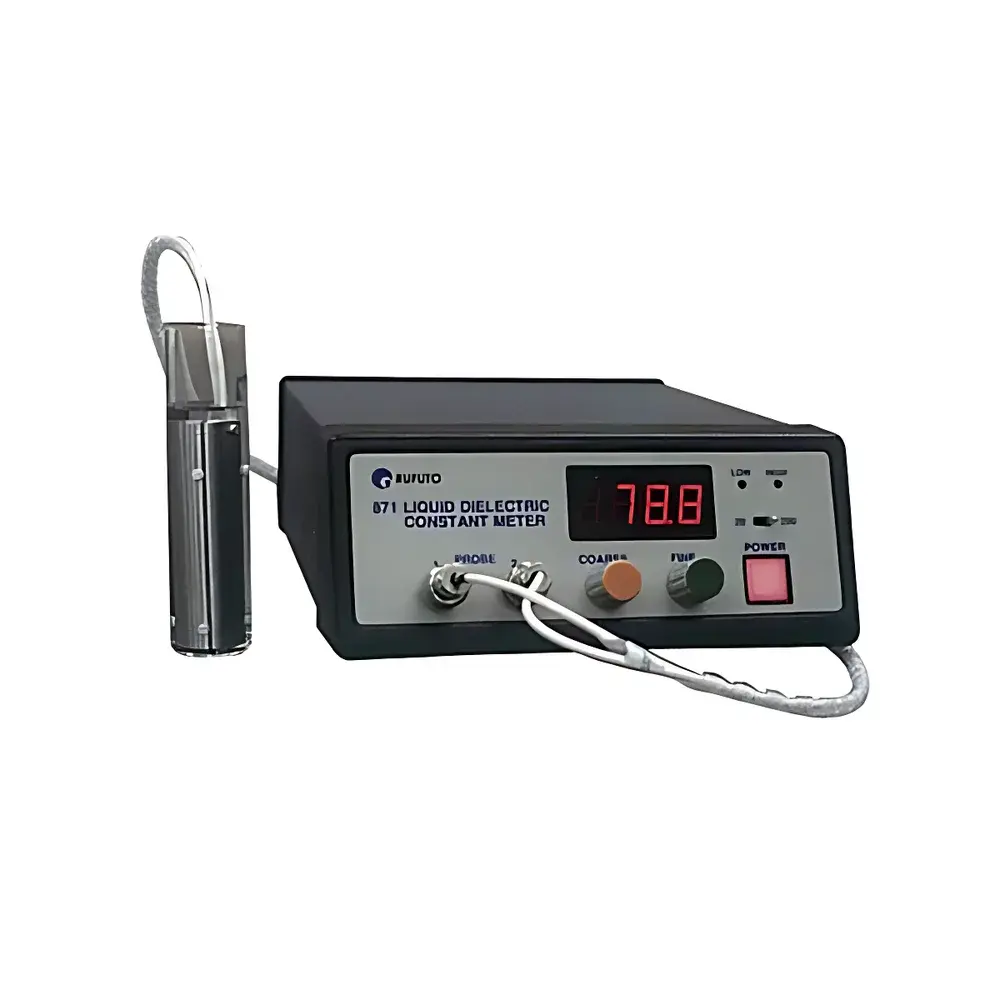
DT RUFUTO-871 Dielectric Constant Analyzer
| Brand | DT (USA) |
|---|---|
| Origin | USA |
| Model | RUFUTO-871 |
| Measurement Range | 1–20 and 1–200 (dimensionless) |
| Accuracy | ±2% |
| Calibration | With deionized water or reference liquids of known permittivity |
| Probe Type | Open-ended coaxial probe |
| Sample Compatibility | Aqueous solutions, polar and non-polar organic solvents, solvent mixtures |
Overview
The DT RUFUTO-871 Dielectric Constant Analyzer is a precision benchtop instrument engineered for rapid, non-destructive measurement of relative permittivity (dielectric constant, εr) across a broad spectrum of liquid samples. It operates on the principle of open-ended coaxial probe reflectometry: a high-frequency RF signal (typically in the 10 MHz–3 GHz range, optimized per calibration protocol) is transmitted into the sample via a calibrated coaxial sensor; the reflected signal’s phase and amplitude shift are analyzed to determine complex permittivity, from which the real part (ε′) — reported as the dielectric constant — is extracted. This method enables direct, in-situ characterization without sample dilution or electrode contact, making it especially valuable for low-conductivity media where traditional impedance-based methods suffer from polarization errors. The RUFUTO-871 is routinely deployed in colloid science laboratories, formulation development units, and QC environments where accurate εr values are critical inputs for Zeta potential calculation (e.g., via Henry’s or Smoluchowski approximations), solvation modeling, and electrolyte solution thermodynamics.
Key Features
- Two selectable measurement ranges: 1–20 (optimized for aqueous and polar systems) and 1–200 (extended range for high-permittivity solvents such as ethylene glycol or glycerol)
- Open-ended coaxial probe architecture ensures minimal sample volume requirement (≤1 mL), eliminates electrode fouling, and allows straightforward cleaning with solvents or ultrasonic baths
- Factory-calibrated with traceable NIST-traceable reference standards; user-performed two-point calibration using deionized water (εr = 78.3 at 25°C) and a second reference liquid (e.g., methanol, εr = 32.6) ensures long-term measurement integrity
- Integrated temperature compensation algorithm corrects for thermal drift when used with optional external Pt100 temperature probe (not included)
- Rugged aluminum chassis with EMI-shielded electronics meets IEC 61326-1 for electromagnetic compatibility in laboratory environments
Sample Compatibility & Compliance
The RUFUTO-871 accommodates homogeneous liquids including ultrapure water, buffer solutions, alcohols, ketones, esters, hydrocarbons, and binary or ternary solvent blends. It is not intended for suspensions, emulsions, or highly viscous fluids (>500 cP) due to interfacial reflection artifacts. All measurements comply with ASTM D150–21 “Standard Test Methods for Dielectric and Resistivity Properties of Solid Electrical Insulating Materials” principles adapted for liquids, and support GLP-compliant workflows through audit-trail-capable software logging (see Software section). Device firmware adheres to FDA 21 CFR Part 11 requirements for electronic records when paired with validated software configurations.
Software & Data Management
The instrument interfaces via USB 2.0 with DT’s proprietary WinDielec v4.2 software (Windows 10/11, 64-bit), providing real-time εr display, automatic calibration curve generation, batch data export (CSV, Excel-compatible), and timestamped measurement logs with operator ID fields. Raw S-parameter data (S11) can be exported for advanced modeling in MATLAB or CST Studio Suite. Software supports configurable pass/fail limits per SOP, PDF report generation with embedded calibration certificates, and secure user role management (Admin, Technician, Viewer) aligned with ISO/IEC 17025 documentation control expectations.
Applications
- Refining Zeta potential calculations in dynamic light scattering (DLS) and electrophoretic mobility instruments by supplying experimentally determined εr, reducing reliance on literature values that neglect composition-dependent deviations
- Monitoring solvent blend ratios in pharmaceutical co-solvent systems (e.g., water–ethanol–propylene glycol) during formulation stability studies
- Validating dielectric properties of battery electrolytes (e.g., LiPF6 in carbonate mixtures) for electrochemical model parameterization
- Quality control of industrial solvents where εr serves as a fingerprint for purity, moisture content, or degradation (e.g., acetone aging)
- Academic research in physical chemistry, including Debye-Hückel theory validation and Kirkwood-Fröhlich dipole correlation analysis
FAQ
What calibration standards are required for routine operation?
Deionized water (certified resistivity ≥18.2 MΩ·cm) and one secondary standard (e.g., methanol, ethanol, or chloroform) with certified εr at 25°C. DT provides a calibration kit (P/N CAL-KIT-R871) containing traceable reference liquids.
Can the RUFUTO-871 measure conductivity simultaneously?
No. It measures only complex permittivity. Conductivity must be determined separately using a dedicated conductometer or impedance analyzer.
Is temperature control integrated?
The base unit does not include a Peltier stage; however, it accepts input from external Pt100 probes (compatible with standard lab circulators) for software-based temperature correction.
How often should recalibration be performed?
Recommended before each analytical session or after probe cleaning; full two-point calibration every 24 hours during continuous use, per ISO/IEC 17025 Clause 7.7.1.
Does the probe require periodic replacement?
The coaxial probe is constructed from passivated 316 stainless steel and PTFE-insulated center conductor; under normal use and proper cleaning, service life exceeds 5 years. DT offers probe refurbishment services (P/N REFURB-PROBE-R871).



