
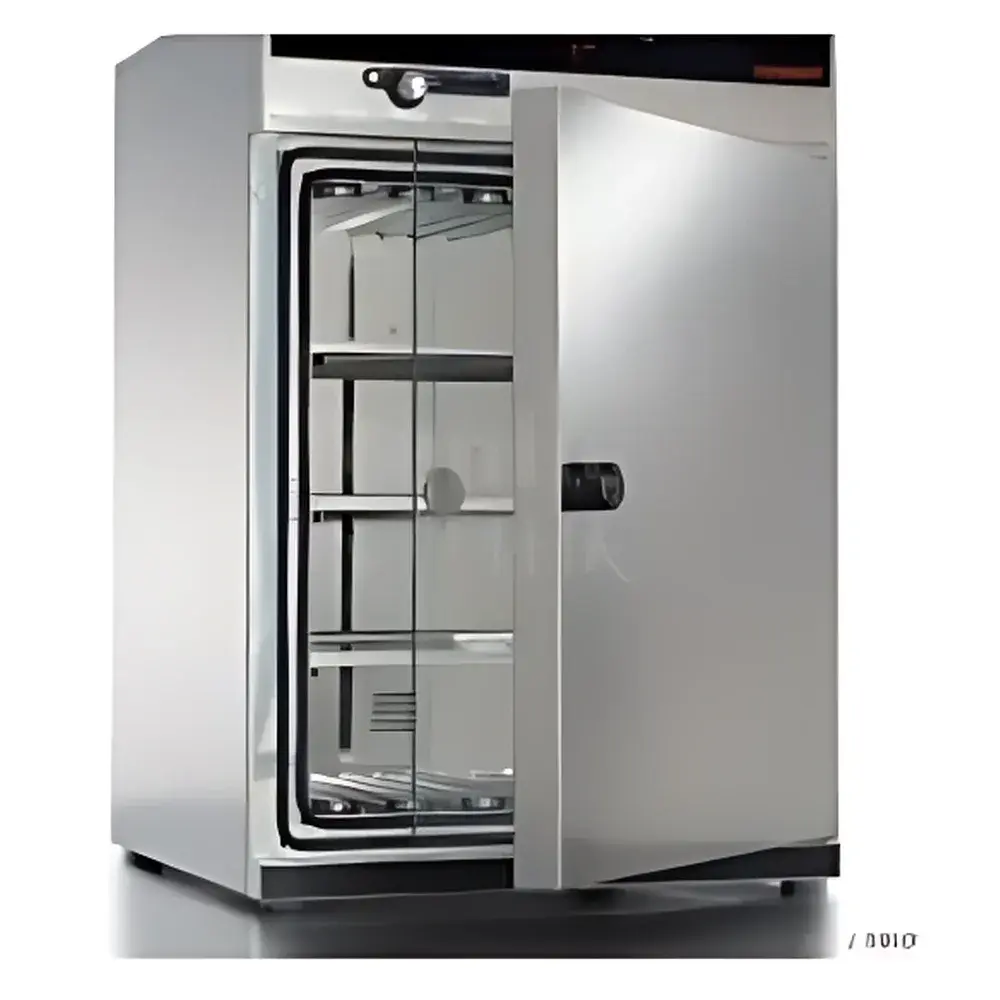
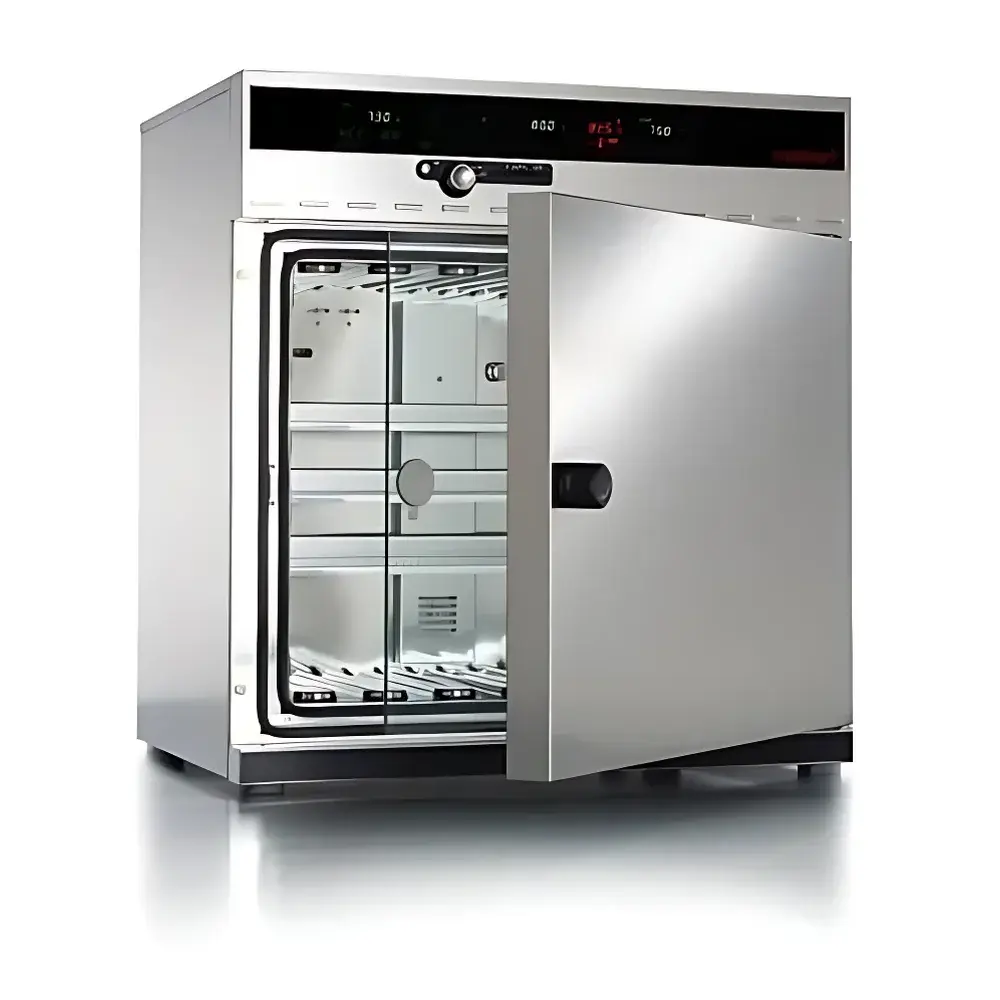
MEMMERT HCP153 Temperature and Humidity Controlled Chamber
| Brand | MEMMERT |
|---|---|
| Origin | Germany |
| Model | HCP153 |
| Instrument Type | Upright Environmental Test Chamber |
| Internal Volume | ~153 L |
| Chamber Dimensions (W×H×D) | 480 × 640 × 500 mm |
| External Dimensions (W×H×D) | 630 × 938 × 650 mm |
| Interior Material | Electropolished Stainless Steel (Deep-Drawn) |
| Exterior Material | Stainless Steel Front, Galvanized Steel Rear |
| Temperature Range (without humidity control) | 20–160 °C |
| Temperature Uniformity (per DIN 12880 at 50 °C) | ≤ ±0.3 K |
| Temperature Stability (per DIN 12880 at 50 °C) | ≤ ±0.15 K |
| Humidity Range | 20–95 % RH (capable of steam-based humidification and condensation-controlled dehumidification) |
| Humidity Sensor | Sterilizable Capacitive RH Sensor |
| Control System | Microprocessor-Based Fuzzy Logic Controller with Dual Pt100 A-Class (4-wire) Temperature Sensors |
| Data Logging | Built-in 1024 KB Circular Memory (≈3 months @ 1-min interval) |
| Communication Interfaces | Standard RS232, Optional RS485 / Ethernet / USB |
| Software | Celsius 2005 (standard), Celsius FDA Edition (21 CFR Part 11 compliant, optional) |
| Safety Systems | Triple Independent Temperature Protection (Mechanical TB, Electronic TWW, ASF Auto-Safety Function), Audible/Visual Alarms for Over-/Under-Temperature, Over-/Under-Humidity, Door Open, Empty Water Reservoir |
| Programmability | Up to 40-step time-temperature-humidity profiles via controller or MemoryCard XL |
| Certification | Factory Calibration Certificate (60 °C center point), Optional IQ/OQ Documentation Packages (DIN 12880, DIN 12900-1), STERICard for 160 °C Sterilization Cycle (4 h) |
Overview
The MEMMERT HCP153 is a precision-engineered upright temperature and humidity controlled chamber designed for rigorous environmental simulation in pharmaceutical stability testing, material aging studies, biological incubation, and quality assurance laboratories. It operates on a dual-control principle: temperature regulation via Peltier-free resistive heating combined with forced-air convection through a closed, non-turbulent airflow system; and humidity control via steam generation from distilled water (supplied externally) and active condensation-based dehumidification. The chamber’s electropolished stainless-steel interior—deep-drawn and passivated—ensures corrosion resistance, ease of cleaning, and compliance with GMP cleanroom requirements. Its thermal architecture conforms strictly to DIN 12880 for temperature uniformity and stability validation, enabling traceable, repeatable environmental conditioning across the full operational range (20–160 °C; 20–95 % RH). Unlike basic incubators, the HCP153 integrates sterilizable humidity sensing and programmable dry-heat sterilization cycles (160 °C, 4 h), making it suitable for applications requiring periodic chamber decontamination without disassembly.
Key Features
- Electropolished deep-drawn stainless-steel chamber interior (ISO 8502-3 compliant surface finish) ensures chemical inertness and facilitates ISO 14644-1 Class 5-compatible cleaning protocols.
- Fuzzy logic microprocessor controller with real-time adaptive compensation for load-induced thermal inertia and humidity lag—enabling rapid setpoint attainment and minimal overshoot.
- Dual independent Pt100 A-class sensors (4-wire configuration) with continuous self-diagnostic monitoring; failure of one sensor triggers automatic fallback to redundant measurement path without process interruption.
- Triple-layer safety architecture: mechanical temperature limiter (TB), electronically adjustable temperature watchdog (TWW), and MEMMERT’s proprietary Automatic Safety Function (ASF)—a hardware-level interlock that cuts power upon deviation exceeding configurable thresholds.
- Integrated sterilizable capacitive humidity sensor (IEC 60751-compliant) with automatic drift compensation during steam sterilization cycles.
- Non-turbulent air circulation system with rear-mounted ducting (<25 mm clearance behind rear wall) guarantees laminar flow patterns and eliminates hot/cold spots per DIN 12880 mapping requirements.
- Standard 1024 KB circular memory buffer stores timestamped temperature, relative humidity, alarm events, and setpoint history at user-selectable intervals (1 min default); data retention ≈3 months.
Sample Compatibility & Compliance
The HCP153 accommodates standard ISO/IEC 17025-compliant sample configurations—including stacked trays, multi-tier racks (E7 series), and custom fixtures—without compromising airflow integrity. Its internal dimensions (480 × 640 × 500 mm) support ICH Q1A(R3) long-term stability storage layouts (e.g., 6×4×3 arrangement of 20 mL vials). All materials contacting the chamber environment meet USP and EU Pharmacopoeia 3.1.1 requirements for extractables and leachables. The system supports full qualification documentation: Factory-calibrated test reports (60 °C center-point verification), optional IQ/OQ packages aligned with ASTM E2500-13 and EU Annex 15, and 27-point temperature/humidity distribution mapping (DIN 12880-2). For regulated environments, the optional Celsius FDA Edition software provides audit-trail-enabled electronic records, role-based user authentication, and digital signature enforcement per 21 CFR Part 11 Subpart B.
Software & Data Management
Celsius 2005 (included) delivers local and remote chamber supervision via Windows OS (NT4 through Windows 10), supporting real-time graphing, alarm export (CSV/XML), and automated report generation. The FDA Edition extends functionality with electronic signatures, immutable audit trails, and ALCOA+ compliant data handling—validated for use in FDA-inspected facilities. Data logging occurs simultaneously to internal flash memory and external PC via RS232 (standard), RS485 (optional daisy-chain for multi-chamber networks), or Ethernet/WiFi (W6 option). MemoryCard XL enables offline profile loading (up to 40 segments), portable calibration data transfer, and STERICard execution. Printer output (PCL3-compatible) is supported via parallel port or USB-parallel adapter (W4/W1 kits), ensuring regulatory-grade hardcopy traceability.
Applications
- ICH Q5C biologics stability testing under accelerated (40 °C/75 % RH) and intermediate (30 °C/65 % RH) conditions.
- Pharmaceutical excipient hygroscopicity assessment per USP and Ph. Eur. 2.9.37.
- Polymer aging studies (ASTM D570, ISO 62) requiring precise moisture uptake quantification.
- Electronics component stress testing (JEDEC JESD22-A110) under high-humidity bias conditions.
- Seed germination and plant tissue culture where diurnal RH cycling must be replicated.
- GMP-compliant equipment qualification (IQ/OQ/PQ) using integrated validation-ready features and Memmert’s certified service support (Q4).
FAQ
Does the HCP153 comply with 21 CFR Part 11 for electronic records?
Yes—when equipped with the optional Celsius FDA Edition software (Q2/Q3), the system meets all technical and procedural requirements for electronic signatures, audit trails, and record retention.
Can humidity be controlled independently of temperature?
No—the system implements coupled control logic to prevent condensation; humidity setpoints are constrained within thermodynamically stable boundaries relative to the active temperature setpoint.
Is the chamber suitable for terminal sterilization of loaded samples?
No—STERICard cycles (160 °C, 4 h) are intended solely for chamber decontamination; loading during sterilization invalidates cycle validation and risks sample degradation.
What is the maximum number of external PT100 probes supported?
Up to three optional Pt100 sensors (V3 accessory) may be installed for localized temperature monitoring; readings appear on the main display and are logged alongside chamber data.
How is water supplied for humidification?
Distilled water is drawn from an external reservoir via a self-priming peristaltic pump; no internal tank reduces microbial growth risk and simplifies maintenance.



