
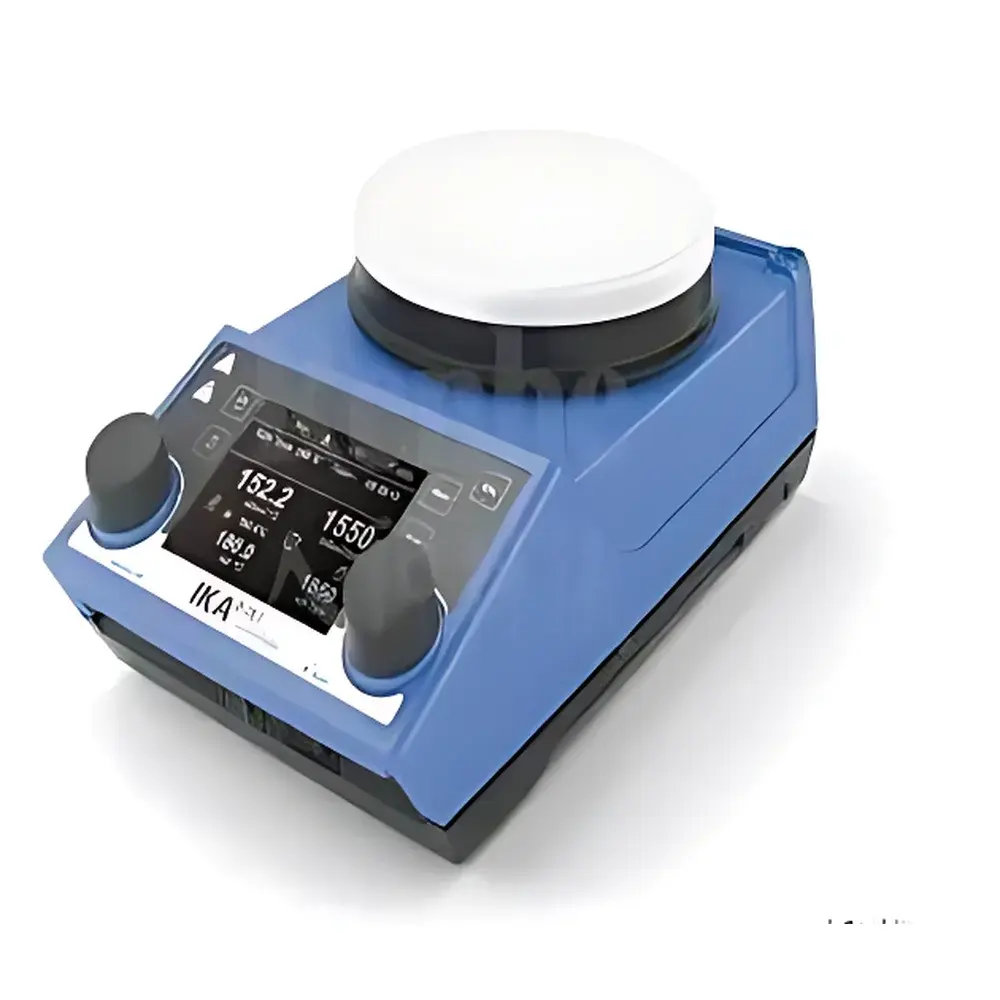
IKA RET control-visc white Safety-Featured Heating Magnetic Stirrer with Integrated Precision Weighing
| Brand | IKA |
|---|---|
| Origin | Germany |
| Model | RET control-visc white |
| Maximum Stirring Volume | 20 L |
| Speed Range | 50–1700 rpm |
| Heating Plate Temperature Range | Ambient + Self-Heating to 340 °C |
| Adjustable Safety Temperature Limit | 50–380 °C |
| Integrated Weighing Capacity | 10–5000 g (Accuracy: ±1 g <500 g |
| Power Input | 650 W |
| Protection Rating | IP42 |
| Interface | RS232, USB |
| Display | TFT touchscreen with multi-language support |
| External Temperature Sensor Support | Dual PT100/PT1000 inputs |
| Compliance | DIN EN 60529, CE, RoHS |
Overview
The IKA RET control-visc white is an advanced safety-integrated heating magnetic stirrer engineered for precision, reproducibility, and unattended operation in regulated laboratory environments. Unlike conventional magnetic stirrers, this instrument uniquely combines three core functional domains—magnetic stirring, programmable resistive heating, and high-resolution mass measurement—within a single compact platform. Its operational principle relies on a brushless DC motor driving rotation via magnetic coupling, a ceramic-coated aluminum heating plate with PID-controlled thermal regulation, and a calibrated load cell integrated beneath the work surface. The system supports dual-mode temperature control: direct plate-setpoint operation or closed-loop medium temperature regulation using external PT100/PT1000 probes inserted into the sample or bath. Designed for ISO/IEC 17025-compliant workflows and GLP-aligned processes, the RET control-visc white meets stringent requirements for traceability, parameter locking, and environmental resilience (IP42 rating). Its architecture enables stable agitation of viscous media up to 20 L (water-equivalent), with real-time torque trend analysis and automatic stir bar centering detection—critical for viscosity-sensitive reactions and dissolution studies.
Key Features
- Integrated precision weighing module (10–5000 g range; ±1 g accuracy ≤500 g) with BNC interface for pH electrode integration
- Dual independent temperature sensing channels: heating plate + sample/bath medium (via optional dual PT100/PT1000 probe)
- Two user-selectable heating modes: rapid ramp-up (up to 7 K/min in 1 L M50 oil) and high-stability precision control (0.1 K resolution)
- TFT touchscreen interface with multi-language support (English, German, French, Spanish, Chinese, Japanese) and intuitive icon-based navigation
- Parameter lock function (“Lock Key”) prevents accidental modification during unattended runs
- Real-time graphical display of torque trends, temperature profiles, and weight changes over time
- Automatic stir bar detection and misalignment alert (Error 5) to prevent vortex collapse or mechanical damage
- Programmable intermittent stirring, countdown timer, and automatic shutdown upon reaching safety temperature limits
- Post-shutdown thermal monitoring: display retains actual plate temperature until it falls below 50 °C
- RS232 and USB ports for remote parameter control, data export (CSV), firmware updates, and audit trail generation
Sample Compatibility & Compliance
The RET control-visc white accommodates standard laboratory vessels—including glass beakers, stainless steel reactors, and jacketed flasks—up to 20 L volume when using appropriately sized stir bars (20–80 mm length). Its enamel-coated aluminum heating plate resists chemical corrosion and thermal shock, supporting continuous operation at up to 340 °C surface temperature. For temperature-critical applications (e.g., polymerization, enzymatic assays, or accelerated stability testing), the dual-sensor configuration ensures compliance with ASTM E2457 (standard practice for thermal validation of heated stir plates) and supports FDA 21 CFR Part 11–aligned electronic record integrity when paired with validated software. The device conforms to DIN EN 60529 (IP42 ingress protection), CE marking directives, and RoHS material restrictions. Its 5–40 °C ambient operating range and ≤80% non-condensing relative humidity tolerance ensure reliability across diverse lab infrastructures.
Software & Data Management
While the instrument operates autonomously via its embedded firmware, the included IKA Labworldsoft-compatible drivers enable bidirectional communication via RS232 or USB. Users can schedule multi-step protocols—including ramp-hold sequences, torque-triggered pauses, and conditional weight thresholds—with full timestamping and operator ID logging. Exported datasets retain native units (°C, rpm, g, N·cm) and support post-processing in MATLAB, Python (pandas), or LIMS platforms. Audit trails include firmware version, calibration timestamps, error logs (e.g., “Error 5: Medium sensor disconnection”), and parameter change history—facilitating internal quality audits and regulatory inspections under ISO 9001 or GMP Annex 11 frameworks.
Applications
- Controlled dissolution testing in pharmaceutical QC labs (USP , ) with simultaneous mass loss/gain tracking
- Viscosity monitoring during polymer synthesis or crosslinking reactions via torque trend analysis
- pH-stat titrations requiring synchronized stirring, heating, and acid/base addition triggered by weight or pH thresholds
- Standardized sample preparation for ICP-MS or HPLC analysis where precise temperature and homogeneity are critical
- Material science workflows involving nanoparticle dispersion in high-boiling-point solvents (e.g., ethylene glycol, silicone oil)
- Teaching laboratories conducting thermokinetic experiments with real-time graphical feedback
FAQ
What safety certifications does the RET control-visc white hold?
It complies with CE, RoHS, and DIN EN 60529 (IP42). Electrical safety follows IEC 61010-1 for laboratory equipment.
Can the weighing function be used simultaneously with stirring and heating?
Yes—the load cell is mechanically isolated from vibration transmission, enabling concurrent operation without interference.
Is calibration of the weighing module traceable to national standards?
Factory calibration is performed against certified weights; users may perform intermediate verification per ISO/IEC 17025 Section 6.6.
Does the USB port support mass storage mode for direct data download?
No—it operates exclusively as a virtual COM port for software communication; data export requires host PC connection.
What is the maximum allowable viscosity for stable 20 L operation?
Stable performance is verified up to 5000 mPa·s (e.g., 1% CMC solution); higher viscosities require reduced volume or lower speed settings.



