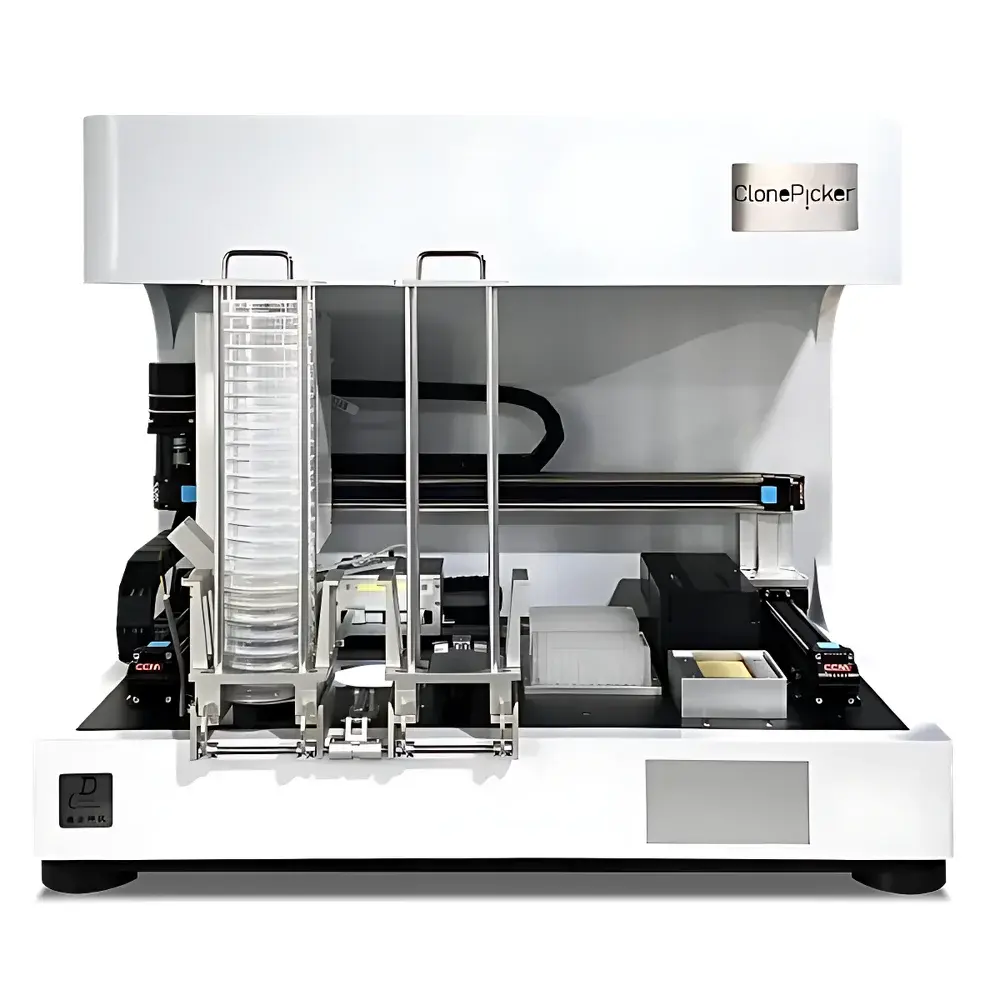
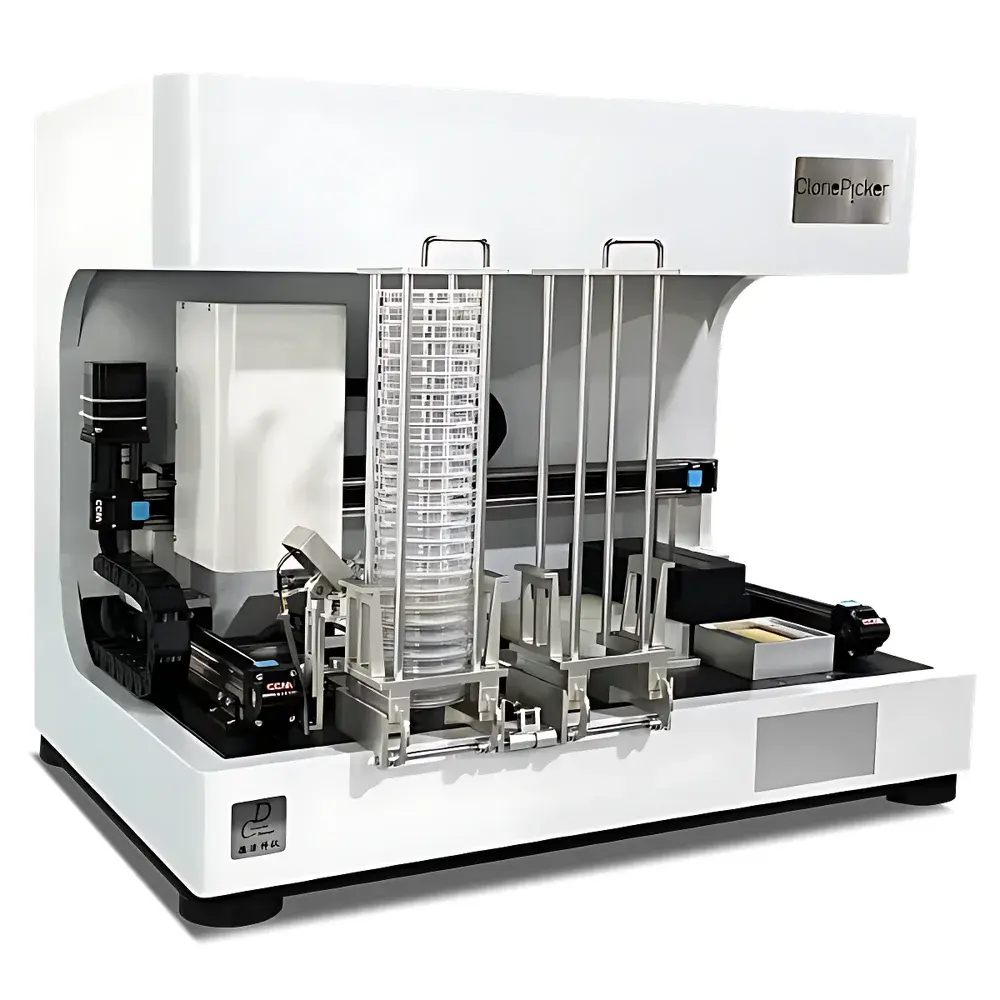
D.C. Labware Autopet-CP8 8-Channel Automated Colony Picking Workstation
| Brand | D.C. Labware |
|---|---|
| Origin | Guangdong, China |
| Manufacturer Type | Authorized Distributor |
| Product Category | Domestic |
| Model | Autopet-CP8 |
| Instrument Type | Multi-needle Colony Picking Workstation |
| Compatible Microorganisms | *Escherichia coli*, *Saccharomyces cerevisiae*, pathogenic bacteria, anaerobes, phage plaques, microalgae, etc. |
| Inoculation Mode | Solid-to-Liquid Transfer |
| Picking Throughput | 800–1,000 colonies/hour |
| Picking Accuracy | >99% |
| Positioning Precision | ≤0.2 mm |
| Destination Plate Formats | Standard or deep-well SBS-compliant plates (48-, 96-, and 384-well) |
| Source Plate Formats | Petri dishes (8/9/10 cm diameter) or square SBS-format dishes |
| Dimensions (L×W×H) | 87 × 62 × 74 cm |
Overview
The D.C. Labware Autopet-CP8 is an 8-channel automated colony picking workstation engineered for high-throughput, precision-based microbial strain isolation in synthetic biology, pharmaceutical R&D, microbial breeding, and genomic library construction. It operates on a solid-to-liquid transfer principle, integrating machine vision-guided colony detection with synchronized multi-needle mechanical actuation to achieve reproducible, contamination-controlled colony selection. Unlike single-channel or consumable-dependent systems, the Autopet-CP8 employs a fixed-array stainless-steel needle architecture—each needle independently positioned and collectively sterilized via integrated resistive heating—enabling rapid, non-contact, low-maintenance operation while maintaining strict adherence to GLP-aligned traceability requirements.
Key Features
- Parallel 8-Needle Architecture: Eight precision-machined stainless-steel needles operate in coordinated sequence—individually targeting colonies on source plates and simultaneously dispensing into eight wells of destination plates—delivering up to 1,000 colonies per hour with ≤0.2 mm positional repeatability.
- Integrated Dry Heat Sterilization Module: All eight needles undergo simultaneous in-situ sterilization at ≥250 °C between picking cycles, eliminating cross-contamination without liquid disinfectants or disposable tips—critical for anaerobic, fastidious, or biosafety-level-2 organisms.
- Dual-Position Plate Handling: Accommodates two independent source plates (e.g., parallel replica plates or time-series assays) or one source + one destination plate, enabling flexible experimental workflows including replica plating, screening cascades, and serial dilution follow-ups.
- Modular Needle Configurations: Needle tip geometry (e.g., tapered, flat-ended, or chisel-profile) and diameter (ranging from 0.3 to 1.0 mm) are field-replaceable to optimize pick efficiency across diverse colony morphologies—including mucoid *Pseudomonas*, filamentous fungi, soft yeast lawns, and phage lysis zones.
- Zero-Consumables Operational Design: No pipette tips, capillaries, or adhesive pads required; all fluid handling is contact-based and gravity-assisted, reducing long-term cost-of-ownership and eliminating tip-clogging failure modes common in liquid-handling systems.
Sample Compatibility & Compliance
The Autopet-CP8 supports a broad spectrum of microbial isolates cultivated on standard agar media—including Gram-negative and Gram-positive bacteria, yeasts, molds, obligate anaerobes (when used inside anaerobic chambers), bacteriophage plaques on double-layer agar, and colonial microalgae. Its open-source plate format compliance ensures full interoperability with SBS-standard petri dishes (80 × 80 mm, 90 × 90 mm, 100 × 100 mm) and ANSI/SBS-compliant microplates. The system meets ISO/IEC 17025 documentation standards for instrument calibration records and supports audit-ready electronic logs compliant with FDA 21 CFR Part 11 when deployed with validated software configurations.
Software & Data Management
The embedded control suite provides real-time colony segmentation using adaptive thresholding, morphological filtering, and RGB-intensity normalization to distinguish target clones from background debris or confluent growth. Users define region-of-interest masks, set minimum/maximum area thresholds (100–50,000 µm²), and apply dynamic grayscale filters to exclude irregularly pigmented or translucent colonies. Optional AI-powered clustering (via scikit-learn backend) enables unsupervised grouping of morphologically similar colonies across multiple plates—facilitating representative picking for environmental isolate bioprospecting. All operations generate immutable JSON-formatted metadata logs containing timestamped plate IDs, coordinate maps, recognition confidence scores, and sterilization cycle parameters—exportable for LIMS integration or regulatory submission packages.
Applications
- High-fidelity colony isolation for CRISPR library validation and single-colony sequencing prep
- Automated hit-picking from antimicrobial susceptibility or enzyme activity screens
- Construction and expansion of strain repositories under ISO 14644-1 Class 5 cleanroom-compatible environments
- Replica plating for genetic stability assessment across serial passaging experiments
- Phage titer determination and plaque purification workflows requiring spatial fidelity
- Microbial consortia assembly where strain-specific morphology correlates with functional phenotype
FAQ
Does the Autopet-CP8 support anaerobic organism handling?
Yes—its open-frame design allows seamless integration into glove boxes or anaerobic chambers; all sterilization and motion components are rated for inert-atmosphere operation.
Can I import custom colony classification models trained externally?
Yes—the software accepts ONNX-formatted inference models; users may deploy domain-specific CNNs trained on proprietary isolate datasets for enhanced morphotype discrimination.
Is plate barcode scanning supported?
Optional USB-connected 2D barcode readers are compatible; scanned identifiers auto-populate plate metadata fields during loading.
What maintenance intervals are recommended for the needle array?
No scheduled replacement is required; needles are inspected visually per 200 hours of runtime, with cleaning performed using 70% ethanol and ultrasonic agitation every 40 hours.
How is software validation handled for GMP environments?
D.C. Labware provides IQ/OQ documentation templates, along with version-controlled firmware binaries and checksum-verified software installation packages aligned with Annex 11 principles.
Related Products