
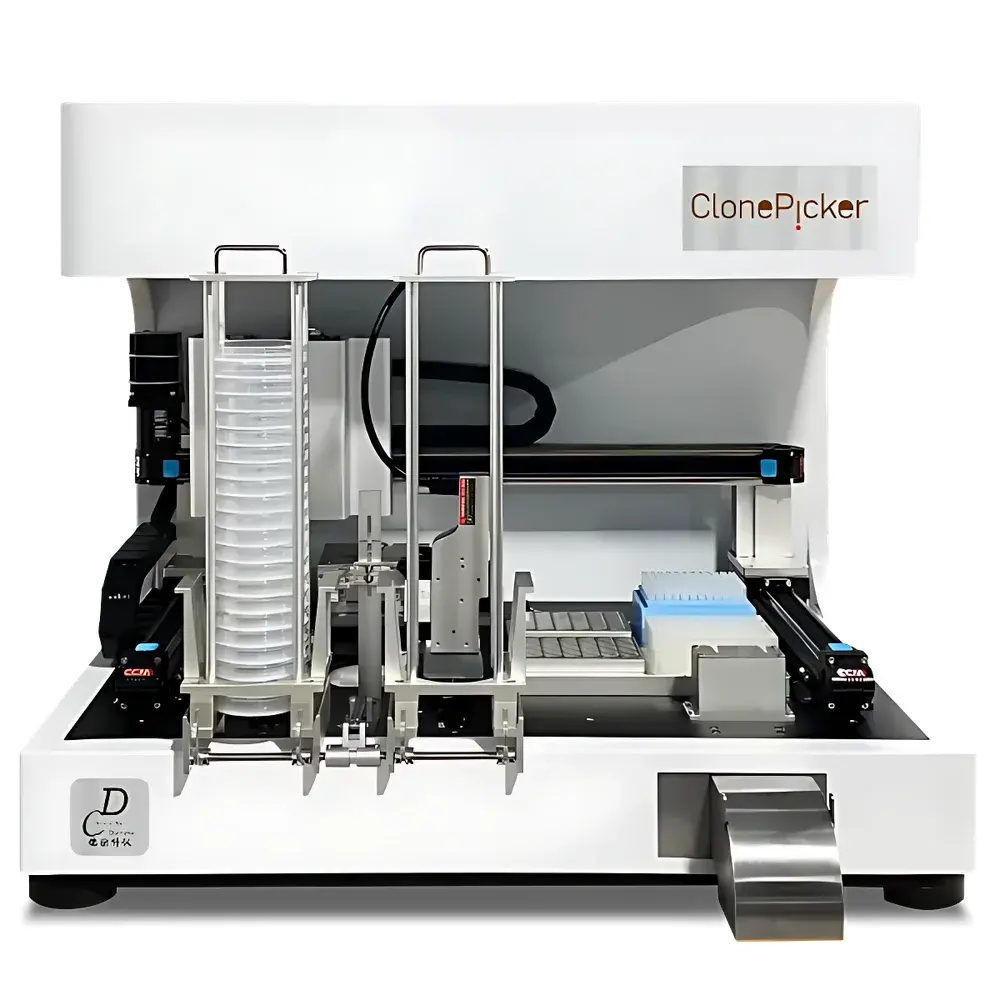
D.C. Labware MBAuto-AP Automated Microbial Plating System
| Brand | D.C. Labware |
|---|---|
| Origin | Guangdong, China |
| Manufacturer Type | Authorized Distributor |
| Country of Origin | China |
| Model | MBAuto-AP |
| Pricing | Available Upon Request |
Overview
The D.C. Labware MBAuto-AP Automated Microbial Plating System is an integrated benchtop platform engineered for high-throughput, reproducible microbial colony isolation and plating in life science laboratories. It operates on a sequential robotic workflow grounded in precise liquid handling mechanics and programmable motion control, enabling fully automated execution of critical pre-culture steps: Petri dish lid actuation, volumetric dispensing of microbial suspensions, uniform agar surface spreading via rotating spreader arms or disposable sterile applicators, thermal inkjet-based alphanumeric plate labeling, and stack-based input/output management. Designed specifically for synthetic biology workflows, strain library construction, antimicrobial susceptibility testing (AST), and high-content screening campaigns, the MBAuto-AP eliminates manual variability associated with hand-plating—reducing operator-induced contamination risk, improving inter-assay consistency, and supporting GLP-compliant documentation traceability when integrated with LIMS.
Key Features
- Integrated 5-step automation: automated lid opening/closing, calibrated liquid dispensing (1–100 µL range, ±2% CV), mechanical or disposable spreader-based uniform coating, non-contact thermal inkjet plate coding (alphanumeric, QR, or 2D DataMatrix), and vertical stack handling (up to 50 plates per batch)
- Modular consumable compatibility: accepts standard Petri dishes (60 mm, 90 mm, 100 mm diameters) and deep-well or shallow-well microtiter formats (96-, 384-, or 1536-well plates) for suspension transfer
- Plate encoding system supports ISO/IEC 15415-compliant 2D symbology, enabling bidirectional integration with laboratory information management systems (LIMS) and electronic lab notebooks (ELN)
- Programmable protocol library with user-defined parameters: dwell time, rotation speed, spreader pressure, dispensing volume, and label position—stored with version-controlled audit trails
- CE-marked enclosure with Class II biological safety compliance; optional HEPA-filtered laminar airflow module available for ISO 5 (Class 100) environments
- Touchscreen HMI with intuitive drag-and-drop workflow builder; firmware supports remote monitoring via Ethernet or Wi-Fi with TLS 1.2 encrypted communication
Sample Compatibility & Compliance
The MBAuto-AP accommodates viscous and low-viscosity microbial suspensions—including E. coli, Bacillus subtilis, yeast, and filamentous fungi—as well as antibiotic-containing or glycerol-stabilized stocks without clogging or droplet deviation. All fluidic pathways utilize chemically inert PTFE and borosilicate glass components rated for autoclaving (121°C, 20 min). The system meets ISO 13485:2016 requirements for medical device-related microbiological assay support and aligns with ASTM E2872-22 (Standard Guide for Validation of Automated Microbial Plating Systems). When operated under documented SOPs, it satisfies FDA 21 CFR Part 11 criteria for electronic records and signatures through timestamped, immutable log files with user authentication and role-based access control.
Software & Data Management
The embedded control software (v3.2+) provides real-time status visualization, error logging with root-cause tagging, and export of structured CSV/JSON datasets containing plate ID, time stamp, dispense volume, spreader RPM, ambient temperature/humidity, and operator ID. Audit trail records retain full metadata—including parameter modifications, calibration events, and emergency stop triggers—for ≥10 years. Optional API integration enables direct synchronization with Thermo Fisher SampleManager, LabVantage, or custom Python-based analysis pipelines via RESTful endpoints. All data exports include SHA-256 checksums for integrity verification and support FAIR (Findable, Accessible, Interoperable, Reusable) principles.
Applications
- High-throughput colony isolation from CRISPR-edited libraries or transposon mutagenesis pools
- Antibiotic resistance profiling using gradient plates or disk diffusion-compatible layouts
- Strain stability assessment across serial passaging experiments
- Quality control of master cell banks (MCB) and working cell banks (WCB) per ICH Q5A(R2)
- Microbial bioburden testing in pharmaceutical manufacturing environments (ISO 11737-1)
- Automated preparation of plates for MALDI-TOF MS identification workflows
FAQ
What types of culture media are compatible with the MBAuto-AP?
Standard agar-based media (LB, TSA, MHA, YPD) and semi-solid formulations (0.3–0.7% agar) are supported. Highly viscous or particulate-containing media require prior filtration (0.22 µm) to prevent nozzle occlusion.
Can the MBAuto-AP integrate with existing LIMS or ELN platforms?
Yes—via configurable REST API or flat-file export (CSV/JSON); validated connectors are available for LabVantage, STARLIMS, and Benchling.
Is routine calibration required, and how is it performed?
Dispense accuracy is verified quarterly using gravimetric measurement per ISO 8655-6; spreader alignment is checked daily using included calibration discs and optical alignment jig.
Does the system support Good Manufacturing Practice (GMP) environments?
When deployed with optional stainless-steel housing, HEPA filtration, and 21 CFR Part 11-compliant software configuration, it meets Annex 11 and EU GMP Chapter 4 requirements for automated equipment qualification.
What maintenance intervals are recommended?
Daily wipe-down of spreader arms and dispensing nozzles; monthly inspection of belt tension and encoder feedback; annual full mechanical recalibration by certified field service engineers.



