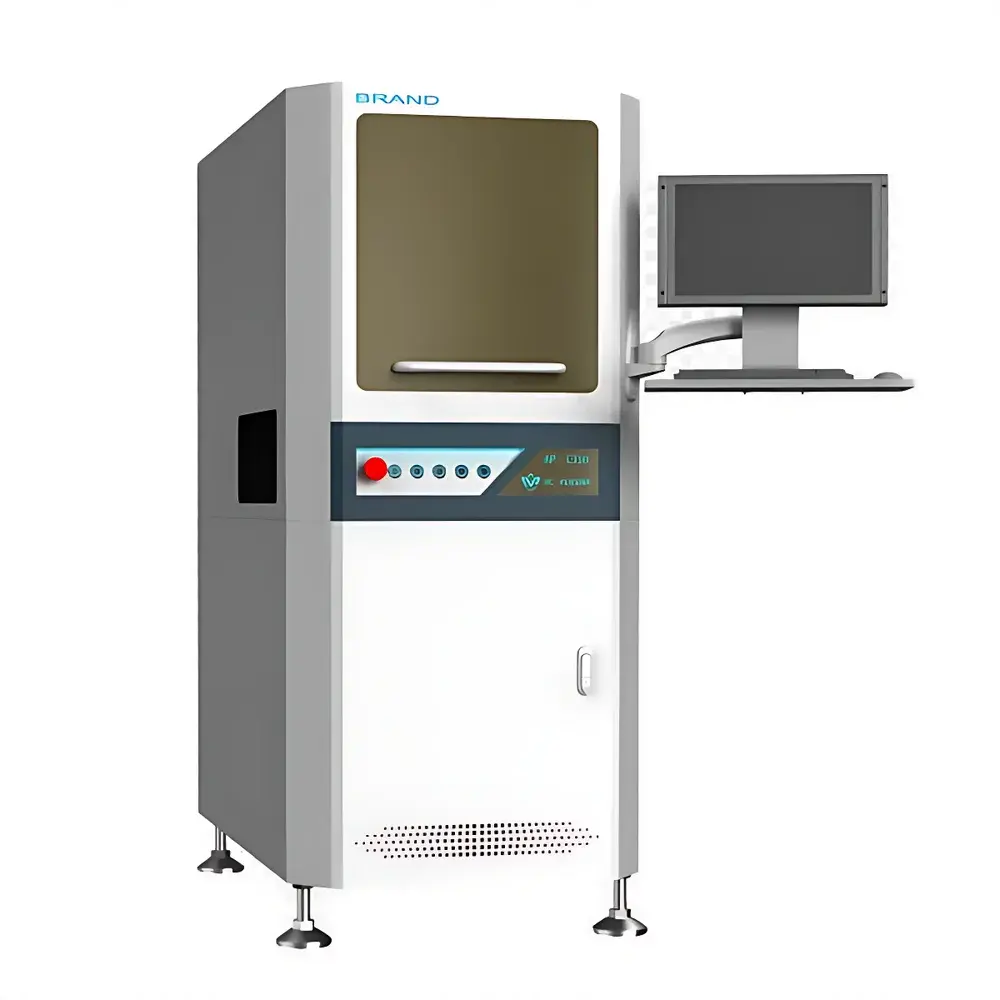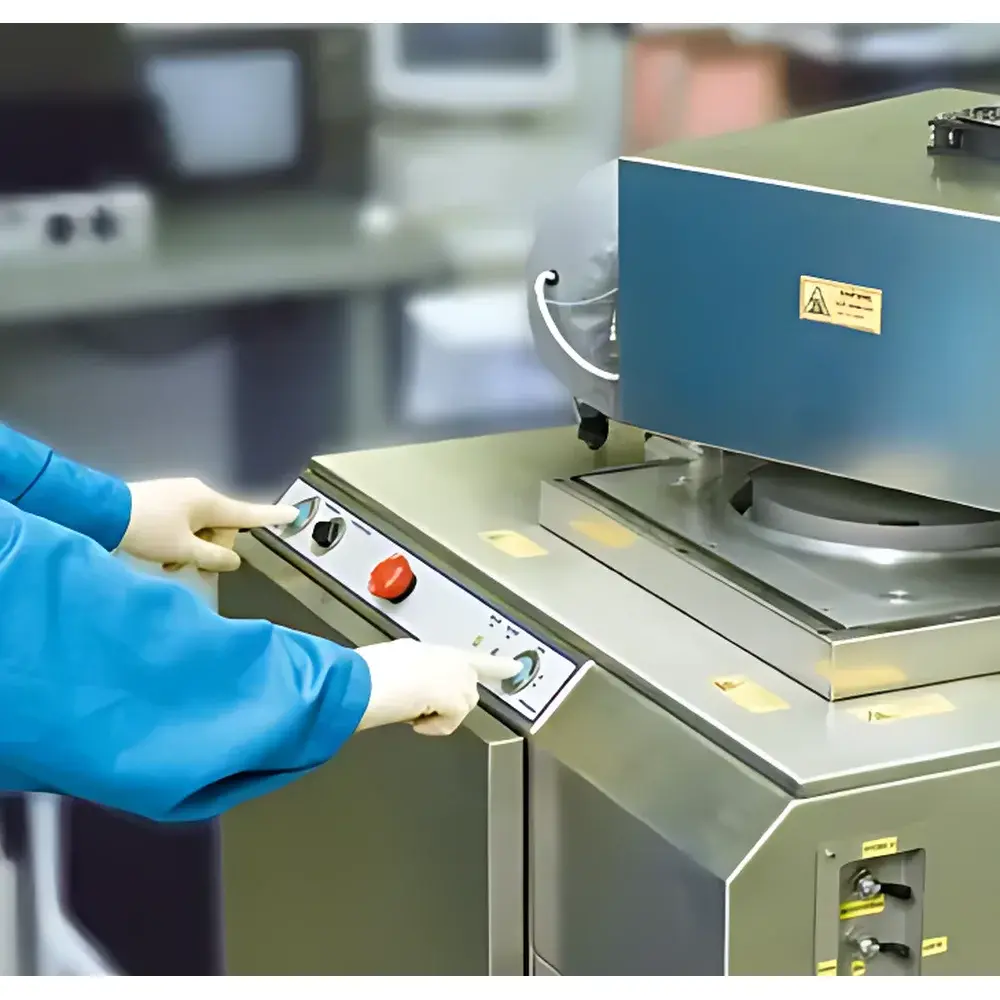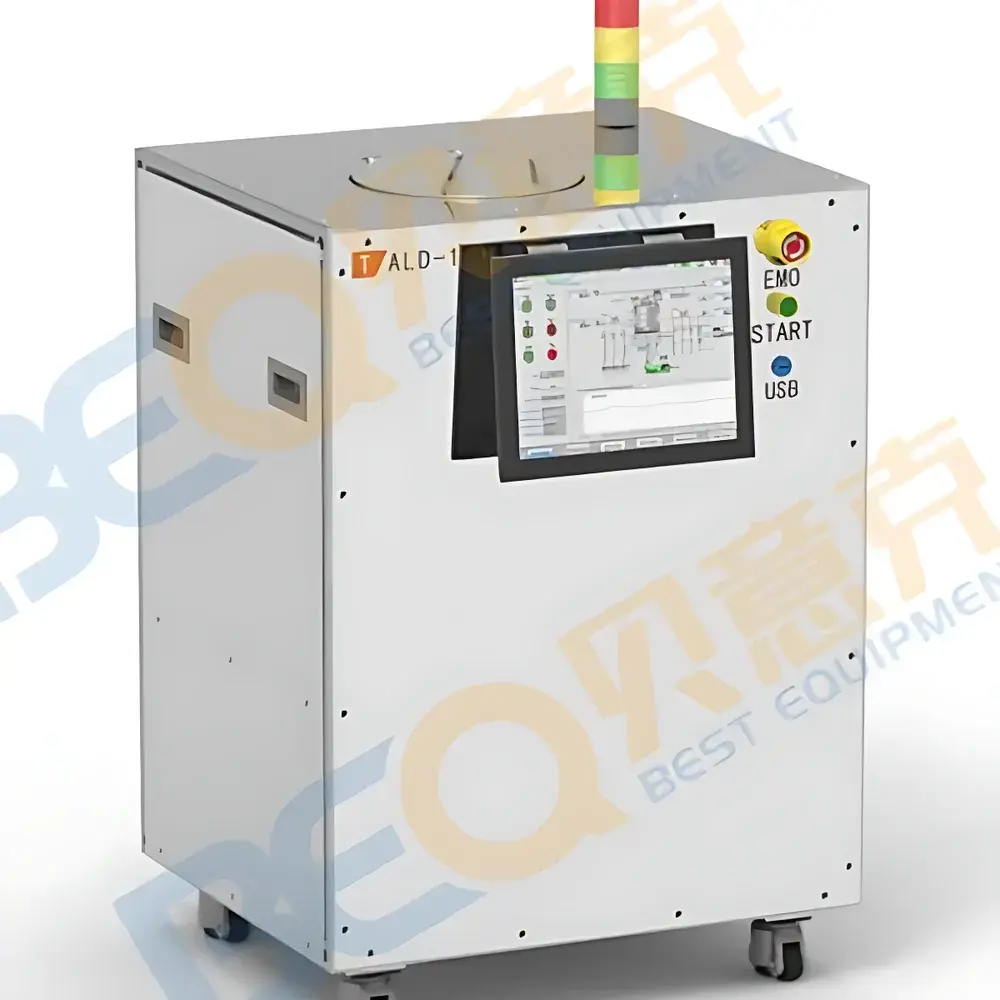
BEQ BTF-ALD-100 Atomic Layer Deposition System
| Brand | BEQ |
|---|---|
| Origin | Anhui, China |
| Manufacturer Type | Authorized Distributor |
| Country of Origin | China |
| Model | BTF-ALD-100 |
| Precursor Configuration | 2 heated metal precursor lines (up to 200 °C) + 1 H₂O precursor line |
| Sample Capacity | Up to 4-inch wafers (100 mm), fully compatible with ≤4″ substrates |
| Uniformity | < ±1% non-uniformity over 4″ Al₂O₃ film after 300 ALD cycles |
| Base Pressure | ≤5 × 10⁻⁵ Torr (with dual-stage rotary vane pump, ≥16 m³/h) |
| Temperature Control | Substrate heating up to 300 °C (±0.5 °C) |
| Vacuum Gauge | MKS digital capacitance manometer (10⁻⁵–10⁵ Torr) |
| Sealing | Perfluoroelastomer (FFKM) O-rings, leak rate < 5 × 10⁻⁷ Pa·L/s |
| MFC Accuracy | ±1% FS for two analog mass flow controllers |
| Power Supply | 380 V AC, 50–60 Hz, 5 kW |
Overview
The BEQ BTF-ALD-100 is a bench-scale, modular atomic layer deposition (ALD) system engineered for precision thin-film synthesis in semiconductor R&D, MEMS fabrication, and advanced materials laboratories. It operates on the self-limiting surface reaction principle: sequential, pulsed delivery of gaseous precursors—separated by inert gas purges—ensures monolayer-by-monolayer growth with sub-nanometer thickness control and exceptional conformality on high-aspect-ratio structures. Designed for reproducible process development and small-batch prototyping, the system supports thermal ALD processes under controlled vacuum conditions (10⁻⁵–10² Torr), with integrated thermal management, real-time pressure monitoring, and hardware-level separation of reactive chemistries to prevent premature decomposition or cross-contamination.
Key Features
- Robust chamber architecture: Electro-polished 316 stainless steel lower chamber and anodized 6061 aluminum upper lid; removable anodized aluminum liner for rapid maintenance and residue-free cleaning.
- Dedicated precursor delivery: Two independently heated metal precursor lines (max. 200 °C, ±0.5 °C stability) and one H₂O line, each routed through Swagelok® high-temperature ALD valves and isolated stainless-steel source bottles (50 mL). No mixing occurs prior to chamber entry.
- Precision thermal control: Resistively heated substrate stage (300 °C max, ±0.5 °C setpoint accuracy) with anodized aluminum wafer support plate for uniform heat distribution and easy decontamination.
- High-integrity vacuum system: Dual-stage rotary vane pump (≥16 m³/h pumping speed) achieves base pressure ≤5 × 10⁻⁵ Torr; MKS digital capacitance manometer provides traceable pressure feedback across seven decades (10⁻⁵–10⁵ Torr).
- Leak-tight sealing: Full FFKM (perfluoroelastomer) O-ring sealing throughout chamber and gas lines; certified leak rate < 5 × 10⁻⁷ Pa·L/s per ISO 20484 compliance protocols.
- Process automation & safety: PLC-based control architecture with industrial PC and suspended touchscreen HMI; integrated cold trap and external stainless-steel thermal exhaust scrubber (up to 600 °C) for safe precursor decomposition and effluent abatement.
Sample Compatibility & Compliance
The BTF-ALD-100 accommodates standard 4-inch (100 mm) silicon, quartz, sapphire, or SOI wafers—and all smaller formats including 2-inch, 1-inch, and diced dies. Its chamber geometry and uniform gas dispersion design ensure < ±1% thickness variation across full 4″ Al₂O₃ films after 300 cycles, meeting industry benchmarks for R&D-grade ALD uniformity (per SEMI F20-0212 and ASTM F3171-19). All wetted materials comply with semiconductor-grade cleanliness standards: electropolished SS316, anodized aluminum, and FFKM elastomers eliminate metallic leaching and particle generation. The system’s vacuum integrity, temperature calibration traceability, and purge-controlled gas sequencing support GLP-aligned process documentation and audit readiness.
Software & Data Management
The embedded control software logs all critical process parameters—including precursor pulse durations, purge times, chamber pressure profiles, temperature ramps, and MFC setpoints—with timestamped, non-editable records stored locally on the industrial PC. Raw data exports to CSV or MATLAB-compatible formats for offline analysis. While the system does not natively implement FDA 21 CFR Part 11 electronic signature functionality, its deterministic PLC logic, hardware-enforced interlocks (e.g., valve sequencing dependencies, over-temperature cutoffs), and immutable event logging provide foundational elements for lab-specific validation packages under ISO/IEC 17025 or internal QA procedures.
Applications
The BTF-ALD-100 enables reliable deposition of high-k dielectrics (Al₂O₃, HfO₂, ZrO₂), functional oxides (TiO₂, ZnO), and passivation layers for emerging devices including GaN HEMTs, ferroelectric memory stacks, solid-state battery interphases, and nanoscale optical coatings. Its configurable precursor manifold allows straightforward adaptation to novel chemistries—such as amide- or amidinate-based metal precursors—supporting academic and industrial exploration of low-temperature ALD, spatial ALD variants, and hybrid CVD-ALD integration schemes.
FAQ
What substrates can be processed in the BTF-ALD-100?
Standard 4-inch wafers (100 mm) and all smaller diameters (2″, 1″, diced chips) are fully supported. Non-planar or flexible substrates require custom fixture evaluation.
Is the system suitable for glovebox integration?
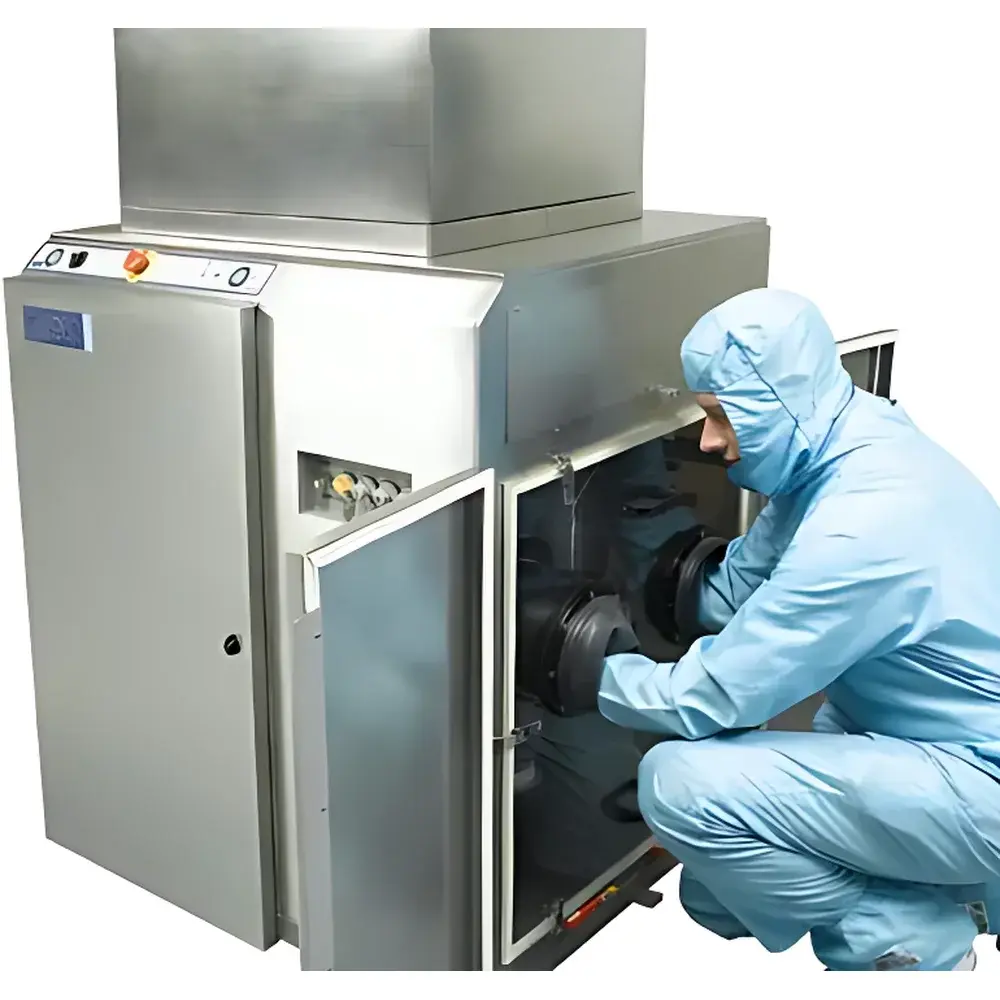
Yes—the vacuum interface, electrical feedthroughs, and gas connections are designed for seamless integration into nitrogen- or argon-purged environments via standard KF40 or CF35 flanges.
Can the system be upgraded to support plasma-enhanced ALD (PE-ALD)?
The current configuration is thermal ALD only. Plasma upgrade kits—including RF matching networks, grounded electrode configurations, and impedance-tuned showerheads—are available as factory-engineered retrofits.
Does BEQ provide process transfer support for scaling to production tools?
Yes—BEQ offers documented工艺 recipes, chamber conditioning protocols, and comparative film characterization reports (XRR, XPS, ellipsometry) to facilitate technology transfer to larger cluster tools or inline production systems.
What maintenance intervals are recommended for long-term reliability?
Quarterly inspection of O-rings, annual recalibration of temperature sensors and pressure transducers, and biannual replacement of pump oil and thermal trap consumables are advised per the maintenance schedule in the technical manual.