
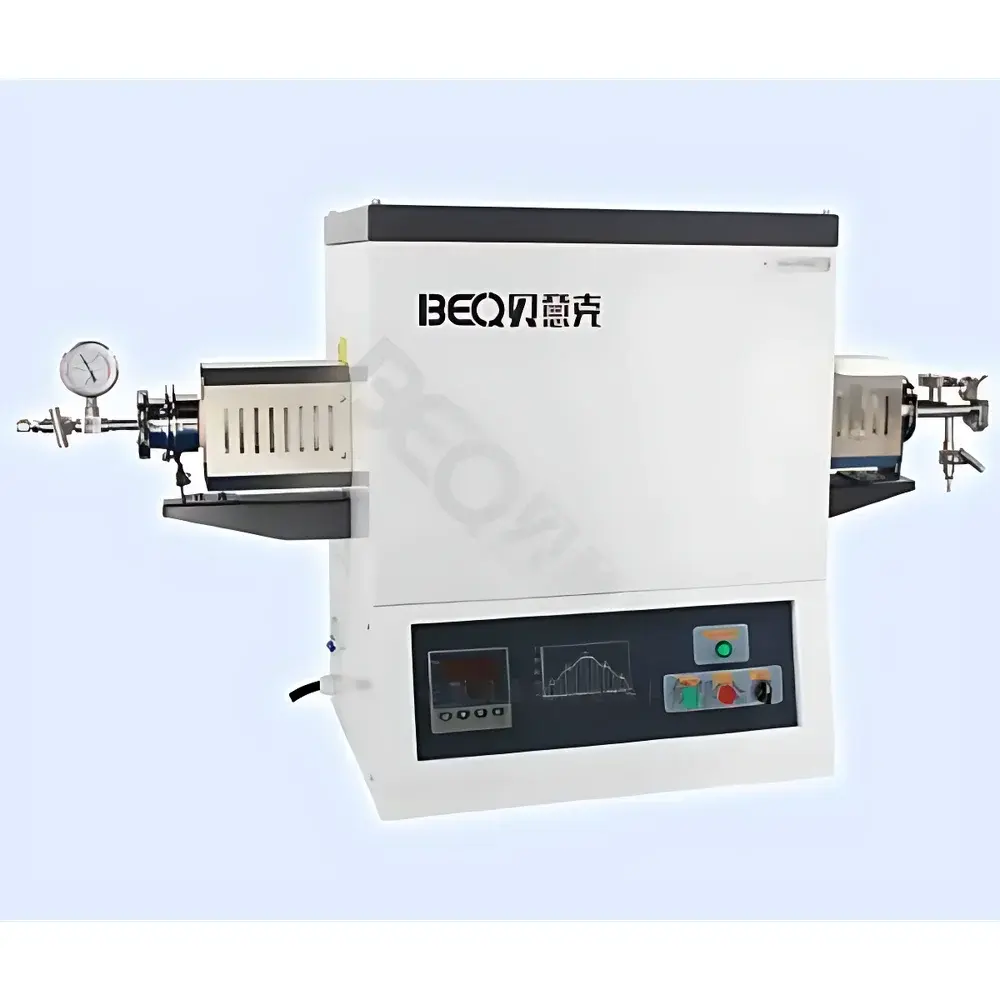
BEQ BTF-1750C High-Temperature Silicon Molybdenum Rod Heated Tube Furnace
| Brand | BEQ |
|---|---|
| Origin | Anhui, China |
| Model | BTF-1750C |
| Maximum Temperature | 1750 °C |
| Temperature Control Accuracy | ±1 °C |
| Heating Rate | ≤10 °C/min up to 1400 °C |
| Heating Element | Silicon Molybdenum (MoSi₂) Rods |
| Control System | Fuzzy PID with Auto-Tuning, 30-Stage Programmable Logic Controller, Over-Temperature & Thermocouple Break Protection |
| Tube Dimensions | 100 mm OD × 1300 mm L |
| Insulation | Vacuum-Formed Alumina Fiber Blankets |
| Cooling | Dual-Layer Air-Cooled Housing |
| Structural Support | Dual End Flange Mounting Brackets |
Overview
The BEQ BTF-1750C is a high-precision, laboratory-grade horizontal tube furnace engineered for demanding thermal processing applications requiring stable, repeatable operation at elevated temperatures up to 1750 °C. It employs silicon molybdenum (MoSi₂) heating elements—known for exceptional oxidation resistance and long-term stability in air-atmosphere environments—mounted within a rigid, double-walled stainless steel housing. The furnace operates on the principle of resistive radiant heating, where MoSi₂ rods generate infrared radiation uniformly distributed across the internal chamber volume. This design ensures axial and radial temperature uniformity within ±3 °C over a 200 mm hot zone under steady-state conditions at 1600 °C—a critical performance criterion for materials synthesis, sintering, annealing, and controlled-atmosphere heat treatments. Its air-cooled dual-layer enclosure maintains external surface temperatures below 60 °C even during continuous operation at maximum setpoint, eliminating the need for water cooling infrastructure and enhancing operational safety in shared lab environments.
Key Features
- Dual-layer forced-air cooling system ensures safe external surface temperature (<60 °C) at full 1750 °C operation, complying with IEC 61000-3-2 harmonic emission guidelines for laboratory equipment.
- Vacuum-formed high-purity alumina fiber insulation (Al₂O₃ ≥99.5%) provides low thermal conductivity (≤0.12 W/m·K at 1000 °C), minimal outgassing, and compatibility with ultra-high-purity processes including semiconductor precursor annealing and optical crystal growth.
- Reinforced flange-mounted support brackets distribute mechanical load evenly across both ends of the quartz or high-alumina tube (100 mm OD × 1300 mm L), minimizing sag-induced stress and extending service life beyond 2000 operational cycles under thermal cycling conditions.
- Fuzzy logic-enhanced PID controller with auto-tuning capability delivers robust setpoint tracking across wide ambient temperature fluctuations (15–35 °C), with integral windup prevention and derivative kick suppression for stable ramp-hold profiles.
- 30-segment programmable temperature profile memory supports complex multi-step thermal protocols—including dwell, ramp, and soak sequences—with independent rate and dwell time parameters per segment, exportable via RS485 interface for GLP-compliant audit trails.
Sample Compatibility & Compliance
The BTF-1750C accommodates standard high-purity fused silica, recrystallized alumina, or mullite tubes (ID range: 60–90 mm), enabling compatibility with inert, reducing, oxidizing, and vacuum atmospheres (down to 10⁻³ mbar with optional vacuum pump integration). Its construction adheres to ISO 17025 calibration traceability requirements when paired with NIST-traceable Type S thermocouples. The furnace meets CE marking directives (2014/30/EU EMC and 2014/35/EU LVD) and incorporates hardware-level safety interlocks compliant with EN 60519-2 for industrial electroheating equipment. Optional gas inlet/outlet ports (¼” VCR fittings) allow seamless integration into ASTM E2921-22-compliant controlled-atmosphere testing workflows.
Software & Data Management
The embedded controller supports Modbus RTU protocol over RS485 for bidirectional communication with SCADA systems or LabVIEW-based acquisition platforms. Real-time temperature data (process value, setpoint, output %) and alarm status are logged at user-configurable intervals (1–60 sec) to internal non-volatile memory (≥10,000 records). Exported CSV files include timestamped metadata (date, operator ID, program name) suitable for FDA 21 CFR Part 11–aligned electronic record retention. Firmware updates are performed via USB flash drive without external software dependencies, ensuring continuity in regulated GMP/QSR environments.
Applications
- Synthesis and annealing of advanced ceramics (e.g., SiC, ZrO₂, YAG) requiring precise thermal ramp control and minimal thermal gradient-induced microcracking.
- Heat treatment of metallic alloys (Inconel, Hastelloy) for grain refinement and phase transformation studies per ASTM E112 and ISO 643 standards.
- Thermal gravimetric analysis (TGA) pre-conditioning of catalyst supports and battery electrode materials prior to DSC or XRD characterization.
- High-temperature diffusion bonding and brazing process development under argon or nitrogen purge, supporting MIL-STD-883H Method 2015 qualification testing.
- Calibration source validation for pyrometers and infrared cameras operating in the 0.8–2.2 µm spectral band, per ASTM E2847.
FAQ
What atmosphere options are supported with the BTF-1750C?
Standard configuration supports air, argon, nitrogen, and forming gas (5% H₂/95% N₂); vacuum operation requires optional mechanical pump and sealed flange assembly.
Is the temperature uniformity verified and documented?
Yes—uniformity mapping reports (±3 °C over 200 mm zone at 1600 °C) are included with each unit and traceable to ISO/IEC 17025-accredited calibration labs.
Can the furnace be integrated into an automated production line?
Yes—RS485 Modbus RTU interface enables direct PLC integration; digital I/O terminals support start/stop, fault reset, and alarm signaling per IEC 61131-3 conventions.
What maintenance is required for the MoSi₂ heating elements?
No routine replacement is needed; elements exhibit >5000 hours lifetime at 1700 °C in air; periodic visual inspection for surface crazing is recommended every 500 cycles.
Does the controller support remote monitoring via Ethernet or Wi-Fi?
Not natively—but third-party Modbus-to-Ethernet gateways (e.g., Moxa EDS-205A) enable secure web-based access with TLS 1.2 encryption and role-based authentication.



