
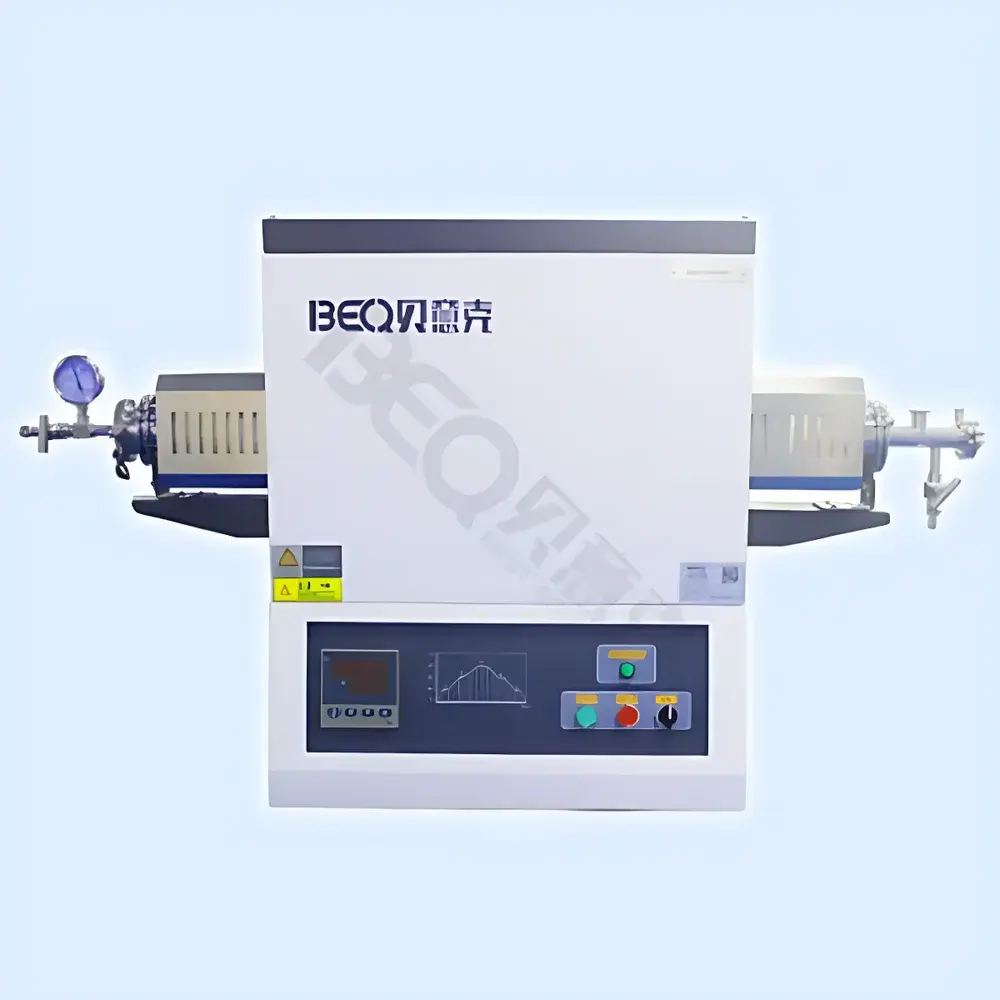
BEQ BTF-1400C-S High-Temperature Horizontal Tube Furnace
| Brand | BEQ |
|---|---|
| Origin | Anhui, China |
| Model | BTF-1400C-S |
| Maximum Temperature | 1400 °C |
| Temperature Control Accuracy | ±1 °C |
| Rated Power | 4 kW |
| Heating Rate | ≤10 °C/min below 1200 °C, ≤5 °C/min from 1200–1300 °C |
| Heating Element | Silicon Carbide (SiC) Rods |
| Control System | Fuzzy PID with Auto-Tuning, 30-Stage Programmable Controller, Over-Temperature & Thermocouple Failure Protection |
| Tube Inner Diameter | Φ60 mm |
| Chamber Lining Material | High-Purity Alumina (Al₂O₃) with US-Imported High-Temperature Alumina Coating |
| Cooling | Dual-Layer Air-Cooled Housing |
| Structural Design | Flanged Support Bracket for Load Distribution |
Overview
The BEQ BTF-1400C-S is a horizontally oriented high-temperature tube furnace engineered for precision thermal processing in research laboratories and materials development facilities. It operates on the principle of resistive heating via silicon carbide (SiC) rods, delivering stable, uniform temperature profiles across an extended isothermal zone—critical for controlled annealing, sintering, crystal growth, and gas-phase reaction studies under inert or reactive atmospheres. Designed to meet the rigorous demands of academic and industrial R&D, the furnace achieves a maximum operating temperature of 1400 °C with a control accuracy of ±1 °C, ensuring reproducibility essential for ASTM E1113, ISO 8573-1, and GLP-compliant thermal protocols.
Key Features
- Uniform thermal field generated by densely arranged SiC heating elements, providing an extended axial hot zone (>200 mm) suitable for multi-sample processing or gradient thermal experiments.
- Dual-layer stainless steel housing integrated with forced-air cooling channels, maintaining external surface temperatures below 60 °C during continuous operation at 1400 °C—enhancing operator safety and reducing ambient heat load.
- High-purity alumina (99.7% Al₂O₃) tube chamber lined with a proprietary US-sourced high-emissivity alumina coating, improving radiative efficiency and extending refractory life beyond 5,000 hours at 1350 °C.
- Robust mechanical design featuring a flanged support bracket system that decouples thermal expansion stress from the mounting structure, minimizing alignment drift during repeated thermal cycling.
- Intelligent 30-segment programmable controller with fuzzy PID algorithm and auto-tuning capability—enabling precise ramp/soak/hold sequences and adaptive compensation for thermal lag and load variation.
- Integrated safety architecture including independent over-temperature cutoff (setpoint +15 °C), real-time thermocouple continuity monitoring, and audible/visual fault indication compliant with IEC 61000-6-2 EMC requirements.
Sample Compatibility & Compliance
The BTF-1400C-S accommodates standard quartz, alumina, or silicon carbide sample boats and crucibles up to 55 mm in outer diameter, compatible with sealed or open-ended tube configurations. Its Φ60 mm internal bore supports standard 1/4″, 3/8″, and 1/2″ OD quartz tubes (e.g., Heraeus Suprasil® or Shin-Etsu JGS2). The furnace meets structural and electrical safety requirements per UL 61010-1 and GB/T 13868–2018 for laboratory heating equipment. When operated with optional gas mass flow controllers and exhaust scrubbers, it supports processes requiring ISO 8573-1 Class 2 compressed air purity or ASTM D7213-controlled atmosphere environments.
Software & Data Management
The embedded controller logs temperature setpoints, actual readings, power output, and alarm events with timestamp resolution of 1 second. Data export is supported via RS485 Modbus RTU protocol for integration into LabVIEW™, MATLAB®, or enterprise LIMS platforms. Optional PC software enables remote monitoring, script-based sequence execution, and automated report generation—including calibration traceability logs required for FDA 21 CFR Part 11 compliance when paired with electronic signature modules. All firmware updates are performed via USB interface with cryptographic signature verification.
Applications
- Thermal treatment of battery cathode precursors (e.g., LiCoO₂, NMC) under argon or oxygen-controlled atmospheres.
- Graphitization and activation of carbon-based nanomaterials (CNTs, graphene oxide) at 1200–1400 °C.
- Synthesis of metal oxides and perovskites for catalysis and photovoltaics research.
- Calibration of high-temperature thermocouples (Types B, R, S) against fixed-point standards (e.g., Pd–Cu eutectic at 1554.9 °C).
- Outgassing and pre-conditioning of ultra-high vacuum components prior to chamber installation.
- Thermogravimetric analysis (TGA) coupling via custom flange adapters for simultaneous mass and temperature monitoring.
FAQ
What type of thermocouple is recommended for accurate measurement at 1400 °C?
Type B (Platinum/Rhodium 30–6) thermocouples are recommended for long-term stability above 1200 °C; the furnace includes dual Type B inputs for redundancy and cold-junction compensation.
Can the furnace be operated under vacuum or reducing atmospheres?
Yes—when equipped with vacuum-rated end flanges (KF-40 or CF-35) and compatible seals, it supports pressures down to 10⁻³ mbar and H₂/N₂/H₂-Ar mixtures; consult BEQ Application Note AN-BTF-07 for material compatibility guidelines.
Is the controller compatible with SCADA systems?
Yes—the RS485 interface supports Modbus RTU register mapping for real-time read/write access to all operational parameters and event logs.
What maintenance intervals are recommended for the SiC heating elements?
Under nominal use (≤1350 °C, 90% resistance stability for 2,000+ hours; visual inspection and resistance measurement every 500 operating hours are advised.
Does the furnace include NIST-traceable calibration documentation?
A factory calibration certificate (per ISO/IEC 17025) is provided with each unit, covering three-point verification (800 °C, 1100 °C, 1400 °C) using reference thermocouples calibrated by an ILAC-MRA signatory lab.



