
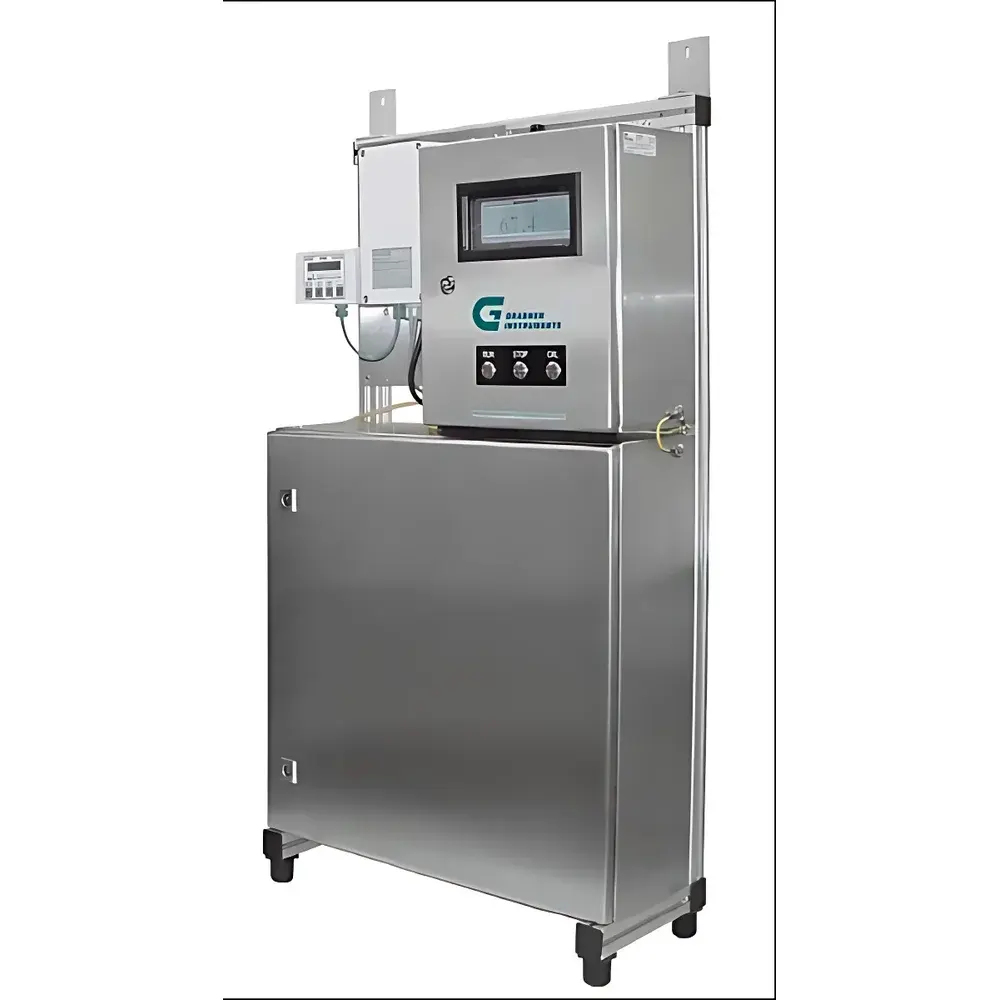
Grabner MiniVAP ON-LINE Automated Online Vapor Pressure Analyzer
| Brand | Grabner |
|---|---|
| Origin | Austria |
| Model | MiniVAP ON-LINE |
| Analysis Method | Three-Stage Expansion Method |
| Pressure Range | 2–1000 kPa |
| Temperature Range | 20–60 °C |
| Repeatability (r) | 0.30 kPa |
| Reproducibility (R) | 0.7 kPa |
| Sample Throughput Cycle Time | 7 min |
| Power Supply | 100/120/230/240 V AC, 50/60 Hz, 65 W |
| Dimensions (W × H × D) | 650 × 1160 × 400 mm |
| Weight | 50 kg |
| Explosion Protection | Class I, Division 1, Group D (NFPA 496, US) / Zone 1, II 2 G Ex d IIB T4 (EN 50016, EU) |
| Vapor-to-Liquid Ratios (V/L) | 4:1 (gasoline & crude oil), 1:2 (LPG & NPG), 20:1 (LVR temperature mode) |
Overview
The Grabner MiniVAP ON-LINE is an automated, real-time vapor pressure analyzer engineered for continuous in-process monitoring of petroleum streams—including gasoline, crude oil, liquefied petroleum gas (LPG), and natural petroleum gas (NPG)—in refinery, terminal, and pipeline environments. It operates on the internationally validated three-stage expansion method, a thermodynamic equilibrium technique that replicates the standardized laboratory procedure defined in ASTM D6378, D6377, and D6897. Unlike batch-mode analyzers, the MiniVAP ON-LINE integrates directly into process lines with dual-stream sampling capability—enabling simultaneous analysis of two independent sample points via a single analytical channel. This architecture eliminates cross-contamination risk while maintaining strict compliance with regulatory test protocols. The instrument incorporates a precisely controlled, thermostatically regulated sample conditioning system to ensure consistent sample temperature stabilization within ±0.1 °C across the full 20–60 °C operating range—critical for accurate vapor pressure determination under variable ambient conditions.
Key Features
- Dual-stream, single-channel sampling architecture for concurrent analysis of two process lines without hardware duplication
- Automated zero-point calibration and dynamic offset correction using internal reference pressure sensors
- Integrated temperature-controlled sample conditioning module with PID-regulated heating/cooling
- 7-minute cycle time per measurement, supporting high-frequency process feedback for real-time quality control
- Explosion-proof enclosure certified to Class I, Division 1 (NFPA 496) and Zone 1, II 2 G Ex d IIB T4 (EN 50016)
- Configurable vapor-to-liquid (V/L) ratios: 4:1 for gasoline and crude oil; 1:2 for LPG/NPG; 20:1 for LVR (vapor/liquid ratio) temperature-dependent mode
- Repeatability of r = 0.30 kPa and reproducibility of R = 0.7 kPa per ASTM E691 protocol
- Compact footprint (650 × 1160 × 400 mm) and low power consumption (65 W), suitable for skid-mounted or cabinet-integrated deployment
Sample Compatibility & Compliance
The MiniVAP ON-LINE is explicitly designed for hydrocarbon-based liquid and liquefied-gas samples with volatility profiles relevant to midstream and downstream petroleum operations. It meets the physical and procedural requirements of multiple ASTM standards: D6378 (for gasoline vapor pressure, VPx), D6377 (for crude oil vapor pressure), and D6897 (for LPG vapor pressure). Additional referenced methodologies include ASTM D5188 (V/L = 20 for LVR determination), D1267 (LPG vapor pressure by direct method), D323, D4953, and D5191 (correction formulae for atmospheric pressure and temperature deviations). The analyzer also conforms to EN 13016-1 and IP 394 for vapor pressure testing of petroleum products. All measurements are traceable to NIST-certified pressure and temperature references, and the system supports audit-ready documentation for GLP and GMP environments.
Software & Data Management
The analyzer interfaces via Modbus TCP/IP or 4–20 mA analog outputs for seamless integration into DCS, SCADA, or MES platforms. Its embedded firmware includes configurable alarm thresholds, trend logging (minimum 30-day local storage), and timestamped raw data export in CSV format. Optional software modules support FDA 21 CFR Part 11-compliant user access control, electronic signatures, and audit trail generation—including operator actions, calibration events, and measurement anomalies. Data integrity is preserved through cyclic redundancy checks (CRC) on all communication packets and non-volatile memory backup during power interruption.
Applications
- Real-time blending optimization in gasoline production units to maintain Reid Vapor Pressure (RVP) specifications
- Crude assay validation during custody transfer at loading terminals
- LPG composition monitoring prior to fractionation or bottling
- Process upset detection in distillation overheads or stabilizer column sidestreams
- Automated LVR (vapor/liquid ratio) reporting for regulatory compliance with EPA Method 25A equivalents
- Support for predictive maintenance models using long-term vapor pressure drift analysis
FAQ
Does the MiniVAP ON-LINE require periodic manual calibration?
No—it performs fully automated zero-point verification and pressure sensor offset correction before each analysis cycle using integrated reference transducers.
Can it measure vapor pressure of unstable or reactive hydrocarbons?
Yes, provided the sample remains within the specified temperature and pressure limits and does not polymerize or decompose within the 7-minute analysis window.
Is remote diagnostics supported?
Yes, via secure HTTPS-enabled web interface with role-based access, live status monitoring, and firmware update capability over Ethernet.
How is sample conditioning achieved without introducing external cooling media?
Through a closed-loop Peltier-based thermal management system with active heat dissipation, eliminating dependency on chilled water or glycol circuits.
What level of cybersecurity is implemented for industrial network integration?
The device complies with IEC 62443-3-3 SL2 requirements, including TLS 1.2 encryption, disabled default credentials, and configurable firewall rules for Modbus TCP ports.






