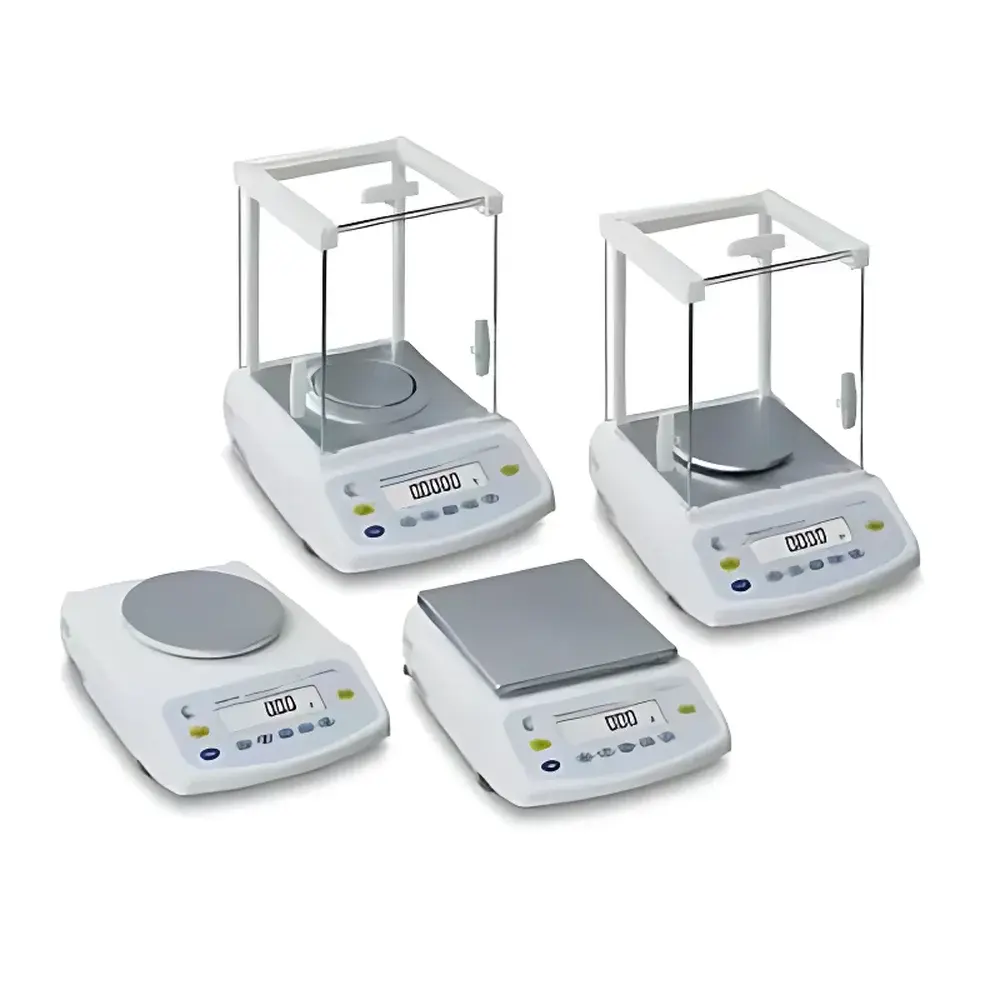
Sartorius BSA-CW Series Fully Automatic Internal Calibration Analytical Balance
| Brand | Sartorius |
|---|---|
| Origin | Germany |
| Product Type | Imported Analytical Balance |
| Calibration | Fully Automatic Internal Calibration |
| Readability | 0.1 mg |
| Capacity | 120 g / 220 g |
| Pan Size | 90 mm diameter |
| Repeatability | ≤ 0.1 mg |
| Linearity | ≤ 0.2 mg |
| Interface | RS232 (GLP-compliant) |
| Sensor Technology | Monolithic Dual-Lever Electromagnetic Force Restoration |
| Environmental Protection | Four-Level Shock Absorption |
| Compliance | GLP, ISO/IEC 17025 (supporting traceable calibration records) |
Overview
The Sartorius BSA-CW Series analytical balances are high-precision mass measurement instruments engineered for laboratories requiring traceable, reproducible, and operator-independent weighing performance. Based on electromagnetic force compensation (EMFC) principle, each unit employs a monolithic dual-lever sensor architecture that eliminates mechanical hysteresis and ensures long-term stability under varying thermal and vibrational conditions. Designed and manufactured in Germany, the BSA-CW series integrates an internal motorized calibration mass—fully automated via microprocessor-controlled actuation—to eliminate manual intervention and minimize calibration-induced drift. The 40 MHz MC1 microcontroller enables rapid stabilization (<2 s typical), while advanced SMT-based circuitry delivers enhanced signal-to-noise ratio and immunity to electromagnetic interference. All models comply with fundamental metrological requirements defined in OIML R 76-1 and support full audit trails required under GLP and ISO/IEC 17025 quality frameworks.
Key Features
- Automatic internal calibration with motor-driven reference mass—performed at user-defined intervals or triggered by temperature drift (±1.5 °C threshold)
- Electrostatically shielded five-sided glass draft shield with anti-static coating, reducing surface charge accumulation and improving repeatability for low-mass samples
- Dual-position tare keys (left/right) for ergonomic operation in multi-user environments
- Bottom-loading hook for density determination and large-volume sample weighing (e.g., volumetric flasks, centrifuge tubes)
- Four-stage mechanical damping system optimized for benchtop installations without external vibration isolation tables
- GLP-compliant RS232 interface with configurable data output format (including date/time stamp, stability indicator, and calibration status)
- Integrated diagnostic engine performing real-time sensor health monitoring, overload detection, and environmental error flagging
Sample Compatibility & Compliance
The BSA-CW series accommodates a broad range of sample types—from powders and granules to volatile liquids and hygroscopic solids—thanks to its fast stabilization time and low air current sensitivity. The 90 mm diameter stainless steel pan is compatible with standard weighing boats, crucibles, and filtration assemblies. All units meet the essential requirements of Directive 2014/31/EU (Measuring Instruments Directive) and carry CE marking for legal metrology use in the European Economic Area. For regulated environments—including pharmaceutical QC labs operating under FDA 21 CFR Part 11—the balance supports electronic signature-ready data export when paired with compliant third-party software. Full traceability is maintained through automatic logging of calibration events, including timestamp, ambient temperature, and deviation from nominal value.
Software & Data Management
Data output conforms to ASTM E2656-20 standards for analytical balance data formatting. The RS232 port transmits ASCII-encoded strings containing weight value, unit, stability flag, tare status, and calibration verification code. Optional Sartorius LabX® Lite software (sold separately) enables automated report generation, statistical process control (SPC) charting, and integration into LIMS environments. Audit trail functionality includes immutable timestamps for all critical operations: zeroing, taring, calibration, and fault recovery. No local storage is embedded; all data persistence occurs externally—ensuring alignment with ALCOA+ principles (Attributable, Legible, Contemporaneous, Original, Accurate, Complete, Consistent, Enduring, Available).
Applications
- Quantitative gravimetric analysis in pharmaceutical formulation development (e.g., API dispensing, excipient blending)
- Density determination of solids and liquids using built-in density application mode with user-defined reference fluid density
- Statistical counting of precision components (e.g., tablets, microfluidic chips) with adjustable count tolerance thresholds
- Animal weighing in preclinical research settings, utilizing dynamic averaging to compensate for subject movement
- Percent-by-weight calculations for standard solution preparation and titrant standardization
- Net weight summation across multiple containers during batch release testing
- Unit conversion workflows supporting mg, g, oz, ct, and grain—critical for materials science and gemology labs
FAQ
Does the BSA-CW series support external calibration with traceable weights?
Yes—while internal calibration is fully automated, the balance accepts external calibration via Class E2 or better reference masses. Calibration reports include uncertainty budgets per ISO/IEC Guide 98-3.
Can the internal calibration be disabled for regulatory audits?
Internal calibration cannot be permanently disabled, but scheduled execution can be suspended. All calibration events—including manual initiation—are logged with digital signatures and cannot be edited or deleted.
Is the RS232 interface compatible with modern Windows/macOS systems?
Yes—when used with a certified USB-to-serial adapter and configured terminal emulation software (e.g., Tera Term), the interface supports direct data streaming to spreadsheets or validated laboratory informatics platforms.
What environmental conditions are recommended for optimal performance?
Operate within 15–30 °C ambient temperature, <70% RH non-condensing, and away from HVAC vents or direct sunlight. Vibration levels should not exceed 0.5 µm peak-to-peak at 10 Hz.
How often must the internal calibration mass be certified?
Sartorius recommends periodic verification every 12 months using accredited metrology services. The internal mass itself is factory-certified to ±0.005% of nominal value and requires no routine user maintenance.