
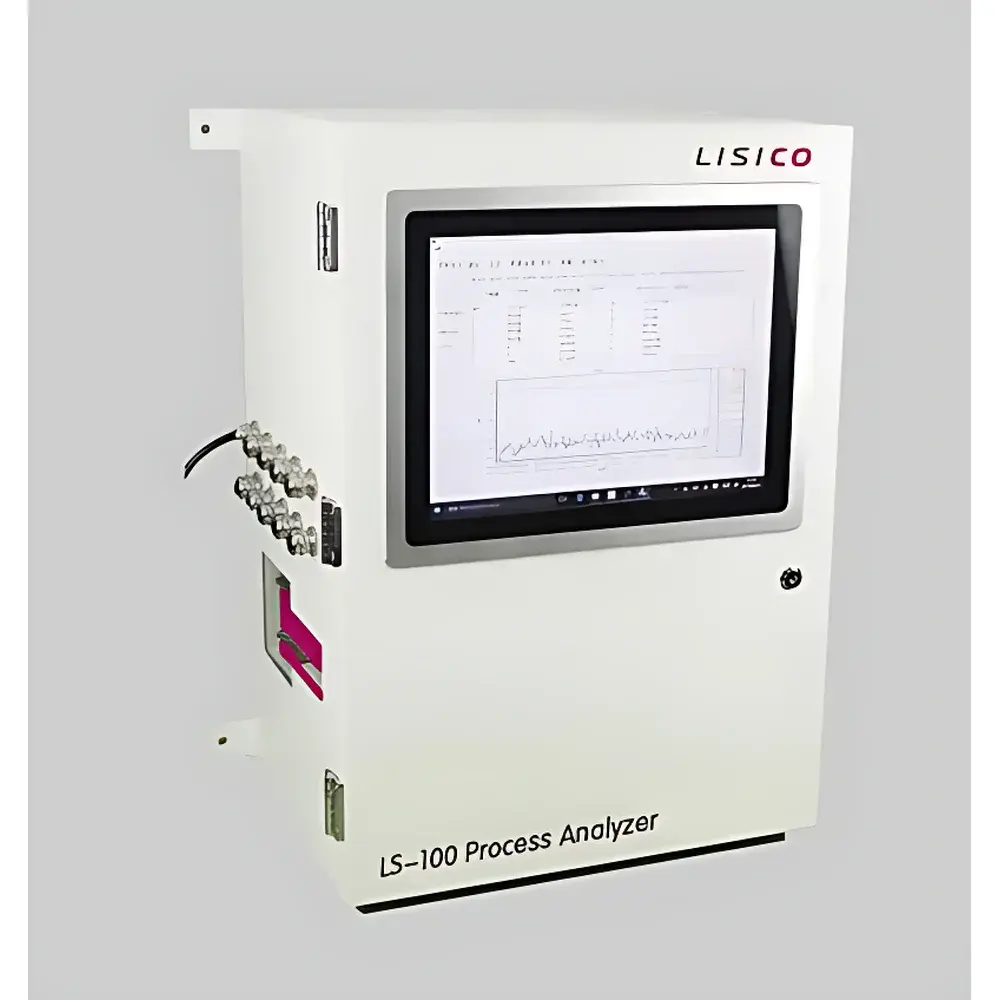
LISICO LS-100-Pro Fourier Transform Near-Infrared (FT-NIR) Spectrometer
| Brand | LISICO |
|---|---|
| Model | LS-100-Pro |
| Type | Online FT-NIR Spectrometer |
| Channels | 8-channel multiplexed |
| Form Factor | Integrated cabinet system with embedded industrial PC, temperature control module, and PLC for DCS integration |
| Dimensions | 540 mm × 350 mm × 650 mm (L×W×H) |
| Weight | 10 kg (excluding spectrometer optics core) |
| Origin | Shanghai, China |
| Instrument Category | Domestic manufactured |
| Distribution Model | Authorized distributor supply |
Overview
The LISICO LS-100-Pro is an industrial-grade, online Fourier Transform Near-Infrared (FT-NIR) spectrometer engineered for continuous, real-time compositional monitoring in process environments. Unlike benchtop or portable NIR systems, the LS-100-Pro implements a robust Michelson interferometer architecture optimized for long-term stability under fluctuating ambient conditions—critical for unattended operation in chemical, pharmaceutical, food, and petrochemical production lines. Its core measurement principle relies on high-resolution interferometric acquisition across the 900–2500 nm spectral range, followed by fast Fourier transformation to generate absorbance spectra with sub-wavenumber resolution. The instrument is not a standalone optical module but a fully integrated analytical node: the spectrometer engine, industrial touch-panel PC, precision thermal stabilization unit, and programmable logic controller (PLC) for Distributed Control System (DCS) interfacing are co-located within a single IP54-rated cabinet. This architecture eliminates external cabling complexity, reduces calibration drift from thermal gradients, and ensures deterministic timing between spectral acquisition and process control actions.
Key Features
- 8-Channel Multiplexed Sampling: Supports simultaneous or sequential interrogation of up to eight independent process streams via fiber-optic probes—enabling shared instrument utilization across multiple reactors, pipelines, or blending tanks without sacrificing temporal resolution.
- Field-Triggered Spectral Acquisition: Integrates momentary push-button interfaces at remote sampling points; pressing the button initiates synchronized spectral capture, timestamping, and metadata tagging—including operator ID, location code, and manual annotation—streamlining calibration sample logging and model maintenance workflows.
- Embedded Real-Time Control Architecture: Features an onboard industrial PC running Windows IoT Enterprise, preloaded with S-Online software. All data processing—including FFT computation, chemometric prediction (PLS, PCR), trend visualization, and alarm generation—occurs locally without dependency on external servers.
- DCS-Ready Communication Stack: Equipped with dual Ethernet ports supporting Modbus TCP, OPC UA, and native DCS protocol emulation (e.g., DeltaV, Honeywell Experion, Emerson DeltaV). Enables bidirectional exchange of predicted concentrations, instrument health status (lamp intensity, interferogram SNR, mirror alignment diagnostics), and configurable alarm states.
- On-Demand Model Switching: Accepts external trigger signals (dry contact or digital I/O) from DCS to load alternate chemometric models—essential for multi-product campaigns where raw material composition, catalyst activity, or product grade requirements vary dynamically.
Sample Compatibility & Compliance
The LS-100-Pro is designed for non-invasive, in-situ analysis of liquids, slurries, powders, and semi-solids via immersion, flow-cell, or reflectance probes (compatible with standard 2–5 m silica/silica-core fibers). It meets mechanical and electromagnetic compatibility requirements per IEC 61326-1 (industrial environment) and conforms to CE marking directives. While not certified to ATEX/IECEx for hazardous areas, its cabinet design supports installation in Zone 2/Class I Div 2 environments when paired with intrinsically safe fiber-optic probes. Data integrity protocols align with FDA 21 CFR Part 11 expectations: audit trails record all model changes, prediction overrides, and user login/logout events; electronic signatures are supported via Windows credential integration. The system supports GLP/GMP-aligned validation documentation packages—including IQ/OQ protocols—and is compatible with ASTM E1655 (standard practices for NIR quantitative analysis) and ISO 12099 (cereals and pulses NIR calibration).
Software & Data Management
S-Online is a domain-specific application built on .NET Framework with a modular architecture. Its core modules include: (1) Acquisition Engine, managing channel sequencing, integration time optimization, and dark-reference compensation; (2) Model Manager, supporting PLS-1, PLS-2, and nonlinear SVM regression models stored in standardized .nir format (compatible with Unscrambler®, Pirouette, and MATLAB); (3) Trend Dashboard, rendering real-time concentration plots with ±3σ confidence bands and automated outlier detection; and (4) DCS Gateway, mapping prediction outputs to configurable OPC tags with configurable update rates (1–60 s). Raw interferograms and processed spectra are archived in HDF5 format with embedded metadata (wavelength, resolution, detector temperature, optical path length). Backups synchronize automatically to network shares or cloud storage endpoints using TLS 1.2–encrypted SMB3 or SFTP.
Applications
The LS-100-Pro delivers validated performance in applications demanding rapid, interference-resistant quantification: real-time monitoring of ethanol concentration in fermentation broth (±0.15 vol%); moisture content in fluidized-bed dryers (±0.08 wt%); API assay in wet granulation (±0.3% w/w); fatty acid profile in edible oil refining; and polymer melt index surrogates in extrusion lines. Its 8-channel capability is especially effective in batch-to-batch transition scenarios—e.g., tracking solvent swap efficiency across four parallel coating lines while concurrently verifying residual monomer levels in two polymerization reactors. In refinery settings, it replaces offline GC analysis for naphtha cut-point verification, reducing lab turnaround from hours to seconds.
FAQ
Is the LS-100-Pro suitable for explosive atmospheres?
No—its base configuration is rated for non-hazardous locations. Intrinsically safe operation requires third-party certification of the optical probe and associated fiber termination hardware.
Can existing chemometric models developed on other FT-NIR platforms be imported?
Yes—S-Online accepts models exported in .nir format compliant with ASTM E1655 Annex A2, including spectral preprocessing steps and validation statistics.
What maintenance is required for long-term field operation?
Annual verification of interferometer alignment and detector dark-current drift is recommended; lamp replacement interval is ≥10,000 hours. No routine optical cleaning is needed due to sealed interferometer housing.
Does the system support remote diagnostics and firmware updates?
Yes—via secure RDP-over-VPN or vendor-managed TLS tunnel; all firmware updates undergo cryptographic signature validation prior to installation.
How is calibration transfer handled across multiple LS-100-Pro units?
Using standardization algorithms (e.g., piecewise direct standardization, PDS) embedded in S-Online’s Model Transfer Utility, with reference spectra acquired from a master instrument under identical optical path conditions.






