
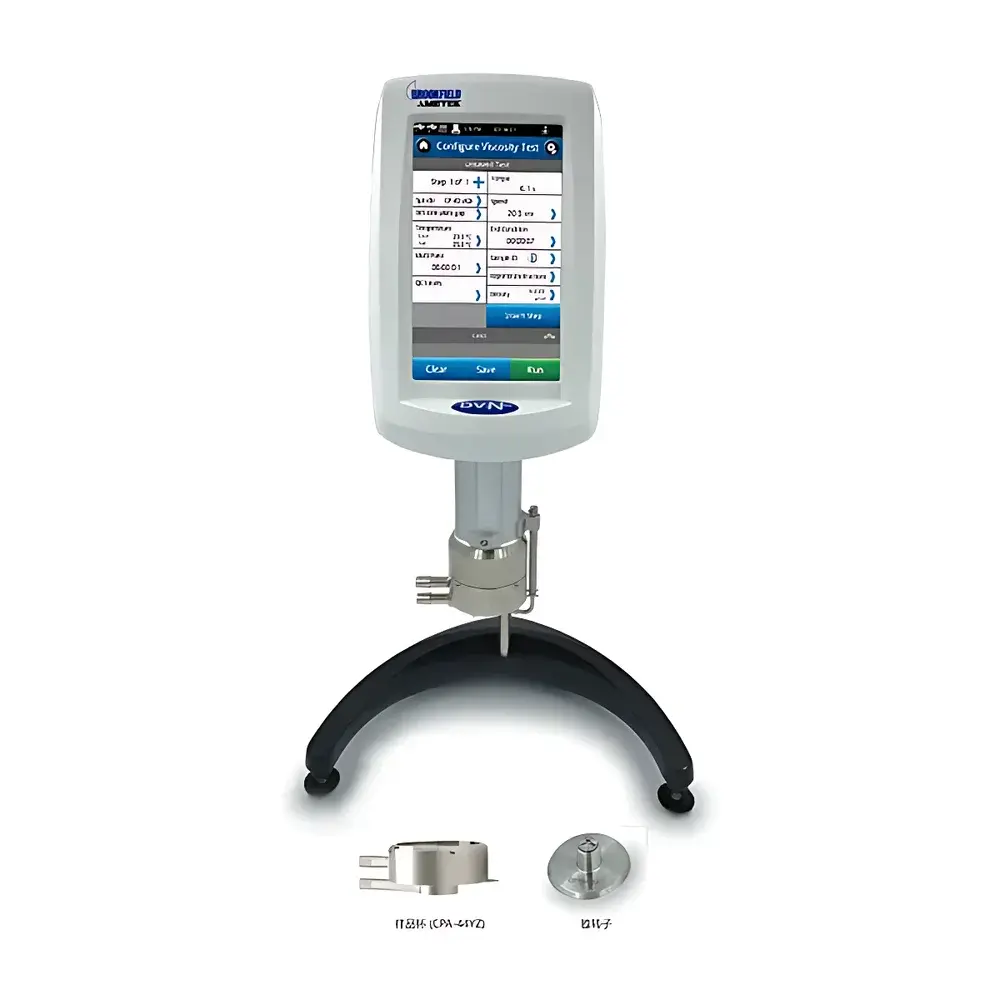
Brookfield DVNext Advanced Cone-Plate Rheometer
| Brand | Brookfield |
|---|---|
| Origin | USA |
| Manufacturer Type | Authorized Distributor |
| Origin Category | Imported |
| Model | DVNext |
| Instrument Type | Rotational Rheometer |
| Sample State | Liquid |
| Bearing Type | Mechanical Bearing |
| Minimum Speed | 0.01 rpm |
| Maximum Speed | 250 rpm |
| Sample Volume | 0.5–2.0 mL |
| Shear Rate Range | Up to 1875 s⁻¹ (with CP-52Z) |
| Torque Accuracy | ±1.0% of Full Scale |
| Repeatability | ±0.2% |
| Temperature Range | 0–100 °C |
| Geometry | Cone-and-plate |
| Control Interface | Integrated Touchscreen Display |
| Auto-Zero Function | Yes |
| Auto-Range Torque Measurement | Yes |
| Wetted Materials | 316 Stainless Steel |
| Optional Accessories | Luer fittings, embedded Pt100 temperature probe, cleaning adapters |
Overview
The Brookfield DVNext Advanced Cone-Plate Rheometer is a precision-engineered rotational rheometer designed for absolute viscosity and fundamental rheological characterization of low-volume liquid samples. Operating on the principle of controlled shear deformation in a defined cone-and-plate geometry, the instrument applies a known rotational velocity to a conical rotor while measuring the resulting torque resistance exerted by the sample fluid between the cone apex and the stationary plate surface. This torque is directly proportional to the shear stress, enabling calculation of absolute dynamic viscosity (in mPa·s) using the geometric constant of the cone angle and radius. The DVNext’s mechanical bearing architecture—optimized for stability and longevity—supports high reproducibility across its full speed range (0.01–250 rpm), with torque accuracy maintained at ±1.0% of full scale and repeatability within ±0.2%. Its integrated touchscreen interface eliminates dependency on external PCs for routine operation, while electronic gap adjustment ensures rapid, operator-independent alignment of cone-to-plate clearance—critical for maintaining measurement fidelity across repeated tests.
Key Features
- Magnetic coupling system for tool-free, repeatable attachment and removal of cone spindles—minimizing mechanical wear and alignment variability
- Electronic gap adjustment with real-time visual feedback, eliminating manual micrometer calibration and reducing setup time by >40%
- Auto-zero function that compensates for thermal drift and mechanical hysteresis prior to each measurement cycle
- Auto-range torque sensing across all spindle/speed combinations, dynamically selecting optimal transducer sensitivity without user intervention
- Temperature-controlled sample cup with double-walled construction and standard fittings for external recirculating baths (0–100 °C)
- All wetted components fabricated from electropolished 316 stainless steel, ensuring chemical compatibility with aqueous, organic, and mildly aggressive media
- Optional embedded Pt100 temperature probe for direct in-situ sample temperature monitoring with ±0.1 °C resolution
Sample Compatibility & Compliance
The DVNext supports sample volumes from 0.5 mL (CPA-40Z, CP-51Z) to 2.0 mL (CPA-41Z), making it suitable for precious, scarce, or biologically sensitive materials—including synovial fluids, microemulsions, nanosuspensions, and noble-metal-containing conductive inks. Its cone-and-plate geometry provides uniform shear rate distribution and eliminates edge effects common in coaxial cylinder systems, supporting compliance with ASTM D2196 (Standard Test Methods for Rheological Properties of Non-Newtonian Materials) and ISO 3219 (Plastics—Polymers in the Liquid State and Emulsions—Determination of Viscosity). When operated with audit-trail-enabled software (e.g., Rheo3000 v5.2+), the system meets FDA 21 CFR Part 11 requirements for electronic records and signatures, supporting GLP and GMP-regulated environments where traceability and data integrity are mandatory.
Software & Data Management
While the DVNext operates autonomously via its built-in touchscreen, optional PC-based software (Rheo3000) enables advanced data acquisition, including time-sweep, shear-rate ramp, oscillatory frequency sweeps, and yield stress determination via controlled-stress protocols. All raw torque, speed, temperature, and time data are timestamped and stored in open CSV/Excel-compatible formats. Software modules support automatic generation of flow curves (τ vs. γ̇), consistency index (K) and flow behavior index (n) fitting per the Power Law model, and comparative analysis across multiple samples with statistical confidence intervals. Audit trails log all user actions—including parameter changes, calibration events, and data exports—with immutable timestamps and operator IDs, satisfying regulatory documentation requirements for QC laboratories.
Applications
- Quality control of pharmaceutical suspensions and ophthalmic solutions requiring low-volume, high-precision viscosity verification per USP
- Rheological profiling of battery electrode slurries during formulation development to optimize coating uniformity and drying behavior
- Characterization of non-Newtonian behavior in food emulsions (e.g., dressings, sauces) under varying shear conditions simulating pumping and dispensing
- Viscoelastic assessment of polymer melts and thermoset precursors in R&D settings where material scarcity limits sample availability
- Stability evaluation of colloidal dispersions via time-dependent thixotropy recovery measurements
- Academic research on soft matter physics, including wormlike micelles and lyotropic liquid crystals
FAQ
What cone geometries are compatible with the DVNext platform?
The DVNext accepts all Brookfield-conical spindles designated with “Z” suffixes (e.g., CPA-40Z, CP-52Z), each calibrated against the same sample cup—ensuring interchangeability without recalibration.
Can the DVNext perform oscillatory measurements?
No—the DVNext is a steady-shear rotational rheometer optimized for viscosity and flow curve determination; oscillatory capability requires the higher-tier Brookfield AMETEK Rheometers (e.g., DVNext Oscillatory Option or RST series).
Is temperature control internal or external?
Temperature regulation is external: the double-jacketed sample cup connects to a certified recirculating chiller or bath; no Peltier or resistive heating is integrated into the base unit.
How is torque calibration verified?
Torque calibration is traceable to NIST standards via Brookfield’s factory-certified calibration kit; field verification uses certified reference oils (e.g., Cannon-Manning Series) with documented viscosities at specified temperatures.
Does the DVNext support GLP-compliant reporting?
Yes—when paired with Rheo3000 software configured with electronic signatures, audit trails, and locked report templates, it fulfills core GLP documentation requirements for regulated testing laboratories.



